Preamble:
This boulder is one of yhe largest ‘’erratics’’ decovered in the Belmont area. It is composed of Sioux sandstone and quartzite. The harder areas of quartzite are well defined. There are numerous smaller boulders along the ridge just east of Belmont Park, together with prominent frost cracks in the glacial-melt clay and silt (till). It appears that the Belmont (beautiful hill) ridge resulted from a standing glacier which melted and left a terminal moraine, composed of clay, silt, and erratics. Glaciers entered eastern Nebraska many times during the great “Ice Age” coming from the north and east.
Glacial erratic:
A glacial erratic is a glacially deposited rock differing from the type of rock native to the area in which it rests. Erratics are carried by glacial ice, often over distances of hundreds of kilometres. Erratics can range in size from pebbles to large boulders such as Big Rock (16,500 metric tons) in Alberta.
They are called erratics because they usually differ in composition from the rocks native to an area.
Glaciers can pick up chunks of rocks and transport them over long distances. When they drop these rocks, they are often far from their origin—the outcrop or bedrock from which they were plucked. These rocks are known as glacial erratics.
Erratics record the story of a glacier's travels. Looking for the bedrock units that correspond with erratics can reveal complex flow patterns.
An excellent example of how erratics can tell the story of past glaciations comes from Yosemite National Park: a field of erratics there contain rocks that were plucked from an outcrop east of Tioga Pass, over the current watershed divide. These erratics reveal that the glaciers there actually flowed uphill, over Tioga Pass.
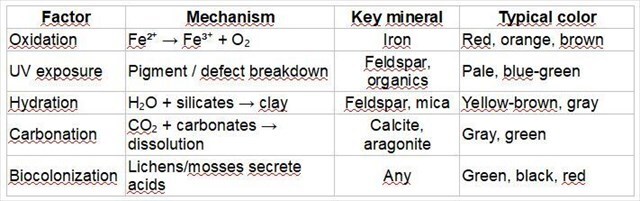
Color alteration:
The color change of rocks is driven by their mineral composition, exposure to environmental conditions, and geological processes such as oxidation, weathering, and hydrothermal activity. These factors modify the rocks’ appearance and help reveal their geological history.
 Your study:
Near the WP (see clue images) of this Earth you will see a Glacial erratic stone, a Virtual (GC9P53Y) is active there.
So, based on what you see on site, by reading the description of this Earthcache, you should find the correct answers.