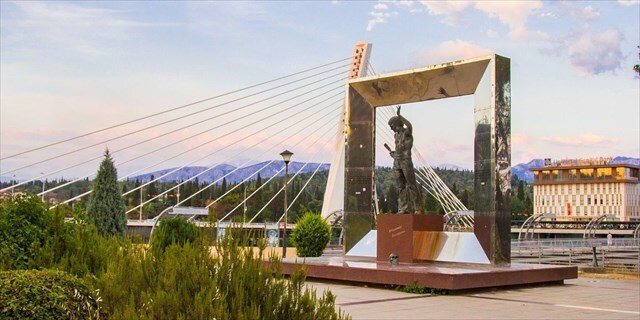
Na navedenim koordinatama nalazi se upečatljiv spomenik posvećen Vladimiru Vysotskom, legendarnom ruskom pjevaču, tekstopiscu i glumcu. Statua ga prikazuje kako drži svoju prepoznatljivu gitaru, prenoseći duh njegovog umjetničkog i kulturnog naslijeđa. Za ovaj EarthCache fokus je na postamentu ovog spomenika. Postament predstavlja lijep primjer magmatske stijene. To je prirodni geološki materijal koji se može posmatrati i proučavati na licu mjesta. Ovaj EarthCache se fokusira na korišćenje vidljivih fizičkih karakteristika stijene na ovoj lokaciji kako bi se odredilo kako je nastala i kako se može klasifikovati.
Spomenik Vladimiru Vysotskom
Obrazovni Cilj
Svrha ovog EarthCache-a je pomoći posjetiocima da:
- Razumiju kako magmatske stijene nastaju iz rastopljenog materijala
- Posmatraju kako uslovi hlađenja utiču na veličinu kristala i teksturu
- Koriste boju i teksturu za klasifikaciju magmatskih stijena na terenu
Nastanak Magmatskih Stijena
Magmatske stijene nastaju kada rastopljeno stijenje hladi i očvrsne. Rastopljeno stijenje se naziva magma kada se nalazi ispod površine Zemlje, a lava kada dospije na površinu. Stijene koje nastaju od magme ispod površine nazivamo intruzivne (plutonske), dok se stijene koje nastaju od lave na površini nazivaju ekstruzivne (vulkanske).
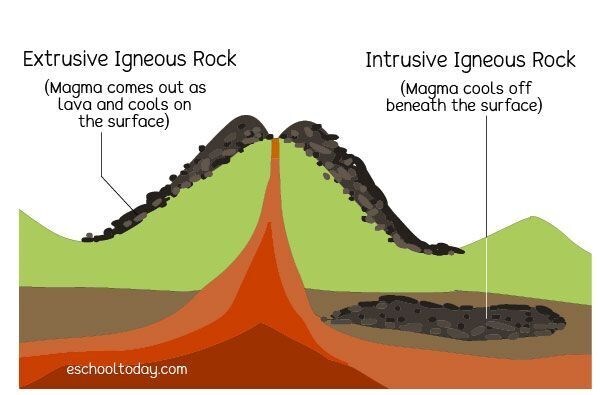
Izvor: eschooltoday.com
- Magma se sporo hladi pod zemljom → intruzivna stijena
- Lava se brzo hladi na površini → ekstruzivna stijena
- Mjesto nastanka utiče na veličinu kristala i teksturu
Brzina Hlađenja i Razvoj Kristala
Brzina kojom se rastopljeno stijenje hladi snažno utiče na veličinu i raspored kristala koji nastaju. Sporo hlađenje omogućava rast većih, dobro vidljivih kristala, dok brzo hlađenje proizvodi vrlo male kristale ili staklastu teksturu. Stijene sa vidljivim kristalima nazivamo faneritične, dok one sa sitnim ili mikroskopskim kristalima nazivamo afanitne.
Faneritične vs. Afanitne Stijene
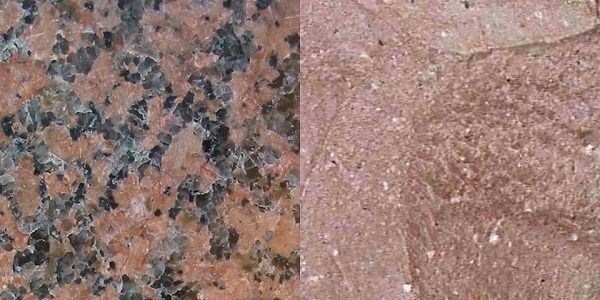
Izvor: geologycafe.com
- Sporo hlađenje → veći kristali → faneritična tekstura
- Brzo hlađenje → mali ili mikroskopski kristali → afanitna tekstura
- Veličina kristala otkriva istoriju hlađenja
Tekstura (Veličina Zrna)
Veličina zrna u magmatskim stijenama odnosi se na veličinu pojedinačnih minerala. Sitnozrne stijene imaju kristale manje od 1 mm, srednjezrne između 1 i 5 mm, a krupnozrne veće od 5 mm. Tekstura daje tragove o istoriji hlađenja i okruženju nastanka.
Veličina Zrna
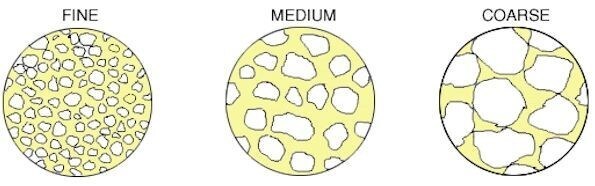
Izvor: Earth Science Australia
- Sitnozrno → brzo hlađeno na površini
- Srednjezrno → hlađeno na srednjoj dubini
- Krupnozrno → sporo hlađeno pod zemljom
Mineralni Sastav i Boja
Mineralni sastav magmatskih stijena često utiče na njihovu boju. Mafske stijene su tamnije i bogate gvožđem i magnezijumom, dok su felsičke stijene svjetlije i bogate silicijumom i feldspatom. Boja je važan pokazatelj pri identifikaciji stijena u terenu.
Mineralni Sastav Magmatskih Stijena
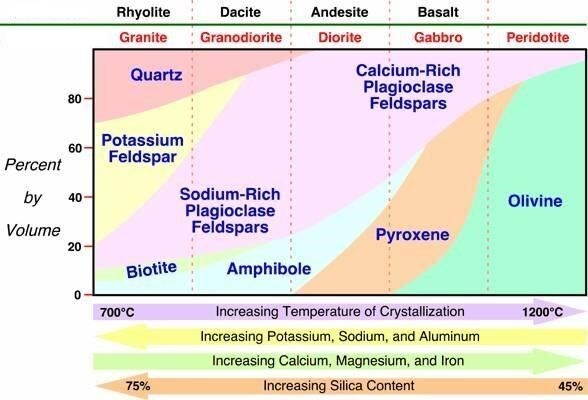
Izvor: Department of Geological Sciences, East Carolina University (www.ecu.edu/geology)
- Mafske → tamna boja, bogate Fe-Mg
- Felsičke → svijetla boja, bogate Si-Al
- Boja pomaže u procjeni sastava na terenu
Identifikacija Magmatskih Stijena
Kombinovanjem opažanja teksture i boje, moguće je odrediti najvjerovatniji tip stijene. Na primjer, krupnozrno, svijetlo stijenje je vjerovatno granit (felsički, intruzivni), dok je sitnozrno, tamno stijenje vjerovatno bazalt (mafski, ekstruzivni). Ova opažanja pomažu u tačnoj klasifikaciji stijena.
Ključ za Identifikaciju Magmatskih Stijena
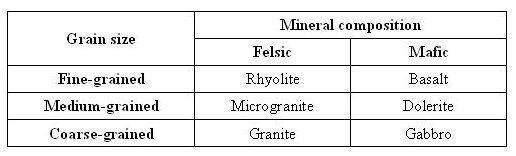
Mafic vs Felsic
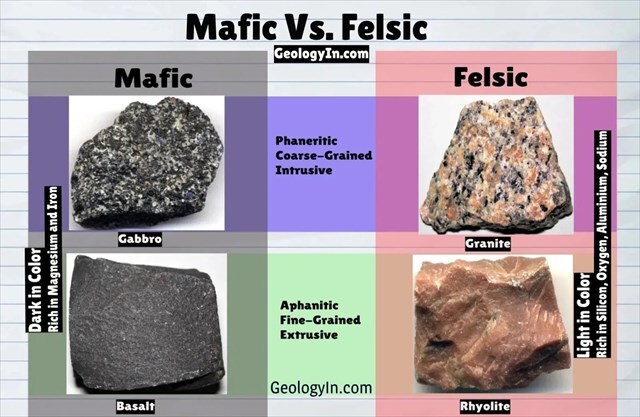
Izvor: geologyin.com
- Kombinuj teksturu i boju za identifikaciju
- Nađi tragove intruzivnog vs. ekstruzivnog nastanka kroz veličinu zrna
- Nađi tragove mafskog vs. felsičkog sastava kroz boju
Zadaci za posmatranje
Posmatraj stijenu na spomeniku i odgovori na sljedeća pitanja na osnovu svojih opažanja:
-
Vidljivost Kristala: Pogledaj površinu stijene pažljivo. Možeš li vidjeti pojedinačne minerale ili su premali da bi ih razlikovao/la? Da li bi opisao/la kao faneritično (vidljivi kristali) ili afanitno (sitni kristali)? Podijeli šta si vidio/la i zašto su kristali vidljivi ili ne.
-
Veličina Zrna: Procijeni veličinu kristala. Da li misliš da su sitnozrna, srednjezrna ili krupnozrna? Objasni kako si procijenio/la veličinu i koje karakteristike su ti pomogle.
-
Okruženje Hlađenja: Na osnovu opažanja, misliš li da je stijena nastala od sporo hlađene magme ispod zemlje ili brzo hlađene lave na površini? Opisati tragove koji su te doveli do ovog zaključka.
-
Boja i Sastav: Koja je ukupna boja stijene? Da li sugeriše mafsku (tamno, bogato Fe-Mg) ili felsičku (svijetlo, bogato Si-Al) kompoziciju? Objasni svoje razmišljanje.
-
Klasifikacija Stijene: Uzimajući u obzir veličinu kristala, teksturu i boju, koji tip magmatske stijene misliš da je u pitanju? Objasni kako su tvoja opažanja dovela do ovog zaključka.
Napravite fotografiju sa sobom ili ličnim predmetom u prvom planu, a spomenik u pozadini i dodajte ovu sliku svom online logu.
Uputstva za Logovanje
- Pošalji svoje odgovore putem Geocaching Message Center-a ili email-a.
- Nemoj uključivati odgovore u javni log.
- Možeš logovati ovaj EarthCache kao Found čim pošalješ svoje odgovore.
At the posted coordinates, you will find a striking monument dedicated to Vladimir Vysotsky, the legendary Russian singer, songwriter, and actor. The statue depicts him holding his iconic guitar, capturing the spirit of his artistic and cultural legacy. For this EarthCache we are interested in the pedestal of this monument. The pedestal represents a nice specimen of igneous rock. The plinth represents a natural geological material that can be observed and studied in place. This EarthCache focuses on using visible physical characteristics of the rock at this location to determine how it formed and how it can be classified.
Vladimir Vysotsky Monument
Educational Goal
The purpose of this EarthCache is to help visitors:
- Understand how igneous rocks form from molten material
- Observe how cooling conditions affect crystal size and texture
- Use color and texture to classify igneous rocks in the field
Formation of Igneous Rocks
Igneous rocks are formed when molten rock cools and solidifies. Molten rock is called magma when it is beneath the Earth's surface and lava when it reaches the surface. Rocks that form from magma below the surface are called intrusive (plutonic), while rocks formed from lava at the surface are called extrusive (volcanic).
Source: eschooltoday.com
- Magma cools slowly underground → intrusive rock
- Lava cools quickly at the surface → extrusive rock
- Formation location affects crystal size and texture
Cooling Rate and Crystal Development
The rate at which molten rock cools strongly influences the size and arrangement of crystals that form. Slow cooling allows crystals to grow larger and more visible, while rapid cooling results in very small crystals or a glassy texture. Rocks with visible crystals are called phaneritic, while those with tiny or microscopic crystals are called aphanitic.
Phaneritic vs. Aphanitic Rocks
Source: geologycafe.com
- Slow cooling → larger crystals → phaneritic texture
- Rapid cooling → small or microscopic crystals → aphanitic texture
- Crystal size reveals cooling history
Texture (Grain Size)
Grain size in igneous rocks refers to the size of individual mineral crystals. Fine-grained rocks have crystals smaller than 1 mm, medium-grained rocks have crystals between 1 and 5 mm, and coarse-grained rocks have crystals larger than 5 mm. Texture provides clues about cooling history and environment.
Grain Size
Source: Earth Science Australia
- Fine-grained → cooled quickly at the surface
- Medium-grained → cooled at moderate depth
- Coarse-grained → cooled slowly underground
Mineral Composition and Color
The mineral composition of igneous rocks often affects their color. Mafic rocks are darker and rich in iron and magnesium, while felsic rocks are lighter and rich in silica and feldspar. Color is an important field indicator when identifying rocks.
Mineral Composition of Igneous Rocks
Source: Department of Geological Sciences, East Carolina University (www.ecu.edu/geology)
- Mafic → dark colored, Fe-Mg rich
- Felsic → light colored, Si-Al rich
- Color helps estimate composition in the field
Igneous Rock Identification
By combining observations of texture and color, it is possible to identify the most likely igneous rock type. For example, a coarse-grained, light-colored rock is likely granite (felsic, intrusive), while a fine-grained, dark rock is likely basalt (mafic, extrusive). Using these observations helps classify rocks accurately.
Igneous Rock Identification Key
Mafic vs Felsic
Source: geologyin.com
- Combine texture and color for identification
- Intrusive vs extrusive clues from grain size
- Mafic vs felsic clues from color
Logging Tasks
Observe the rock at the monument and answer the following questions based on your own observations:
-
Crystal Visibility: Look closely at the surface of the rock. Can you see individual mineral crystals, or are they too small to distinguish? Would you describe it as phaneritic (visible crystals) or aphanitic (tiny crystals)? Share what you saw and why you think the crystals are visible or not.
-
Grain Size: Estimate the size of the crystals. Do you think they are fine-grained, medium-grained, or coarse-grained? Explain how you estimated the size and what features helped you.
-
Cooling Environment: Based on what you observed, do you think this rock formed from slowly cooled magma underground or quickly cooled lava at the surface? Describe the clues that led you to this conclusion.
-
Color and Composition: What is the overall color of the rock? Does it suggest a mafic (darker, Fe-Mg rich) or felsic (lighter, Si-Al rich) composition? Explain your reasoning.
-
Rock Classification: Considering crystal size, texture, and color, what type of igneous rock do you think this is? Explain how your observations led you to this conclusion.
Take a picture with yourself or a personal item with the monument in the background and attach this image to your online log.
Logging Instructions
- Send your answers via Geocaching Message Center or email.
- Do not include answers in your public log.
- You may log this EarthCache as Found once your answers have been sent.
An den angegebenen Koordinaten finden Sie ein eindrucksvolles Denkmal zu Ehren von Vladimir Vysotsky, dem legendären russischen Sänger, Songwriter und Schauspieler. Die Statue zeigt ihn mit seiner ikonischen Gitarre und vermittelt so den Geist seines künstlerischen und kulturellen Erbes. Für diesen EarthCache liegt unser Fokus auf dem Sockel dieses Denkmals. Der Sockel besteht aus einem schönen Exemplar eines magmatischen Gesteins. Er besteht aus einem natürlichen geologischen Material, das vor Ort beobachtet und untersucht werden kann. Dieser EarthCache konzentriert sich darauf, die sichtbaren physikalischen Eigenschaften des Gesteins an diesem Standort zu nutzen, um seine Entstehung zu bestimmen und es geologisch einzuordnen.
Vladimir Vysotsky Denkmal
Lernziel
Der Zweck dieses EarthCaches ist es, den Besuchern zu helfen:
- zu verstehen, wie magmatische Gesteine aus geschmolzenem Material entstehen
- zu beobachten, wie Abkühlungsbedingungen die Kristallgröße und Textur beeinflussen
- Farbe und Textur zu nutzen, um magmatische Gesteine im Gelände zu klassifizieren
Entstehung von Magmatischen Gesteinen
Magmatische Gesteine entstehen, wenn geschmolzenes Gestein abkühlt und erstarrt. Geschmolzenes Gestein wird Magma genannt, wenn es unter der Erdoberfläche ist, und Lava, wenn es an die Oberfläche gelangt. Gesteine, die aus Magma unter der Oberfläche entstehen, werden als plutonische (intrusive) Gesteine bezeichnet, während Gesteine, die aus Lava an der Oberfläche entstehen, als vulkanische (extrusive) Gesteine bekannt sind.
Quelle: eschooltoday.com
- Magma kühlt langsam unterirdisch → intrusives Gestein
- Lava kühlt schnell an der Oberfläche → extrusives Gestein
- Der Entstehungsort beeinflusst Kristallgröße und Textur
Abkühlungsrate und Kristallbildung
Die Geschwindigkeit, mit der geschmolzenes Gestein abkühlt, beeinflusst stark die Größe und Anordnung der Kristalle. Langsames Abkühlen ermöglicht größere, gut sichtbare Kristalle, während schnelles Abkühlen sehr kleine Kristalle oder eine glasige Textur erzeugt. Gesteine mit sichtbaren Kristallen werden als phaneritisch bezeichnet, während solche mit winzigen oder mikroskopischen Kristallen aphanitisch genannt werden.
Phaneritisch vs. Aphanitisch
Quelle: geologycafe.com
- Langsame Abkühlung → größere Kristalle → phaneritische Textur
- Schnelle Abkühlung → kleine oder mikroskopische Kristalle → aphanitische Textur
- Kristallgröße verrät Abkühlungsgeschichte
Textur (Korngröße)
Die Korngröße bei magmatischen Gesteinen bezieht sich auf die Größe der einzelnen Mineralkristalle. Fein-körnige Gesteine haben Kristalle kleiner als 1 mm, mittel-körnige Gesteine zwischen 1 und 5 mm, und grob-körnige Gesteine größer als 5 mm. Die Textur gibt Hinweise auf die Abkühlungsgeschichte und das Umfeld.
Korngröße
Quelle: Earth Science Australia
- Fein-körnig → schnell an der Oberfläche abgekühlt
- Mittel-körnig → in mittlerer Tiefe abgekühlt
- Grob-körnig → langsam unterirdisch abgekühlt
Mineralzusammensetzung und Farbe
Die Mineralzusammensetzung von magmatischen Gesteinen beeinflusst oft deren Farbe. Mafische Gesteine sind dunkler und reich an Eisen und Magnesium, während felsische Gesteine heller und reich an Silizium und Feldspat sind. Die Farbe ist ein wichtiger Hinweis bei der Bestimmung von Gesteinen im Gelände.
Mineralzusammensetzung von magmatischen Gesteinen
Quelle: Department of Geological Sciences, East Carolina University (www.ecu.edu/geology)
- Mafisch → dunkle Farbe, Fe-Mg reich
- Felsisch → helle Farbe, Si-Al reich
- Farbe hilft bei der Abschätzung der Zusammensetzung vor Ort
Bestimmung Magmatischer Gesteine
Durch die Kombination von Beobachtungen zu Textur und Farbe lässt sich der wahrscheinlichste Gesteinstyp bestimmen. Ein grobkörniges, helles Gestein ist z. B. wahrscheinlich Granit (felsisch, intrusiv), während ein fein-körniges, dunkles Gestein wahrscheinlich Basalt (mafisch, extrusiv) ist. Solche Beobachtungen helfen, Gesteine korrekt zu klassifizieren.
Bestimmungsschlüssel für magmatische Gesteine
Mafic vs Felsic
Quelle: geologyin.com
- Kombiniere Textur und Farbe zur Bestimmung
- Hinweise auf intrusiv vs. extrusiv aus Korngröße
- Hinweise auf mafisch vs. felsisch aus Farbe
Beobachtungsaufgaben
Beobachte das Gestein am Denkmal und beantworte die folgenden Fragen basierend auf deinen eigenen Beobachtungen:
-
Kristall-Sichtbarkeit: Sieh dir die Oberfläche des Gesteins genau an. Kannst du einzelne Mineralkristalle erkennen, oder sind sie zu klein, um sie zu unterscheiden? Würdest du es als phaneritisch (sichtbare Kristalle) oder aphanitisch (winzige Kristalle) beschreiben? Teile, was du gesehen hast und warum die Kristalle sichtbar sind oder nicht.
-
Korngröße: Schätze die Größe der Kristalle. Denkst du, sie sind fein-körnig, mittel-körnig oder grob-körnig? Erkläre, wie du die Größe geschätzt hast und welche Merkmale dir geholfen haben.
-
Abkühlungsumgebung: Basierend auf deinen Beobachtungen, glaubst du, dass dieses Gestein aus langsam unterirdisch abgekühltem Magma oder schnell an der Oberfläche abgekühlter Lava entstand? Beschreibe die Hinweise, die dich zu diesem Schluss führten.
-
Farbe und Zusammensetzung: Welche Gesamtfarbe hat das Gestein? Deutet sie auf eine mafische (dunkler, Fe-Mg reich) oder felsische (heller, Si-Al reich) Zusammensetzung hin? Erkläre deine Überlegungen.
-
Gesteinsklassifikation: Unter Berücksichtigung von Kristallgröße, Textur und Farbe, um welchen Typ magmatischen Gesteins handelt es sich deiner Meinung nach? Erkläre, wie deine Beobachtungen zu diesem Schluss führten.
Mache ein Foto mit dir oder einem persönlichen Gegenstand im Vordergrund und dem Denkmal im Hintergrund und füge dieses Bild deinem Online-Log hinzu.
Log-Anweisungen
- Sende deine Antworten über das Geocaching Message Center oder per E-Mail.
- Gib nicht die Antworten in deinem öffentlichen Log an.
- Du kannst diesen EarthCache als Gefunden loggen, sobald deine Antworten gesendet wurden.