EN
Oxidation
Oxidation is a chemical process that occurs when certain minerals react with oxygen present in the air or dissolved in water. During this reaction, some chemical elements, especially metals like iron, lose electrons and form new compounds, often oxides. One of the most common examples of this phenomenon is the formation of rust, when iron reacts with oxygen and water, producing iron oxides with reddish, brownish, or orangish tones.
4Fe++ + 3O2 + 6H2O = 2(Fe2O3·3H2O)
In granitic rocks, oxidation can occur because many of the minerals present contain iron in their composition. Granite is an igneous rock mainly composed of quartz, feldspar, and mica, but it may also include ferromagnesian minerals such as biotite or other iron-rich minerals. When the rock fractures or when there are veins (lines of different appearance crossing the granite), a pathway is created for the entry of water and oxygen. These agents promote the chemical alteration of iron-rich minerals, forming iron oxides that accumulate on the surfaces or in the fractures of the rock.
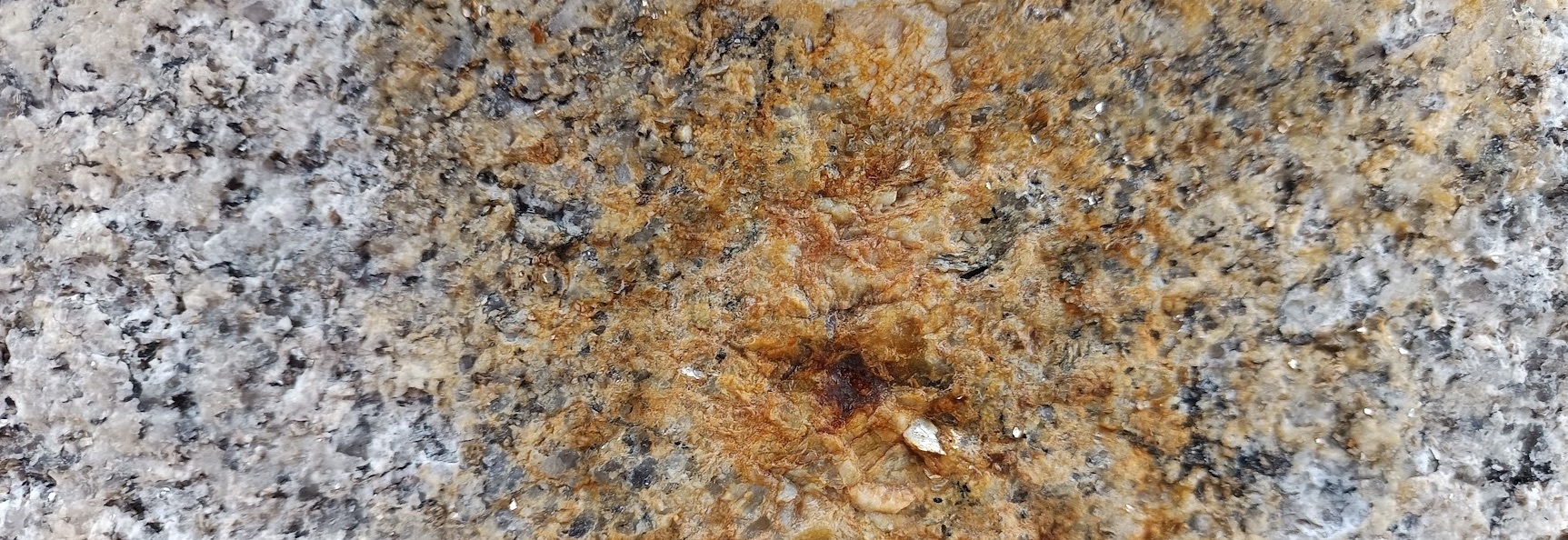
Example of oxidation in granite
At the coordinates of this earthcache, it is possible to observe oxidized granite. This coloration suggests the presence of iron-containing minerals that, over time, reacted with oxygen and water. Among the minerals that may be associated with this type of alteration are iron sulfides such as pyrite or chalcopyrite, as well as iron-rich minerals present in the original granite, such as biotite.
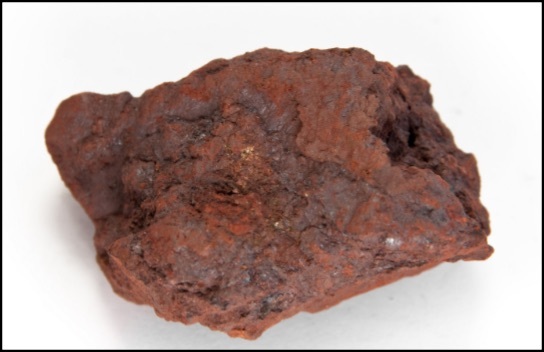
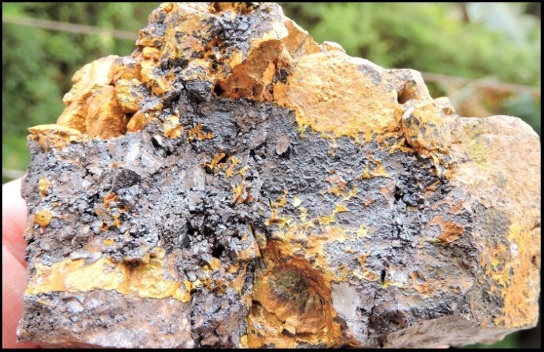
When iron-rich minerals alter at the surface due to contact with water and oxygen, they can form iron oxides and hydroxides. Two common examples are hematite and goethite. Hematite is an iron oxide (Fe₂O₃) that usually shows red to reddish-brown colors. Goethite, on the other hand, is an iron hydroxide (FeO(OH)) and typically shows brownish or yellowish tones.
 |
 |
| Hematite |
Goethite |
References:
Wikipedia, Hematite, https://en.wikipedia.org/wiki/Hematite
Wikipedia, Goethite, https://en.wikipedia.org/wiki/Goethite