Uwaga, to nie jest zwykły dworzec.
Warszawa Śródmieście skrywa jeden z ciekawszych przykładów sztuki w przestrzeni publicznej: modernistyczne mozaiki zaprojektowane przez Wojciecha Fangora.
Mozaiki Fangora na dworcu Warszawa Śródmieście
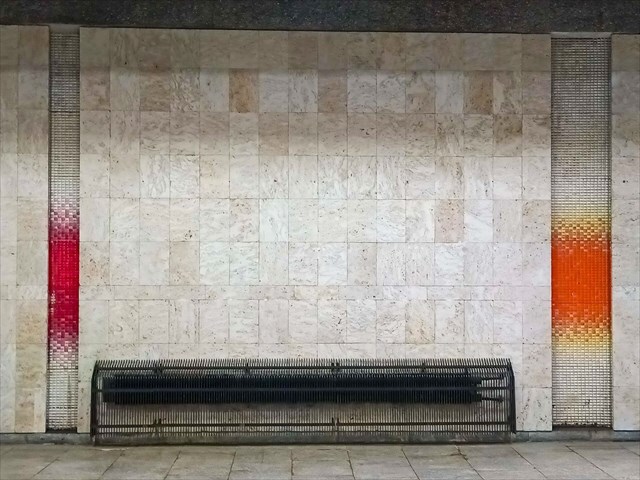
Mozaiki Wojciecha Fangora na dworcu Warszawa Śródmieście.
Wojciech Fangor był jednym z tych artystów, których trudno zamknąć w jednej szufladce. Malował, projektował plakaty, eksperymentował z kolorem, przestrzenią i sposobem, w jaki widz odbiera obraz. Zaczynał od sztuki figuratywnej, później współtworzył Polską Szkołę Plakatu, a z czasem stał się jednym z najbardziej rozpoznawalnych polskich twórców związanych z op-artem.
Najłatwiej zapamiętać go po obrazach z miękkimi, rozmytymi kołami i falami koloru. Nie mają ostrych konturów, dlatego sprawiają wrażenie, jakby pulsowały, drgały albo delikatnie wychodziły w stronę widza. Fangora interesowało nie tylko to, co znajduje się na obrazie, ale też to, co dzieje się pomiędzy obrazem a patrzącą osobą.
Fangor w przestrzeni miasta
Jego twórczość dobrze odnalazła się w przestrzeni publicznej. Fangor nie projektował wyłącznie dekoracji. Myślał o tym, jak człowiek porusza się w danym miejscu, jak zmienia się perspektywa i jak kolor może wpływać na odbiór przestrzeni.
Dobrym przykładem są mozaiki na dworcu Warszawa Śródmieście. Powstały na początku lat 60. jako część aranżacji podziemnej stacji. Nie były przypadkową ozdobą doklejoną do architektury, ale elementem zaplanowanym razem z wnętrzem dworca.
Kolor miał tu znaczenie praktyczne. Ciepłe barwy, takie jak czerwienie, oranże i żółcie, wiązano z kierunkiem wschodnim, a błękity i zielenie z kierunkiem zachodnim. W ruchu, zwłaszcza z okna pociągu, mozaiki miały działać jeszcze mocniej.
Ciekawostka:
Zespół dekoracji obejmuje 52 mozaiki sufitowe i 27 mozaik ściennych. Wykonano je ze szkliwionych elementów ceramicznych o wymiarach około 4 × 3 cm.
Co ciekawe, po wielu latach Fangor wrócił do warszawskiego transportu publicznego. Zaprojektował oprawę plastyczną siedmiu stacji centralnego odcinka II linii metra. Dzięki temu jego prace można spotkać w Warszawie nie tylko w muzeach i galeriach, ale też w miejscach zupełnie codziennych: na dworcu, w metrze, w drodze do pracy, szkoły albo na spacer.
Dlaczego warto się tu zatrzymać?
Mozaiki na Warszawie Śródmieście są czymś więcej niż kolorowym detalem z czasów modernizmu. To fragment większej historii o artyście, który traktował miasto jak przestrzeń do patrzenia, poruszania się i odkrywania.
Wystarczy na chwilę zwolnić, podnieść wzrok i zobaczyć, że nawet zwykła stacja kolejowa może być małą galerią sztuki.
Zadania
Zadanie 1:
Współrzędne doprowadzą Cię do tablicy pamiątkowej znajdującej się na ścianie pawilonu wejściowego do Dworca Śródmieście. Odczytaj rok, w którym odjechał pierwszy pociąg z dworca znajdującego się wcześniej w tym miejscu. Zapamiętaj go jako RRRR.
Wyślij e-mail na adres: "matshark+GCBJ75C@gmail.com".
W temacie wiadomości wpisz swój nick, spację oraz rok odczytany z tablicy, czyli Twoje RRRR.
Temat wiadomości powinien mieć format: nick RRRR.
(Pamiętaj o spacji między nickiem a rokiem. Jeśli wpiszesz nick i rok razem, np. nickRRRR, automatyczne potwierdzenie może nie zadziałać. Jeśli adres e-mail i temat wiadomości będą prawidłowe, niedługo otrzymasz automatyczne potwierdzenie prawidłowej odpowiedzi).
Zadanie 2:
Następnie wejdź na Dworzec Śródmieście, korzystając z najbliższego wejścia. Przespaceruj się po dworcu w poszukiwaniu mozaik Fangora. Zrób zdjęcie, na którym widać jakiś Twój przedmiot osobisty, PWG albo GPS, na tle mozaiki, która Ci się najbardziej podoba. Zdjęcie dołącz do logu znalezienia.
Ważne:
Nie musisz pokazywać twarzy. Wystarczy fragment sylwetki, PWG, trackable albo inny osobisty przedmiot, który potwierdzi Twoją wizytę na miejscu.
Kesz opublikowany w ramach majowego wyzwania grupy Geocaching Warszawa. W tym miesiącu wspólnie celebrujemy Blue Switch Day, publikując codziennie nowe skrytki!
English version
Warszawa Śródmieście is not just an ordinary railway station. It hides one of the most interesting examples of public art in Warsaw: modernist mosaics designed by Wojciech Fangor.
Fangor’s mosaics at Warszawa Śródmieście station
Wojciech Fangor’s mosaics at Warszawa Śródmieście station.
Wojciech Fangor was one of those artists who are difficult to place in a single category. He painted, designed posters, and experimented with colour, space, and the way viewers perceive an image. He began with figurative art, later became associated with the Polish School of Posters, and eventually became one of the most recognisable Polish artists connected with op art.
He is perhaps easiest to remember for his paintings with soft, blurred circles and waves of colour. They have no sharp outlines, which makes them seem as if they are pulsing, vibrating, or gently moving towards the viewer. Fangor was interested not only in what is inside the image, but also in what happens between the image and the person looking at it.
Fangor in urban space
His work fitted public space very well. Fangor did not simply design decoration. He thought about how people move through a place, how perspective changes, and how colour can affect the perception of space.
A good example can be found here, at Warszawa Śródmieście railway station. The mosaics were created in the early 1960s as part of the overall design of the underground station. They were not a random ornament added to the architecture, but an element planned together with the station interior.
Colour also had a practical function. Warm colours, such as reds, oranges, and yellows, were associated with the eastern direction, while blues and greens were linked with the western direction. In motion, especially when seen from a train window, the mosaics were meant to have an even stronger effect.
Interesting fact:
The decorative ensemble consists of 52 ceiling mosaics and 27 wall mosaics. They were made of glazed ceramic pieces measuring approximately 4 × 3 cm.
Interestingly, many years later Fangor returned to Warsaw’s public transport system. He designed the visual setting for seven stations of the central section of Warsaw Metro Line M2. Thanks to this, his works can be encountered in Warsaw not only in museums and galleries, but also in everyday places: at a railway station, in the metro, on the way to work, school, or for a walk.
Why stop here?
The mosaics at Warszawa Śródmieście are more than just a colourful modernist detail. They are part of a larger story about an artist who treated the city as a space for looking, moving, and discovering.
Take a moment, slow down, look up, and you may find that even an ordinary railway station can become a small art gallery.
Logging tasks
Task 1:
The coordinates will lead you to a commemorative plaque located on the wall of the entrance pavilion to Warszawa Śródmieście station. Read the year in which the first train departed from the railway station that used to be located here. Remember it as YYYY.
Send an email to: "matshark+GCBJ75C@gmail.com".
In the subject line, enter your geocaching nickname, a space, and the year read from the plaque, that is your YYYY.
The subject line should have this format: nickname YYYY.
(Please remember to put a space between your nickname and the year. If you write them together, for example nicknameYYYY, the automatic confirmation may not work. If the email address and the subject line are correct, you should soon receive an automatic confirmation message.)
Task 2:
Then enter Warszawa Śródmieście station using the nearest entrance. Take a walk around the station and look for Fangor’s mosaics. Take a photo showing one of your personal items, your PWG, or your GPS in front of the mosaic that you like the most. Attach this photo to your found log.
Important:
You do not have to show your face. A part of your silhouette, your PWG, a trackable, or another personal item is enough to confirm your visit.
This cache was published as part of the May challenge by the Geocaching Warszawa group. This month, we are celebrating Blue Switch Day together by publishing new caches every day!
Virtual Rewards 5.0 - 2026-2027
This Virtual Cache is part of a limited release of Virtuals created between February 3, 2026 and February 3, 2027. Only 4,000 cache owners were given the opportunity to hide a Virtual Cache. Learn more about Virtual Rewards 5.0 on the Geocaching Blog.