94th Bombardment Group Memorial
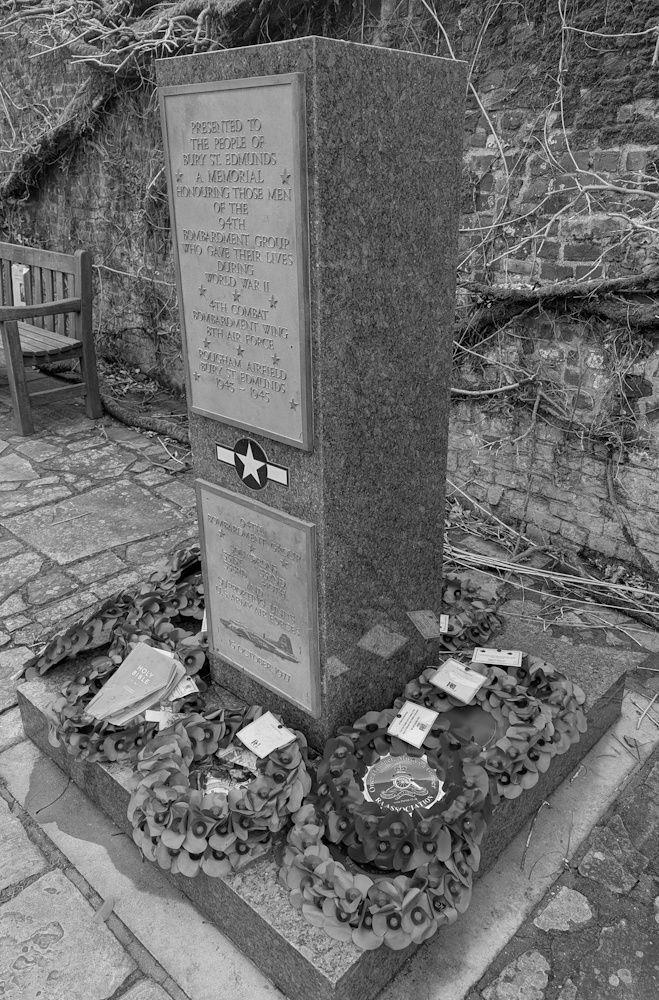
The 94th Bombardment Group Memorial, dedicated in October 1977, is on the west side of the Appleby Rose Garden in Bury St Edmunds, Suffolk. It honours the USAAF 94th Bomb Group, part of the Eighth Air Force, who were stationed at nearby RAF Bury St Edmunds during WWII. They flew 324 missions over Nazi-occupied Europe from 1943–1945. RAF Bury St Edmunds is a former Royal Air Force station located 3 miles (4.8 km) east of Bury St Edmunds. The airfield, now in private ownership and much reduced in size, is still active and is known as Rougham Airfield.
EarthCache Lesson and Questions
This EarthCache lesson is about the formation of granite and the influences on the colour and crystal size of the rock. In order to log this cache please make some observations of the war memorial at the given location and send your answers to the CO. Please feel free to log the cache having sent in your answers, we'll get back to you if there is a problem.
1 The surface of the memorial is made up of crystals, describe the colours and sizes of the crystals that you can see.
2 The granite has a very distinct overall colour. What colour is it and what does this tell you about the composition of the rock?
3 Given the crystal size do you think that this granite cooled relatively fast or slow?
4 On the back of the stone there is a small patch which looks different to the rest of the stone. Please describe it's location on the stone, shape, size and colouring. Do you think that it is a phenocryst or a xenolith, and why?
5 Add a photo to your log, but please don't include the memorial(s). I will delete any photo which gives away any answers.
Granite
Of the three main classes of stone - sedimentary, igneous and metamorphic - granite is an igneous rock. Igneous rocks form when molten rock, called magma, within the earth rises towards the surface and cools.
Sometimes the magma will break through the surface, at which point is is called lava, and it cools outside the earth to form such rocks as basalt and obsidian. Because the rock cools quickly there is little time for crystals to grow in size, so the crystals in these rocks are small - often invisible to the naked eye. These rocks are known as extrusive igneous rocks as the cooling occurs outside the earth.
In other cases the magma becomes trapped in a void deep within the earth's crust. In this case the cooling is much slower, taking thousands or millions of years. This allows larger crystals to form, which can range from around 1mm (quick cooling) to 30mm (slow). These rocks are known as intrusive igneous rocks as the cooling occurs within the earth. A well known example of an intrusive igneous rock is granite.
Granites can be either largely white, pink or grey in colour, depending on the mixture of minerals. Granite is formed of three main component minerals: feldspar (40%-80%) and quartz (20%-60%), with a small quantity of mica or amphibole. Quartz is normally colourless, but often appears as grey on the surface of granite. Mica or amphibole are normally seen as small black specks.
Feldspars are a range of minerals, all aluminosilicates, which are often grouped into two variants - plagioclase and alkali feldspar. Plagioclase is the most common mineral group in the Earth's crust and is normally a transparent or translucent white or grey in colour. Alkali feldspars contain potassium and are often coloured - with pink being a common variety. The proportion of alkali feldspar to plagioclase in true granite varies from 35% to 90%, where the percentage is higher than 90% then the material is called alkali feldspar granite - often referred to as red granite.
In igneous rocks you can often find areas which look very different to the surrounding rock. These areas can be xenoliths, where a piece of a different (older) rock has been scraped up in the magma and not melted, or a phenocryst, where part of the magma has crystalised in a different way to the surrounding rock. To spot these you need to look at the overall structure of the rock and spot areas which are significantly different. Xenoliths often stand out more clearly as they may have a different colour or texture.
Granite lacks any internal structure (ie it is random in the way the crystals bond together). It is hard, has a high tensile strength, and can be polished to a high gloss finish. It is therefore used in many applications including building cladding, worksurfaces and memorials.
References:
Wikipedia - Granite
https://en.wikipedia.org/wiki/Granite
Wikipedia - Feldspar
https://en.wikipedia.org/wiki/Feldspar
Wikipedia - Xenolith
https://en.wikipedia.org/wiki/Feldspar
Wikipedia - Phenocryst
https://en.wikipedia.org/wiki/Feldspar
Photograph by the CO
Permission to place this EarthCache at this location has been granted by West Suffolk Council, who manage the Abbey Gardens and surrounding public spaces.
This cache has been placed for the East Anglia UK Mega 2026