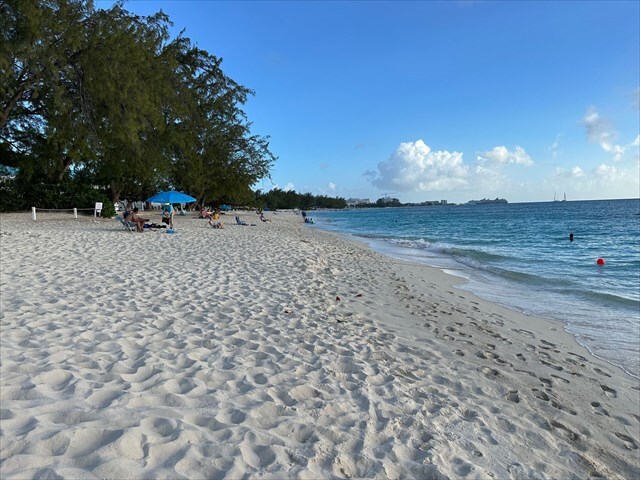
Seven Mile Beach is one of the most famous beaches in the Caribbean, known for its long stretch of soft white sand and clear turquoise water. Located along the western coast of Grand Cayman, it is a popular destination for swimming, snorkeling, and watching stunning sunsets. Despite its name, the beach is actually a bit shorter than seven miles.
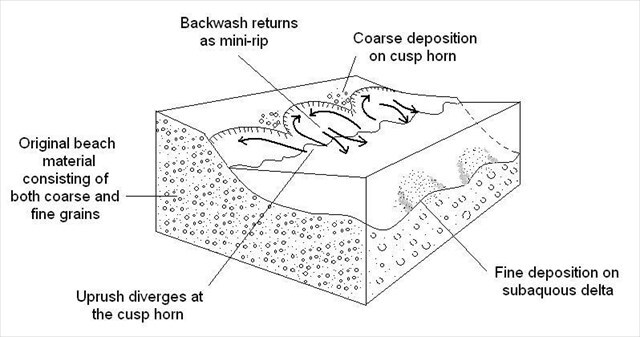
Beach cusps are small evenly spaced crescent-shaped patterns that form along the edge of a beach. If you look closely, you’ll see a series of pointed “horns” (slightly raised areas) alternating with curved “bays” (shallow dips), which creates a scalloped shoreline. They form mainly because of the interaction between waves and the sand on the beach. As waves wash up (swash) and then flow back down (backwash), they don’t always move evenly. Slight irregularities in the beach surface can cause water to concentrate in certain spots. Over time, this focused flow pulls sediment away from some areas (forming the bays) and deposits it in others (forming the horns).
There are several important terms related to beach cusps that help describe their shape and key characteristics.
- Depth – how far the curved bays cut into the shoreline compared to the horns.
- Spacing – the distance between each cusp, usually measured from one horn to the next.
- Amplitude – how pronounced the cusps are, or the height difference between the raised horns and lower bays.
- Elevation – the height of the horns and bays relative to sea level, with horns typically slightly higher.
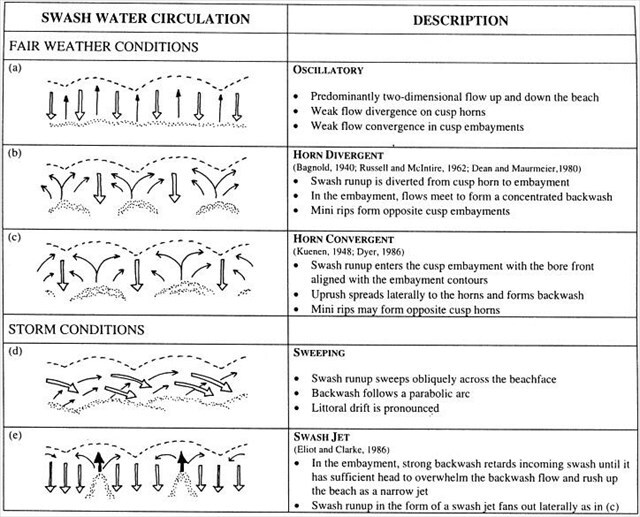
There are five types of beach cusps, and include oscillatory, horn divergent, horn convergent, sweeping, and swash jet cusps. Oscillatory cusps form from balanced, back-and-forth wave motion that creates symmetrical patterns along the shoreline. Horn divergent cusps occur when swash flows spread outward from the cusp horns, while horn convergent cusps develop when swash flows move inward toward the horns, building them up more prominently. Sweeping cusps are shaped by waves approaching the shore at an angle, producing more elongated and uneven forms. Swash jet cusps form when strong, concentrated streams of water rush up the beach, carving deeper embayments between the raised horns.
Logging Requirements:
- Describe the beach cusps visible in the area (be sure to mention depth, spacing, amplitude, and elevation). Are all of them similar in size, or do some vary slightly?
- Compare the contrast the sand at the horns with the sand in the bays. What can this tell us about the forces which shape this beach?
- Upload a photo with either yourself or a personal object taken at GZ. No group photos are allowed, each person must upload his/her own photo.