As America celebrates the 250th anniversary of the American Revolution we are refreshing some of the "American Revolution Geo Trail” cache located at historic sites across New Jersey.
Start your journey or revisit these historic locations to learn about the endurance, perseverance and bravery of the American patriots who fought in the War for Independence.
In February of 1776, Captain Daniel Neil was assigned to command the first artillery company of the state of New Jersey. Captain Neil, "a young man born In Ireland, by untiring energy and devotion to duty, quickly got his command in good trim for the active service it was soon to engage in."
He was ordered to position his four guns to cover the Newark Bay in northern New Jersey at the mouth of the Elizabeth river, then known as Mill Creek.
On July 3rd, 1776, a British gunboat was seen in the by off the southern shore of Shooter's Island. This was the first gunboat seen in the area - the ship was part of Admiral Lord Howe's fleet, which had just landed on Staten Island to unload troops.
Since Captain Neil's attack occurred shortly after midnight on July 4th, 1776, the periodical asserts that Neill's cannon shots were the first fired after the official adoption of the Declaration of Independence - the Congress in Philadelphia had formally performed the act between nine and ten o'clock the previous evening.
"It was the first exploit of the new-born nation, and a gallant young Irish patriot, a citizen of this province, carried it to success."
 General Mercer mortal wounds, At the left, Capt. Daniel Neil is shown bayoneted against his cannon. Capt. Daniel Neil was the Captain of Artillery and died on the battlefield after receiving a number of saber wounds from the British
Neil and his company were active in New Jersey throughout 1776, and crossed the Delaware with Washington on December 26.
During the Battle of Trenton, Neil and the East Jersey Artillery were attached to General John Sullivan’s division, attacking Trenton from the west. His guns supported Sullivan’s attack on the Knyphausen Regiment and then helped secure Assunpink Bridge. Neil’s finest hour, however, was to come a week later.
On January 3, 1777, as the Continental Army approached Princeton, Neil and his company were reassigned to General Hugh Mercer’s brigade. When Mercer was detached by General Nathanael Greene to engage the British, Neil and his two cannon advanced in support. Mercer ran headlong into elements of the 17th Regiment of Foot and a pitched battle erupted. Neil’s battery began throwing round shot at the approaching British lines as quickly as they could load and fire.
Neil ordered one cannon to withdraw with the infantry, staying behind to help cover the retreat with his second gun. Neil was unable to withdraw the second cannon, and was killed while he worked his gun. His sacrifice helped cover the withdraw of the remainder of Mercer’s men.
Captain Neil’s final resting place is unknown, and it is possible that he lies buried in the mass grave located on Princeton Battlefield.
The Colonnade is more than an architectural curiosity, though, since it is placed to serve as both an entrance and marker for the gravesite of fallen soldiers that lies nearby. A plaque on the portico notes:
“In the memorial grove beyond you, those who fell in the Battle of Princeton, both American and British, lie buried. The historic portico in which you stand was re-erected here to mark the entrance to the tomb of these unknown soldiers of the Revolution”
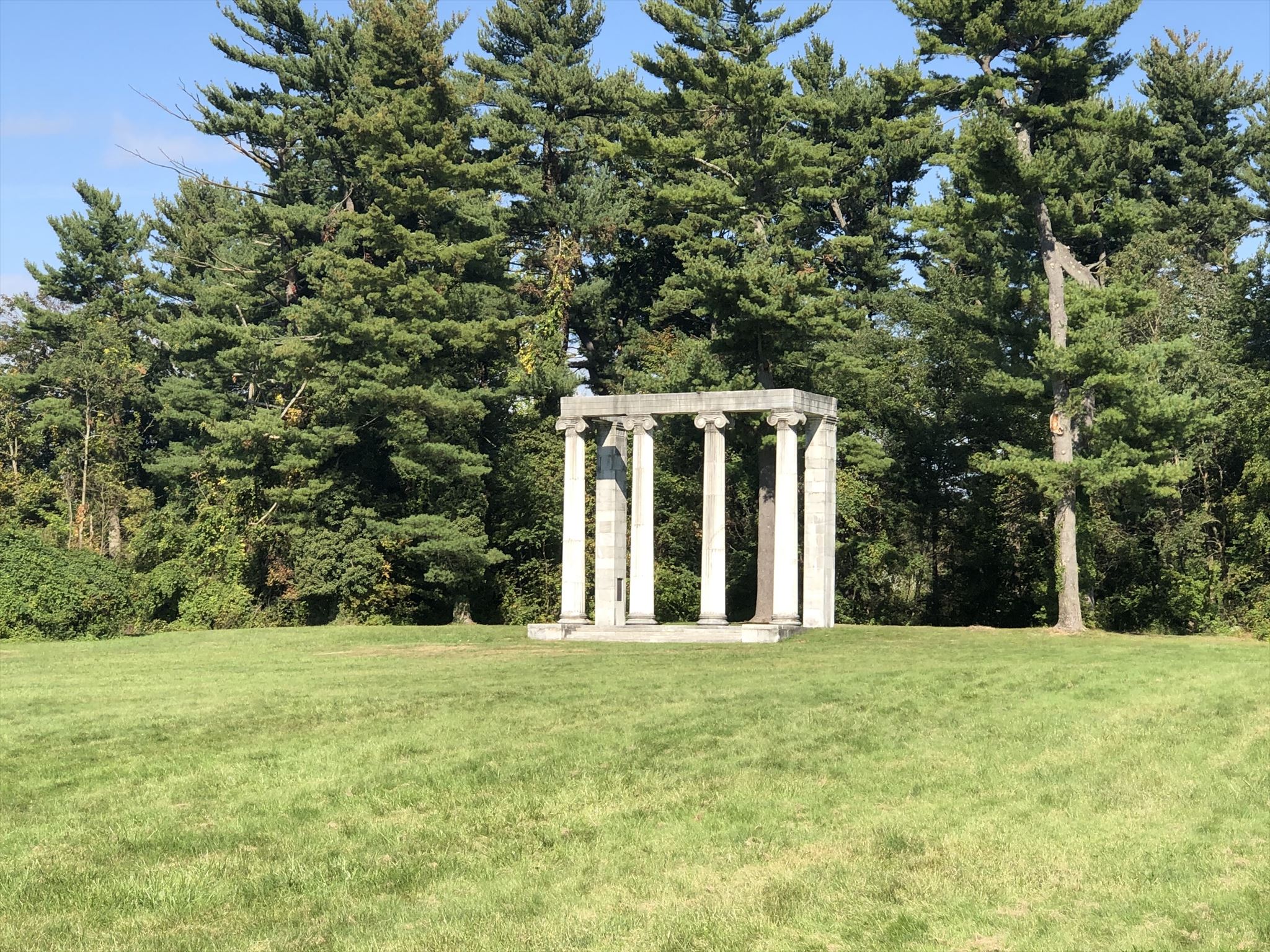 ”Colonnade Memorial"
The memorial was erected in 1918, in memory of the thirty-six unknowns buried here, including fifteen American and twenty-one British soldiers. The words engraved on the tablet are those of Alfred Noyes (1880 – 1958), taken from his poem “Princeton” (1917). Noyes was a visiting professor at Princeton University, and later became Poet Laureate of England. He wrote his poem 140 years after the battle, at a time when American and British soldiers were fighting together in support of their common heritage of freedom.
The opening lines of the poem are quoted on the plaque:
"Here Freedom stood by slaughtered friend and foe, And, ere the wrath paled or that sunset died, Looked through the ages; then, with eyes aglow, Laid them to wait that future, side by side."
The Colonnade can be considered a fitting tribute both to the brave Americans who fell at Princeton and, by echoing the artistry of ancient Greece, a reminder of the long history of the ideals of freedom and self-government for which they fought.
New Jersey served as the crossroads of the American Revolution, Situated between British-held New York City and Patriot held Philadelphia, with over 600 battles, skirmishes and acts of war; today there are over 150 historic sites to explore.
The New Jersey American Revolution Geo-Trail is a heritage journey to adventure and discovery. This geocache is one of The American Revolution Geo~Trail geocaches placed throughout New Jersey. Visit many historic locations that have a connection to important New Jersey's American Revolutionary War history. Information at njpatriots.org
 ”njpatriots.org"
The Northern New Jersey Cachers, NNJC is about promoting a quality caching experience in New Jersey. For information on The Northern New Jersey Cachers group you can visit: www.nnjc.org.
 nnjc.org & njpatriots.org