Silver Bluff Geoart - Wood Stork 47
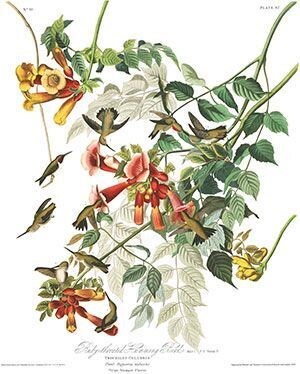
Ruby-Throated Humming Bird
Please read through the Searching Guidelines below before heading to the geocache.
There is import information to keep geocaching in good graces with the management.
Plate 47
Ruby-Throated Humming Bird
Archilochus colubris
he Ruby-throated Hummingbird is the only breeding hummingbird in eastern North America. Hovering in front of a flower to sip nectar, the Ruby-throated Hummingbird beats its wings more than 50 times per second. Despite their small size, impressive migrants may migrate from Canada to Costa Rica. In general, hummingbird feeders are safe, but they should be placed out of reach of cats and windows, avoid red food coloring, and cleaned often.
This Play Anywhere Wherigo® will require you to discover a key phrase that you will then enter into the Wherigo cartridge. The keyphrase is made up of four "words" that could be a collection of letters, numbers or actual words. There are no spaces in the keyphrase. The cartridge will provide you with the final location. You may download the cartridge and play it from the comfort of your home before you begin your adventure at the sanctuary.
How to get to the cache location. You may park at the main parking area near the sanctuary office. Walk 1.5 miles along the Quail Trail to get to the river. You will cross over to the old road to access the ramp. From there, it is a short bushwhack to the cache.
This section will provide you with Part 1 that is needed as part of the keyphrase.
H. What is the only hummingbird that breeds in the USA east of the Mississippi River?
- Black-chinned - A
- Stellula - B
- Rufous - C
- Ruby-throated - D
U. The female of a Ruby-throated humming bird is
- 3.5 grams or 0.12 oz. - E
- 10 grams or 0.35 oz. - F
- 17 grams or 0.6 oz. - G
- 24 grams or 0.85 oz. - H
- 42 grams or 1.48 oz.- I
M. Humming bird wings rotate from the shoulder in a horizontal figure-eight motion to generate lift while remaining stationary in the air. A hummingbird’s unique flight style allows it to fly forward, backward, and even upside down with great agility. How many times does a humming bird beat its wings per second?
- 10 - J
- 30 - K
- 50 - L
- 70 - M
M2. What color are ruby-throated humming bird eggs?
- pale blue or turquoise-green - N
- plain white - O
- brown with white spots - P
- yellow-orange with white spots - Q
E. During active flight, how many times per minute does a ruby-throated humming bird's heart beat?
- 100 - R
- 400 - S
- 800 - T
- 1200 - U
- 1600 - V
R. What is it called when a humming bird lowers its metabolism at night?
- gelid - W
- metamere - X
- rhamphotheca - Y
- torpor - Z
Hopefully, you had no trouble with part 1 questions and answers. Part 1 uses the answers. Part 2 is the other.
This section will help you discover Part 3 of the keyphrase.
This prime number = 12073. Qcra witel rg vhl nfapoubue pv swbf
Part 3 is the key to Part 4 of the keyphrase
Kbf ivsqfiutc wis nrlu dfos chobjj nipfuucu
Sliver Bluff Geoart Information
The geoart was created at a sanctuary in the area along the Savanna River called, Silver Bluff. The sanctuary is open from dawn to dusk, and permission for this hide was granted by the sanctuary manager. If you see sanctuary personnel during your visit, please thank them for supporting geocaching. The geoart consists of 55 geocaches in the shape of a wood stork. This sanctuary annually has hosted the largest inland concentration of foraging, endangered wood storks in South Carolina. There were some caches already existing at the sanctuary, and they were incorporated into the geoart. The difficulty/terrain ratings of the 55 geocaches are all different and provide a diverse geocaching experience. When combined with the related geoart of 26 geocaches, all 81 possible D/T ratings are included.
Searching Guidelines
As you are searching for Silver Bluff Geoart caches, please follow the following guidelines.
- Parking along roads: There are dirt roads in the area. They are not heavily used, but please be careful. Please do not block the roads or park on the roads. Be sure to pull off of the dirt roads completely. Please do not park near the gate at the end of Silver Bluff Road. Also, do not walk past that particular gate. Use the Quail Trail to access the caches at the south end of the sanctuary.
- Access to Authorized Personnel Only Areas: You are authorized to go past the signs that say, "Authorized Personnel Only" when searching for geocaches. Near the main office, there is a dirt road that has such a sign. There are some Terrain 1 (wheelchair accessible) caches down the road, and people are welcome to drive down that road into the authorized personnel areas for disability access. If you are asked about entering that area, just kindly mention that you are a geocacher who needs to take advantage of the disability access.
- Bird Boxes: There are many bird boxes in the sanctuary. No geocaches are hidden in bird boxes and there are no fake bird boxes. There might be some containers attached magnetically to the metal baffles below the boxes or on the ground by the boxes. Please be careful when approaching bird boxes, because there might be birds actively using them in the spring.
- Main Office, Trail Heads and Parking: You are welcome but not required to stop by the main office during your visit. Access to the trail heads is from the main parking area. There is also parking at Kathwood providing access to the walkways around the ponds.
John Audubon Drawing Information
The image on the cache page is from the original drawing by John James Audubon and was printed between 1827 and 1838. You may search the internet for the bird name with the plate number to find the original plates and complete descriptions of the birds as written by Audubon.

You can validate your puzzle solution with
certitude.