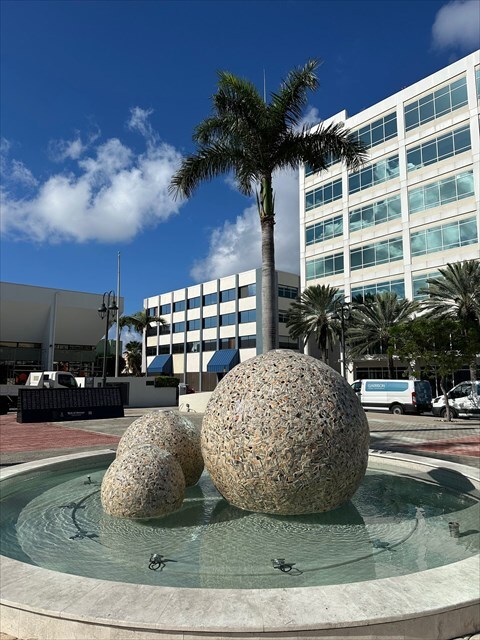
Heroes Square is a public space dedicated to honoring the Cayman Islands’ national heroes and important historical figures. Located in the heart of George Town, it features monuments, plaques, and a clock tower that commemorate individuals who have made significant contributions to the country’s development and identity. The square also serves as a gathering place for ceremonies, national celebrations, and community events.
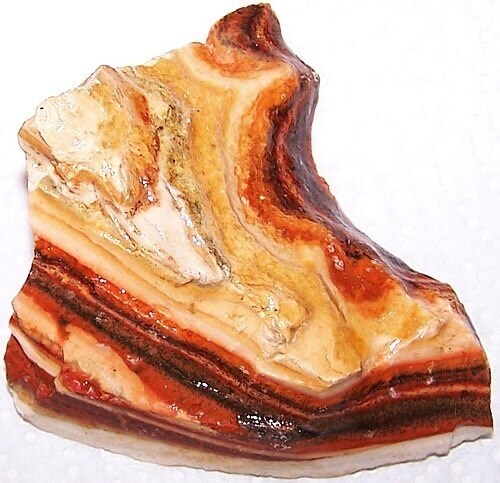
If you look closely at the fountain composed of three spheres, you'll notice that they are made up of a mosaic of tiny pieces of stone, which are caymanite. Caymanite is a distinctive, multi-colored rock found mainly in the Cayman Islands. It is not a single mineral but instead is a type of dolostone (a sedimentary rock rich in the mineral dolomite) that has been altered over time.
Caymanite was formed over the course of millions of years, and began as calcium-rich marine sediments, made up of shells, coral, and other materials, that accumulated on the seafloor in warm, shallow seas. Over time, these sediments were compacted and hardened into limestone. Later, magnesium-rich fluids move through the rock and chemically alter it into dolostone in a process called dolomitization. As the rock continues to change, it developed cracks and cavities that become filled with different minerals, forming the distinctive swirled and layered patterns seen in caymanite. Finally, weathering and erosion expose the rock at the surface, where it can be found today.
Some common mineral impurities found in caymanite that affect its color and banding include:
- Iron oxides (hematite and limonite) can create reddish or yellowish tones.
- Clay minerals may lead to gray, brown, or greenish tints.
- Graphite results in dark gray or black streaks.
- Dolomite, a variant of calcite, can create shades of pink or cream.
- Calcite, can contribute to white, or light colored bands.
- Manganese oxides can produce pink, purple, or dark banding, though usually found in small amounts.
Logging Requirements:
- Examine the mosaic stones closely. Describe their physical characteristics (such as colors, luster, opacity, patterns...etc).
- Which color(s) appear to be most common? Which minerals do you think are responsible for producing the color variations that you see? Explain.
- Upload a photo with either yourself or a personal object taken at GZ. No group photos are allowed, each person must upload his/her own photo.