Sandstone
Sandstone is a sedimentary rock formed when loose sand grains become compacted and cemented together over long periods of time. This process usually takes place after sand has been buried beneath additional layers of sediment, where pressure gradually turns the loose material into solid rock.
Sandstone commonly forms in environments where large amounts of sand accumulate, such as river deltas, beaches, shallow marine environments, and desert dune systems. Different depositional environments can give sandstone different structures and appearances, including layering, ripple marks, and cross-bedding.
Sandstone belongs to the group known as clastic sedimentary rocks. Clastic rocks are formed from fragments of older rocks and minerals that have been broken down through weathering and erosion. Wind, water, ice, and gravity transport these particles before they are deposited and eventually lithified into rock.
The grains in sandstone are most commonly composed of quartz because quartz is both hard and resistant to weathering. Feldspar and other mineral fragments may also occur depending on the source area of the sediments.
Like many sedimentary rocks, sandstone can preserve fossils and ancient surface features such as ripple marks, mud cracks, and raindrop impressions. These structures provide important clues about the environment and climate that existed when the sediments were originally deposited.

Clastic Sedimentary Rocks and Grain Size
Clastic sedimentary rock are classified mainly according to the size and shape of the sediment grains they contain.
Conglomerate = coarse, rounded grains (approximately 64 mm to more than 256 mm)
Breccia = coarse, angular grains (approximately 2 mm to 64 mm)
Sandstone = sand-sized grains ranging from about 2 mm to 1/16 mm
Shale = extremely fine grains smaller than 1/16 mm
Sandstone is mainly composed of sand-sized particles, but it may also contain both finer and coarser material. In addition to the sand grains themselves, sandstone commonly contains two important components known as matrix and cement.
The matrix consists of very fine-grained material, such as clay or silt, filling the spaces between the larger sand grains. The cement is made of minerals that crystallize between the grains and bind the sediment together into solid rock. Common cementing minerals in sandstone include quartz, calcium carbonate, and iron oxide.
The amount of matrix present helps determine how well sorted the sandstone is. Sandstone with a large amount of matrix is considered poorly sorted, while sandstone with very little matrix is called well sorted or arenite.
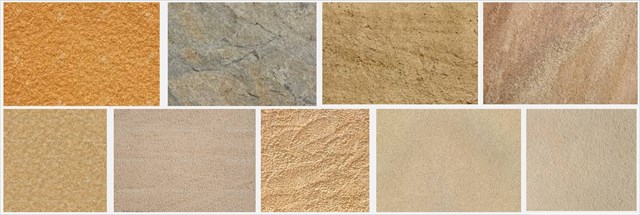
The mineral composition of both the grains and the cement strongly influences the color of the sandstone. Quartz-rich sandstone is often light-colored, while iron oxide can produce reddish, brown, or orange tones. Calcium-rich sandstone may appear pale gray or cream-colored. As a result, sandstone can occur in many different colors and textures depending on its origin and mineral content.
Typical Sandstone color
Formation and Appearance of Sandstone
Sandstone develops gradually over long periods of time as layers of sand accumulate in environments such as rivers, lakes, beaches, deserts, and shallow marine basins. As new sediments continue to build up above the older deposits, pressure increases and compacts the sand layers. Groundwater moving through the sediments carries dissolved minerals, commonly quartz, calcite, or iron-rich compounds, which crystallize between the grains and act as a natural cement. Over time, this process lithifies the loose sand into solid sandstone.
Because the original sand may come from many different rock sources, sandstone can vary greatly in both color and texture. The appearance depends not only on the composition of the sand grains themselves, but also on the minerals acting as cement within the rock.
Although sandstone is often made up largely of light-colored minerals such as quartz and feldspar, additional minerals and chemical elements can strongly affect its coloration. Iron oxide is one of the most common coloring agents and frequently produces red, brown, orange, or yellow tones. In some sandstones, manganese-bearing minerals can create purple or dark gray hues, while minerals rich in chlorite or glauconite may produce greenish colors.
Porosity and Permeability
To geologists, the term “sand” refers specifically to grain size rather than composition. Sand-sized particles range from approximately 1/16 millimeter to 2 millimeters in diameter. Sandstone is therefore defined as a rock composed predominantly of grains within this size range.
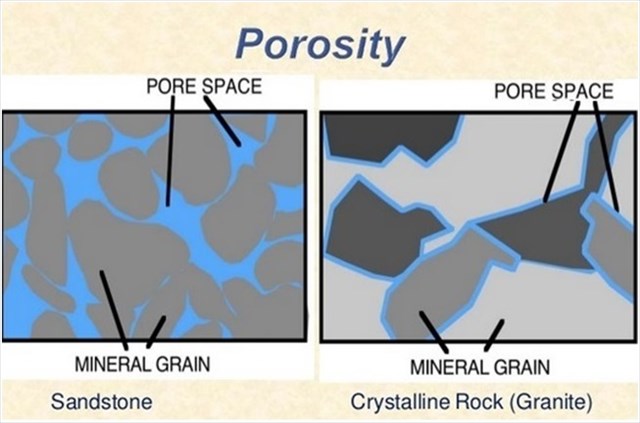
Many sandstones are naturally porous and permeable because small spaces remain between the grains. These pore spaces can store and transport water, oil, and natural gas, making sandstone an important reservoir rock in both hydrogeology and the energy industry. The degree of porosity and permeability depends on how tightly the grains are packed together and how much cement fills the spaces between them.
Sandstone Properties and Uses
Sandstone is widely used as a construction material because it is generally strong, durable, and relatively easy to shape and cut. Its strength can vary depending on the type of sandstone, the minerals present, and how well the grains are cemented together. Some sandstones are highly resistant to weathering, while others are softer and more porous.
In addition to dimension stone and building blocks, crushed sandstone is commonly used in road construction, foundations, paving, and aggregate material because it can maintain its structure under pressure.
Sandstone occurs in several varieties, including quartz-rich sandstone, arkosic sandstone rich in feldspar, and bluish or gray sandstone types often referred to as bluestone. These different varieties have different levels of durability, porosity, and resistance to weathering, which makes them suitable for different practical and architectural purposes.
Porosity and Permeability
One of the most important geological characteristics of sandstone is that it often acts as an aquifer. This means it can store and transport groundwater because the rock contains many tiny open spaces between the sand grains.
Porosity refers to the amount of empty space or pore space within the rock. These microscopic spaces may contain water, air, or petroleum. Porosity is commonly expressed as a percentage of the total rock volume. For example, a sandstone with 8% porosity contains approximately 8% open space and 92% solid material.
Although sandstone may appear dense and solid, it behaves somewhat like a very hard sponge. The spaces between the grains allow fluids to be trapped within the rock.
Permeability describes how easily fluids such as water, oil, or gas can move through those pore spaces. Many sandstones have both high porosity and high permeability, making them important groundwater reservoirs and petroleum-bearing rocks.
The level of permeability depends on factors such as:
grain size,
sorting of the grains,
and how much cement fills the pore spaces.
Well-sorted sandstone with loosely packed grains often allows fluids to move more easily than tightly cemented sandstone.
Density and Durability
Sandstone has an average specific gravity of about 2.2, making it relatively lighter than many other construction stones while still maintaining good strength and durability. This combination of moderate weight, resistance to weathering, and ease of quarrying has made sandstone a commonly used building material throughout history in walls, monuments, bridges, and public buildings.
To log this cache.
To get to log this cache you will have to visit and answer the questions which are related to the coordinates given the earthcache.
When answers are collected, send them to CO for verification.
You can log immediately after answers are sent CO. If there are any questions about your answers CO will contact you.
Logs without answers to CO or with pending questions from CO will be deleted without any further notice.
Please do not include pictures in your log that may answer the questions.
Questions
1. Answer the questions below by visiting the coordinates.
A. Go to the given coordinates and study the rock at the location. What type of rock do you observe, and what color does it mainly have? (Use the reference photo below.)

B. Describe the sandstone in front of you. What characteristics and structures can you observe, and what may have caused them? Measure the approximate spacing between any visible layers or bedding planes. What color is the rock, and what could explain these colors?
C. Sedimentary rocks formed in marine or water-related environments can sometimes contain fossils. Carefully inspect the rock at the location. Can you find any visible fossils?
D. Sedimentary rocks often occur in layers and may display different colors depending on their mineral composition. Observe the sandstone carefully. Do you notice any variations in color? Describe what you see and explain what may have caused these differences.
2. Take a photo of you, the group or the GPS from the location without revealing any of the answers.
Sources:
https://en.wikipedia.org/wiki/Sandstone
https://www.geological-digressions.com/classification-of-sandstones/
https://www.britannica.com/science/sandstone