
Xenoliths
A xenolith is a fragment of older “foreign” rock that has become trapped inside molten magma and later enclosed within an igneous rock as the magma cooled and solidified. The word xenolith comes from Greek and literally means “foreign rock.”
Xenoliths are important in geology because they provide direct evidence of rocks that existed before the surrounding magma formed. Since the trapped rock fragment was already solid before being engulfed by magma, true xenoliths are always older than the host rock around them.
When magma rises through the Earth’s crust, it can break off pieces of surrounding rock from the walls of cracks and magma chambers. These fragments may survive without completely melting and become carried within the magma. Once the magma cools into solid rock, the trapped fragments remain preserved as xenoliths.
Many xenoliths originate deep within the Earth, including from the mantle beneath the crust. Mantle xenoliths are especially valuable because they offer rare samples of material from depths that humans cannot directly reach. These xenoliths are commonly transported to the surface by volcanic eruptions and are often found in basaltic lava flows and volcanic pipes.
Xenoliths can vary greatly in size, ranging from tiny fragments only a few millimeters across to blocks several meters wide. Their appearance often contrasts strongly with the surrounding rock, making them easier to identify in the field. Some xenoliths are angular and sharp-edged, while others become more rounded after partial melting or transport within moving magma.
The intense heat from the magma may also alter the xenolith itself. This process, known as contact metamorphism, can change the minerals and texture of the trapped rock. In some cases, a thin reaction zone forms between the xenolith and the host rock, showing where chemical exchange occurred during cooling.
Some inclusions found in igneous rocks are not completely foreign. If the trapped rock fragment formed from the same magma as the host rock, it is called an autolith or cognate inclusion rather than a true xenolith.
Xenoliths often stand out from the surrounding rock because they differ in color, texture, grain size, or mineral composition. They may appear darker, lighter, finer-grained, or more coarse-grained than the host rock around them.
A simple way to imagine a xenolith is like a raisin inside a loaf of bread — the raisin existed first and later became enclosed by the surrounding material as it formed around it.
.
Examples of Xenolith:
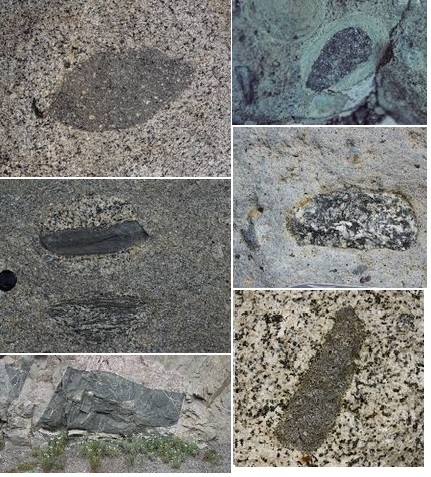
Geological Significance of Xenoliths
Xenoliths are highly important in geological research because they act as natural samples from deeper parts of the Earth. Since many xenoliths originate from the lower crust or upper mantle, they provide scientists with valuable information about areas otherwise impossible to study directly.
Different types of xenoliths can reveal variations in temperature, pressure, and chemical composition deep beneath the Earth’s surface. By studying their minerals and textures, geologists can better understand tectonic activity, magma evolution, and the structure of the lithosphere beneath volcanic regions.
Xenoliths are commonly found in volcanic rocks such as basalt, kimberlite, and andesite, where rapidly rising magma transports fragments upward before they completely melt. Some mantle-derived xenoliths contain minerals such as olivine, pyroxene, and garnet, which are stable only under very high-pressure conditions deep underground.
In some cases, xenoliths also preserve evidence of deformation, metamorphism, or partial melting that occurred before they were incorporated into magma. This makes them useful for reconstructing ancient geological processes and the tectonic history of a region.
To log this cache.
To get to log this cache you will have to visit and answer the questions which are related to the coordinates given the earthcache.
When answers are collected, send them to CO for verification.
You can log immediately after answers are sent CO. If there are any questions about your answers CO will contact you.
Logs without answers to CO or with pending questions from CO will be deleted without any further notice.
Please do not include pictures in your log that may answer the questions.
Questions
1. Answer the questions under by visiting the Coordinates.
A. Search the rock surface for xenoliths. Approximately how many xenoliths can you identify, and do you think they are older or younger than the surrounding host rock?
B. Estimate the size of the largest xenolith you can find at the site.
C. Based on your observations, do the xenoliths appear to be igneous rocks like the surrounding host rock? Explain your reasoning.
2. Take a photo of you, the group or the GPS from the location without revealing any of the answers.
Sources:
https://en.wikipedia.org/wiki/Xenolith
https://www.britannica.com/science/xenolith
https://www.sciencedirect.com/topics/earth-and-planetary-sciences/xenolith