„Rock and Roll“
Einleitung / Introduction / Introduction
Deutsch
Willkommen beim EarthCache „Rock and Roll“.
Der Name dieses EarthCaches verbindet zwei Besonderheiten dieses Ortes: Der „Rock“ steht für den beeindruckenden Basaltstein, der hier als geologisches Zeugnis vulkanischer Aktivität zu sehen ist. Der „Roll“ spielt auf die Boule- beziehungsweise Pétanque-Felder und die Halle in unmittelbarer Nähe an, ein Ort, an dem Kugeln rollen, während der Basalt seit Jahrmillionen unbeweglich die Geschichte der Erde erzählt.
Dieser EarthCache lädt euch dazu ein, die Entstehung, Struktur und Eigenschaften von Basalt näher kennenzulernen und die geologischen Besonderheiten dieses faszinierenden Gesteins direkt vor Ort zu entdecken.
Français
Bienvenue à l’EarthCache « Rock and Roll ».
Le nom de cette cache associe deux caractéristiques particulières du lieu : Le mot « Rock » fait référence à l’impressionnant bloc de basalte visible ici, témoin géologique d’une ancienne activité volcanique. Le mot « Roll » évoque les terrains et la halle de pétanque situés à proximité, où les boules roulent tandis que le basalte reste immobile depuis des millions d’années et raconte l’histoire de notre planète.
Cet EarthCache vous invite à découvrir la formation, la structure et les propriétés du basalte directement sur le terrain.
English
Welcome to the EarthCache “Rock and Roll”.
The name of this EarthCache combines two special aspects of this location: “Rock” refers to the impressive basalt stone visible here, a geological witness of ancient volcanic activity. “Roll” refers to the nearby boules/pétanque courts and hall, where balls roll across the ground while the basalt has remained motionless for millions of years, preserving Earth’s geological history.
This EarthCache invites you to explore the formation, structure, and characteristics of basalt and to discover the fascinating geology of this volcanic rock on site.
Geologie des Basalts / Géologie du basalte / Geology of Basalt
Deutsch
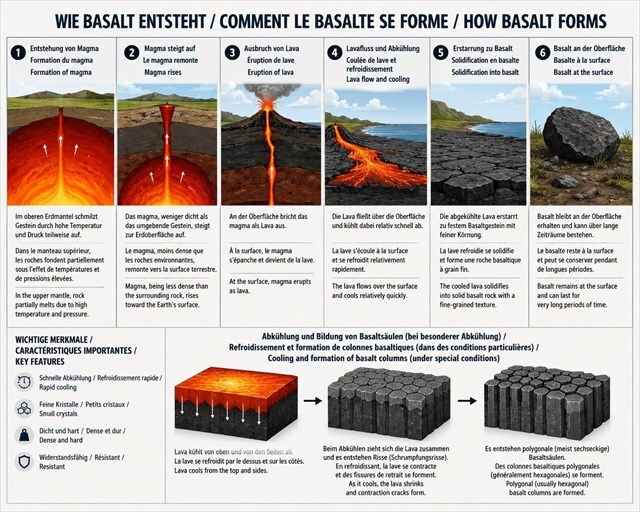
Basalt ist ein vulkanisches Ergussgestein und gehört zu den häufigsten Gesteinsarten der Erde. Es entsteht, wenn basaltische Lava an die Erdoberfläche gelangt und dort relativ schnell abkühlt. Die Lava stammt aus dem oberen Erdmantel und ist besonders reich an Eisen und Magnesium, während sie vergleichsweise wenig Silizium enthält.
Durch die schnelle Abkühlung können sich nur kleine Mineralkristalle bilden. Deshalb besitzt Basalt meist eine feinkörnige Struktur. Typische Mineralien im Basalt sind Pyroxen, Plagioklas und häufig auch Olivin. Frisch gebrochener Basalt erscheint meist dunkelgrau bis schwarz.
Besonders interessant sind die Schrumpfungsrisse, die während der Abkühlung entstehen. Wenn die Lava auskühlt, zieht sie sich zusammen. Dadurch bilden sich oft polygonale Säulen, die als Basaltsäulen bekannt sind. Diese Strukturen können fünf-, sechs- oder siebeneckig sein und entstehen durch natürliche Spannungen im Gestein.
Basalt ist ein sehr hartes und widerstandsfähiges Gestein. Deshalb wird er häufig als Baumaterial, Schotter oder Pflasterstein verwendet. Gleichzeitig liefert Basalt wichtige Hinweise auf vulkanische Prozesse und die Entwicklung der Erdkruste.
Der hier sichtbare Stein zeigt typische Eigenschaften basaltischer Gesteine: dunkle Farbe, hohe Dichte und eine massive Struktur. Mit etwas genauerer Beobachtung lassen sich oft feine Kristalle oder Abkühlungsstrukturen erkennen.
Français
Le basalte est une roche volcanique effusive et l’un des types de roches les plus répandus sur Terre. Il se forme lorsque de la lave basaltique atteint la surface terrestre et refroidit relativement rapidement. Cette lave provient du manteau supérieur de la Terre et est riche en fer et en magnésium, mais relativement pauvre en silice.
En raison du refroidissement rapide, seuls de petits cristaux minéraux peuvent se développer. Le basalte possède donc généralement une structure à grains fins. Les minéraux typiques du basalte sont les pyroxènes, les plagioclases et souvent l’olivine. Lorsqu’il est fraîchement cassé, le basalte apparaît généralement gris foncé à noir.
Les fissures de contraction formées pendant le refroidissement sont particulièrement intéressantes. Lorsque la lave refroidit, elle se contracte. Cela entraîne souvent la formation de colonnes polygonales appelées colonnes basaltiques. Ces structures peuvent avoir cinq, six ou sept côtés et résultent des tensions naturelles dans la roche.
Le basalte est une roche très dure et résistante. Il est donc fréquemment utilisé comme matériau de construction, gravier ou pavé. En même temps, il fournit des informations importantes sur les processus volcaniques et l’évolution de la croûte terrestre.
La pierre visible ici présente des caractéristiques typiques du basalte : couleur sombre, densité élevée et structure massive. En observant attentivement, il est parfois possible d’identifier de petits cristaux ou des structures de refroidissement.
English
Basalt is a volcanic extrusive rock and one of the most common rock types on Earth. It forms when basaltic lava reaches the Earth’s surface and cools relatively quickly. This lava originates from the upper mantle and is rich in iron and magnesium while containing relatively low amounts of silica.
Because of the rapid cooling process, only small mineral crystals can develop. As a result, basalt usually has a fine-grained texture. Typical minerals found in basalt include pyroxene, plagioclase, and often olivine. Freshly broken basalt is usually dark gray to black in color.
Particularly interesting are the contraction cracks formed during cooling. As the lava cools, it shrinks. This often leads to the formation of polygonal columns known as basalt columns. These structures may have five, six, or seven sides and form due to natural stress within the cooling rock.
Basalt is a very hard and durable rock. Therefore, it is often used as construction material, gravel, or paving stone. At the same time, basalt provides important information about volcanic processes and the development of Earth’s crust.
The stone visible here shows typical characteristics of basaltic rocks: dark color, high density, and a massive structure. With careful observation, fine crystals or cooling structures may sometimes be recognized.
Aufgaben / Questions / Questions
Deutsch
Beantwortet folgende Fragen richtig und sendet mir eure Antworten.
Ihr dürft direkt loggen. Sollte etwas an den Antworten nicht korrekt sein, melde ich mich bei euch.
- Warum besitzt Basalt meist nur sehr kleine Kristalle?
- Welche Strukturen können durch die Schrumpfung der Lava während der Abkühlung entstehen?
- Miss die Höhe des Steins in Zentimetern. Wie hoch ist der Stein?
- Mache ein obligatorisches Foto von dir selbst oder einem persönlichen Gegenstand vor Ort mit dem Stein im Hintergrund.
Français
Répondez correctement aux questions suivantes et envoyez-moi vos réponses.
Vous pouvez directement loguer cette cache. Je vous contacterai en cas de problème.
- Pourquoi le basalte possède-t-il généralement de très petits cristaux ?
- Quelles structures peuvent se former lorsque la lave se contracte pendant le refroidissement ?
- Mesurez la hauteur de la pierre en centimètres. Quelle est sa hauteur ?
- Prenez une photo obligatoire de vous-même ou d’un objet personnel sur place avec la pierre en arrière-plan.
English
Answer the following questions correctly and send me your answers.
You are allowed to log directly. If something is wrong with the answers, I'll get in touch with you.
- Why does basalt usually contain only very small crystals?
- Which structures can form when lava shrinks during cooling?
- Measure the height of the stone in centimeters. What is the height of the stone?
- Take a mandatory photo of yourself or a personal item on site with the stone in the background.