una roccia nella roccia

Questa earthcache ti porterà in uno dei monumenti più famosi di Milano, il magnifico Castello Sforzesco.

Alle coordinate indicate nel Cortile della Rocchetta, troverai un loggiato di colonne in pietra che presentano una straordinaria formazione geologica chiamata xenoliti.
A prima vista, gli elementi scuri all'interno della pietra più chiara potrebbero sembrare una macchia o un'irregolarità. Tuttavia, essi testimoniano processi geologici avvenuti milioni di anni fa.
Questa earthcache ha lo scopo di aiutarti a capire come si formano gli xenoliti e come si conservano all'interno delle rocce magmatiche.
Obiettivo Didattico
Questa earthcache aiuta i visitatori a:
- Capire cosa sono gli xenoliti e come si formano
- Apprendere come il magma interagisce con le rocce circostanti
- Riconoscere la differenza tra uno xenolite e la sua roccia ospitante
- Utilizzare il Principio delle Inclusioni per determinare le relazioni di età relativa
Che cos'è uno Xenolite?
La parola xenolite deriva dai termini greci xenos che significa "straniero" e lithos che significa "pietra". Uno xenolite è quindi una "roccia straniera" racchiusa all'interno di un'altra roccia.
La maggior parte degli xenoliti si trova nelle rocce magmatiche. Si formano quando il magma fuso risale attraverso la crosta terrestre e stacca frammenti di rocce preesistenti. Alcuni di questi frammenti entrano a far parte del magma e vengono trasportati durante il suo movimento nel sottosuolo.
xenoliti visibili all'interno della roccia ospitante
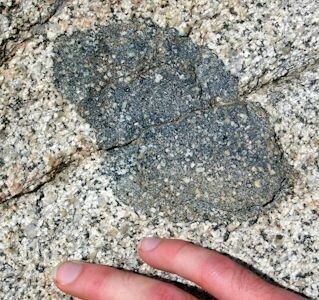
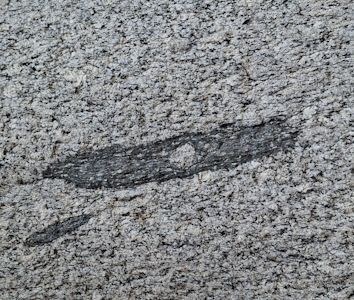
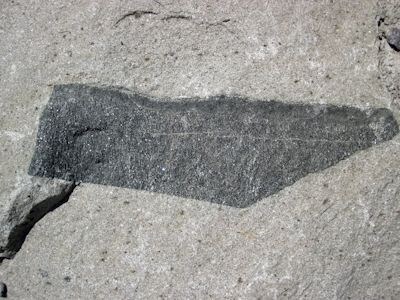
Se le condizioni sono favorevoli, i frammenti non si fondono completamente, ma sopravvivono abbastanza a lungo da permettere al magma circostante di raffreddarsi e solidificarsi. Il risultato è un frammento di roccia più antica conservato all'interno di una roccia più giovane.
Poiché gli xenoliti esistevano prima della formazione della roccia circostante, forniscono ai geologi preziose informazioni su ambienti geologici che potrebbero non essere più accessibili direttamente.
- Xeno = straniero
- Lite = roccia
- Gli xenoliti sono più antichi delle rocce che li circondano
- La maggior parte degli xenoliti proviene da rocce incontrate dal magma in risalita
- Conservano le tracce di eventi geologici passati
La Roccia Ospitante: Testimonianza di un Raffreddamento Lento
La roccia che circonda uno xenolite è chiamata roccia ospitante. La colonna in questo sito appare fatta di granito, una roccia magmatica intrusiva a grana grossa frequentemente utilizzata come materiale da costruzione.
Le rocce magmatiche intrusive si formano quando il magma si raffredda lentamente sotto la superficie terrestre. Il raffreddamento avviene nel corso di lunghi periodi, dando ai cristalli minerali il tempo di crescere e diventare visibili a occhio nudo.
Osserva da vicino la pietra più chiara che circonda lo xenolite. Dovresti essere in grado di vedere i singoli granuli minerali di diversi colori. Questi cristalli si sono formati in profondità nel sottosuolo molto tempo prima che la roccia venisse estratta e utilizzata nell'architettura del castello.
I cristalli visibili forniscono un indizio importante. Indicano che il magma ospitante si è raffreddato lentamente, suggerendo che si sia formato nelle profondità della crosta piuttosto che sulla superficie terrestre.
- I cristalli visibili indicano un raffreddamento lento
- Il raffreddamento lento avviene tipicamente nel sottosuolo
- I cristalli grandi sono tipici delle rocce magmatiche intrusive
- La roccia ospitante si è formata dopo che lo xenolite è entrato a far parte del magma
Quando il Magma Incontra la Roccia Solida
Mentre il magma risale attraverso la crosta, incontra vari tipi di roccia. Il calore intenso può fondere parzialmente o alterare queste rocce, ma non sempre avviene una fusione completa.
La sopravvivenza di un frammento dipende da diversi fattori, tra cui la temperatura del magma, la composizione del frammento, le sue dimensioni e il tempo di permanenza all'interno del materiale fuso.
I frammenti piccoli possono fondersi completamente e scomparire. I frammenti più grandi spesso sopravvivono, anche se possono subire alterazioni a causa del calore o interagire chimicamente con il magma circostante.
Processo generale di formazione dello xenolite
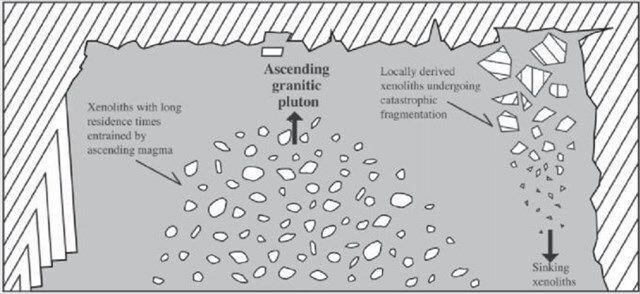
Lo xenolite visibile in questa colonna mostra un frammento che è sopravvissuto a questo viaggio ed è rimasto permanentemente racchiuso all'interno della roccia ospitante in via di raffreddamento.
La forma di uno xenolite può fornire indizi sulla sua storia. Frammenti spigolosi possono suggerire un trasporto limitato, mentre frammenti arrotondati potrebbero indicare un'interazione più prolungata con il magma.
- Non tutte le rocce incontrate dal magma si fondono completamente
- I frammenti più grandi hanno maggiori probabilità di sopravvivere
- La forma dello xenolite può rivelare la storia del suo trasporto
- Il contatto tra le rocce registra i processi geologici del passato
Il Principio delle Inclusioni
Uno dei concetti chiave utilizzati dai geologi è il Principio delle Inclusioni. Esso afferma che i frammenti racchiusi all'interno di una roccia devono essere più antichi della roccia che li contiene.
Pensa a un biscotto con gocce di cioccolato. Le gocce di cioccolato devono esistere prima di entrare a far parte dell'impasto. I geologi applicano la stessa idea alle rocce.
Lo xenolite non avrebbe potuto rimanere intrappolato all'interno del magma se non fosse già esistito. Pertanto, lo xenolite deve essere più antico della roccia ospitante che lo circonda.
Questo principio consente ai geologi di determinare la sequenza degli eventi geologici anche quando non si conoscono le età esatte delle rocce.
- Lo xenolite si è formato per primo
- Il magma ha successivamente incorporato il frammento
- La roccia ospitante si è cristallizzata attorno allo xenolite
- La roccia ospitante è quindi più giovane dello xenolite
Come Loggare questo cache
Concentriamoci sulle colonne poste ai due lati dell'ingresso del Cortile della Rocchetta. Osserva attentamente uno degli xenoliti e la roccia ospitante per rispondere alle seguenti domande in base alle tue osservazioni:
-
Identificazione dello Xenolite:
Quale parte della pietra ritieni sia uno xenolite e quale la roccia ospitante? Descrivi le caratteristiche visive che ti hanno aiutato a distinguerle.
-
Confronto di Colore e Consistenza:
Confronta lo xenolite e la roccia ospitante circostante. Quali differenze noti nel colore, nella dimensione dei granuli, nella consistenza o nell'aspetto generale?
-
Età Relativa:
Utilizzando il Principio delle Inclusioni, determina quale materiale si è formato per primo. Spiega come sei arrivato a questa conclusione.
-
Interpretazione Geologica:
In base alle tue osservazioni, spiega con parole tue come questo xenolite possa essere rimasto racchiuso all'interno della roccia ospitante.
-
Requisito Fotografico:
Scatta una fotografia che mostri te stesso o un tuo oggetto personale insieme a una delle colonne contenenti gli xenoliti che hai visto all'ingresso della piazza e allegala al tuo log online.
Istruzioni per registrare l'earthcache
- Invia le tue risposte tramite il Centro Messaggi di Geocaching o via email.
- Non inserire le risposte nel tuo log pubblico.
- Puoi registrare questa earthcache come "Found" (Trovata) non appena avrai inviato le risposte.
a rock within a rock
This earthcache takes you to one of Milan's most famous landmarks, the magnificent Castello Sforzesco.
At the listed coordinates in the Cortile della Rocchetta, you will find a gallery of stone columns featuring a remarkable geological formation called xenoliths.
At first, the dark features within the lighter stone may look like a stain or irregularity. However, they show evidence of geological processes that took place millions of years ago.
This earthcache aims to help you understand how xenoliths form and how they are preserved within igneous rocks.
Educational Goal
This earthcache helps visitors:
- Understand what xenoliths are and how they form
- Learn how magma interacts with surrounding rocks
- Recognize the difference between a xenolith and its host rock
- Use the Principle of Inclusions to determine relative age relationships
What is a Xenolith?
The word xenolith comes from the Greek words xenos meaning "foreign" and lithos meaning "stone." A xenolith is thus a "foreign rock" enclosed within another rock.
Most xenoliths occur in igneous rocks. They form when molten magma rises through the earth's crust and breaks off pieces of existing rocks. Some of these pieces become part of the magma and are carried along as it moves underground.
xenoliths visible within the host rock
If conditions are favorable, the fragments do not completely melt, but survive long enough for the magma around them to cool and solidify. The result is a piece of older rock preserved within a younger rock.
Because xenoliths existed before the surrounding rock formed, they provide geologists with valuable information about geological environments that may no longer be directly accessible.
- Xeno = foreign
- Lith = rock
- Xenoliths are older than the rocks that surround them
- Most xenoliths come from rocks encountered by rising magma
- They preserve evidence of earlier geological events
The Host Rock: Evidence of Slow Cooling
The rock surrounding a xenolith is called the host rock. The column at this location appears to be made of granite, a coarse-grained intrusive igneous rock frequently used as a building material.
Intrusive igneous rocks form when magma cools slowly beneath the earth's surface. Cooling happens over long periods, giving mineral crystals time to grow and become visible to the naked eye.
Examine the lighter stone surrounding the xenolith closely. You should be able to see individual mineral grains of different colors. These crystals formed deep underground long before the rock was quarried and used in the castle's architecture.
The visible crystals provide an important clue. They indicate that the host magma cooled slowly, suggesting it formed deep within the crust rather than at the earth's surface.
- Visible crystals indicate slow cooling
- Slow cooling typically occurs underground
- Large crystals are typical of intrusive igneous rocks
- The host rock formed after the xenolith became part of the magma
When Magma Meets Solid Rock
As magma rises through the crust, it encounters various rock types. The intense heat can partially melt or change these rocks, but complete melting does not always happen.
Whether a fragment survives depends on several factors, including the temperature of the magma, the composition of the fragment, its size, and how long it stays within the molten material.
Small fragments may melt completely and disappear. Larger fragments often survive, though they may become altered by heat or chemically interact with the surrounding magma.
Generalized xenolith formation process
The xenolith visible in this column shows a fragment that survived this journey and became permanently enclosed within the cooling host rock.
The shape of a xenolith can provide clues about its history. Angular fragments may suggest limited transport, while rounded fragments might indicate a longer interaction with the magma.
- Not all rocks encountered by magma melt completely
- Larger fragments are more likely to survive
- Xenolith shape may reveal its transport history
- The contact between rocks records past geological processes
The Principle of Inclusions
One of the key concepts used by geologists is the Principle of Inclusions. It states that fragments enclosed within a rock must be older than the rock that contains them.
Think of a chocolate chip cookie. The chocolate chips must exist before they become part of the dough. Geologists apply the same idea to rocks.
The xenolith could not become trapped within the magma unless it already existed. Therefore, the xenolith must be older than the host rock that surrounds it.
This principle allows geologists to determine the sequence of geological events even when the exact ages of the rocks are unknown.
- The xenolith formed first
- The magma later incorporated the fragment
- The host rock crystallized around the xenolith
- The host rock is therefore younger than the xenolith
Logging Tasks
Let's focus on the columns on both sides of the entrance to the Cortile della Rocchetta. Observe one of the xenoliths and the host rock carefully to answer the following questions based on your own observations:
-
Identifying the Xenolith:
Which part of the stone do you think is a xenolith and which part is the host rock? Describe the visual features that helped you tell them apart.
-
Color and Texture Comparison:
Compare the xenolith and the surrounding host rock. What differences do you notice in color, grain size, texture, or overall look?
-
Relative Age:
Using the Principle of Inclusions, determine which material formed first. Explain how you came to that conclusion.
-
Geological Interpretation:
Based on your observations, explain in your own words how this xenolith may have become enclosed within the host rock.
-
Photo Requirement:
Take a photograph showing yourself or a personal item with one of the columns containing the xenoliths you saw at the entrance of the square and attach it to your online log.
Logging Instructions
- Send your answers via Geocaching Message Center or email.
- Do not include answers in your public log.
- You may log this earthcache as Found once your answers have been sent.