This is an earthcache and you are required to complete these tasks to count this as a find. This cache brings you to a pathway into Jackson Ridges State Natural Area. Please stay on the path! You will follow the path where you'll be able to observe and answer the questions after reading the information below. Please do not post the answers to the questions in your logs, send them to the owner via message or email.
1. How many ridges (and therefore swales) are here?
2. Explain in your own words how the ridges and swales/dunes were formed (include the time frame).
3. Were sand dunes being formed or destroyed at the time of your visit? Explain how you came about this answer.
4. Take a photo of yourself (face not required) or a personal item here (try not to show answers in the background)
-------------------------------------------------------------------------------
Where Lake Michigan came from
Lake Michigan was formed by glaciers that started their retreat about 14,000 years ago. The glaciers melted, and inland seas had been carved out over time. As these new inland seas established, waves brought sand to shore, which we can still see today. Over time, the borders of the lakes had weak spots, where water emptied out lower the lake levels and lowering the elevation of the shoreline. Sand and sand dunes that had been created on the old shoreline continued to go through secession over time and became forested areas.
There are beach ridges around Lake Michigan, including here. As the water receded dozens of feet in height, and many times further in distance, the ridges that marked the ancient shorelines remained. Each of the ridges took an average of 30-50 years to form.
How Dunes (ridges) are formed
Sand was moved around during and after the glaciers were in this area. Much of the sand that is within lake Michigan today was brought here from the rivers that flowed from inland into the big lake, often forming bays. Sandbars and deltas built up where the rivers entered the lake, and as the lake levels lowered more sand was exposed on the surface.
A sand dune needs the following three things to form:
1) A large amount of loose sand in an area with little vegetation
2) A wind or breeze to move the grains of sand
3) An obstacle that causes the sand to lose momentum and settle. This obstacle could be as small as a rock or as big as a tree.
As wind hits the shoreline, it picks up grains of sand and carries them inland, widening and lengthening the beach. With more sand on mostly bare surfaces, wind was able to move the sand easily. Sand doesn't usually move far quickly - it travels only about an inch or two above the ground on earth. There are three ways that sand can be moved:
1) Saltation: The sand grains bounce along in the wind. About 95 percent of sand grains move in this manner.
2) Creep: When sand grains collide with other grains causing them to move. Creep accounts for about 4 percent of sand movement.
3) Suspension: Sand grains blow high in the air and then settle. About 1 percent of sand moves this way.
When sand is in motion, it doesn't stop until it comes to an obstacle. Pioneer beach grasses, such as marram grass, wheat grass and sand reed grass, slow the winds, forcing them to drop their load of sand. The heaviest grains settle first, forming a small ridge against the obstacle. Which came first - the ridge or the break in wind? They are intimately intertwined, and you don't have to ask the chicken or egg question on this earthcache! The ridge grows, causing more sand grains to pile up. Sand is moved up the pile, and it gets so steep on its backslope (slip face) that it collapses under its own weight - this is why sand dunes are not symmetrical. The dune gets to the angle of repose (the angle where the dune remains stable and stops collapsing on the slip face), which is between 30-34`.
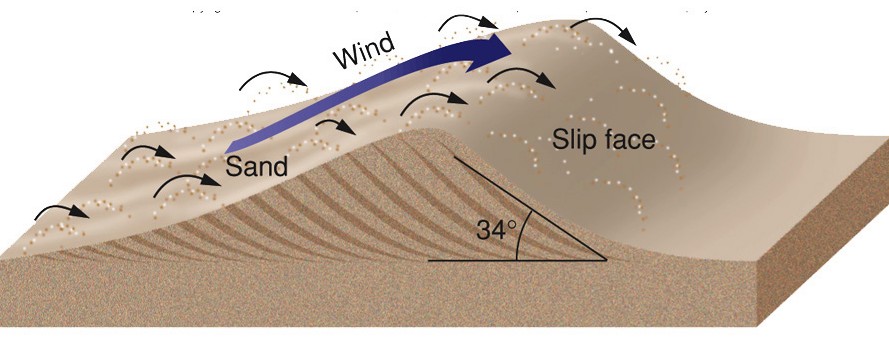
The speed and direction of the wind, as well as the weight and makup of the local sand will determine the shapes and sizes that the dunes become. Stronger winds tend to make taller dunes, and gentler winds usually spread them out.
Vegetation that takes root on the dunes helps to stabilize it and prevents as much movement of sand. Some of the common plants that stabilize the dunes are sand reed, marram grass, Canada wild rye, northern wheat grass, common and trailing junipers, sand cherry, and willow species. As the grasses stabilize the dunes, this enables the root systems of shrubs to establish too. Eventually trees such as juniper, northern red oak, eastern white pine, and paper birch take over. For a dune to evolve into a full grown forest, it will take approximately one thousand years.
Saltation and Sand Dunes on Other Planets
Sand dunes, formed through aeolian processes (wind) are found on other planets too! They cover extensive portions of Mars.
 Log scale plot of density ratios for terrestrial subaqueous and subaerial sand systems, and comparison with those anticipated on Venus, Mars, and Saturn’s moon Titan. Fluid and solid densities are shown along the top; gravity constants along the base of the panel. Modified from Southard 2021, Fig. 8.1.5.
The ability for sand to move in the air is drastically different on different pieces of rocck around the solar system.

Colorized picture of dunes at Endurance Crater on Mars
 art of the extensive Fortuna–Meskhent field of transverse dunes on Venus.
 Dune fields on Saturn's moon Titan
Sources:
https://www.geological-digressions.com/wind-blown-sand-on-mars-venus-and-titan/
https://www.geocaching.com/geocache/GC24HNH_kohler-park-dunes
https://www.geocaching.com/geocache/GC2K576_sand-beach-dunes-and-lsd
Permission for this cache has been given by Sarah Herrick, the WI DNR State Natural Area Program Specialist.