Totally Findable Tourist Caches
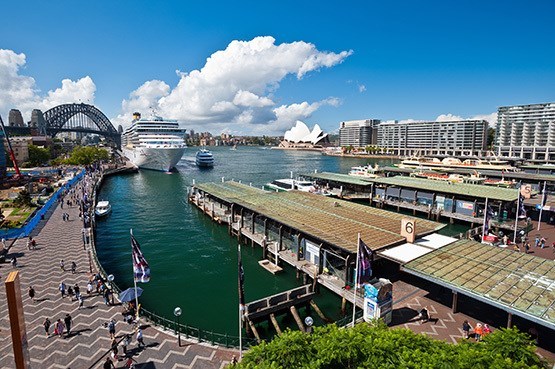
Welcome to Sydney
This series of geocaches is designed primarily with visitors to Sydney in mind who may have limited time and transport options and want a quick and easy find while out enjoying some sightseeing around this beautiful city.
All cache containers will be one of three types; a flat magnetic key case (MKC), a round film canister (FC or MFC for magnetic) or a fake rock (FR).
As always with city caching, the surrounding structures can affect GPS accuracy. If in doubt, use the hint however be mindful that the hint will indicate the type of container used and will be very specific to help you find the cache easily. If you want a challenge to find this cache and don't wish to know exactly where it's hidden, do not look at the hint.
At each location you’ll be given some information about the site you are visiting. I hope you find this information enlightening.
Enjoy!
------------<<0>>------------

Like all major cities around the world, Sydney has had and still has, its underbelly of crime and violence.
Push Gangs
Historical "pushes" in Sydney were notorious 19th-century urban street gangs and youth cliques that dominated working-class neighbourhoods. Members were part of the "larrikin" subculture, known for public brawling, intimidation, and anti-social behavior. They were called "pushes" because the word was 19th-century British and Australian slang for a crowd, pack, or assembled group of people who moved or "pushed" together through the streets.
The 19th-Century Street Pushes
- The Rocks Push: Operating from the 1870s through the 1890s, this was the most feared bare-knuckle boxing and criminal gang in The Rocks area, famously led by figures like Larry Foley.

Larry Foley - Leader of the Rocks Push
- Suburban Pushes: Other working-class areas had their own rival groups, such as the Miller's Point Push and Balmain's Liver Push, Soudan Push, and Warwick Push, which fought for neighborhood control and clashed with police.
The Razor Gang Era
The early decades of the 20th century were dominated by localized street violence and the emergence of Sydney’s first major organized syndicates. Passage of the 1927 Liquor Amendment Act and strict anti-prostitution laws inadvertently created lucrative underground economies. Neighborhoods like Surry Hills and Darlinghurst became battlefields for control over illegal "sly-grog" shops and prostitution networks. Because the New South Wales government criminalized the carrying of concealed handguns, criminals adopted the straight shaving razor as their weapon of choice. They were cheap, readily available from any barber shop and could easily be hidden. This brutal era was famously defined by the fierce, violent rivalry between two powerful crime matriarchs, Kate Leigh and Tilly Devine, who weaponized street thugs to protect their respective vice empires.

Kate Leigh and Tilly Divine - Rival Crime Matriarchs
Mid-Century Evolution and Post-War Expansion
Following the Second World War, the criminal element diversified away from simple street vice into more sophisticated, institutionalized rackets. The late 1940s and 1950s saw the rapid rise of illegal baccarat gaming clubs, illegal SP (starting price) bookmaking, and widespread cargo theft at the Sydney docks. Criminal networks began to operate with a higher degree of organization, utilizing systematic bribery to compromise local law enforcement and political figures. This corruption insulated major players from prosecution and allowed syndicates to consolidate wealth, setting the stage for an unprecedented expansion of illegal gambling networks that operated openly across the metropolitan area.

The Vietnam War, Corruption, and the Influx of Narcotics
The late 1960s and 1970s marked the most volatile transformation in Sydney’s criminal history, triggered by the Vietnam War and the arrival of American servicemen on Rest and Recreation leave. This influx created a massive market for illicit entertainment, prostitution, and, most critically, a booming trade in heroin. Figures like Abe Saffron, often dubbed the "Mr Sin" of Sydney, gained immense power by controlling the nightlife district of Kings Cross. Illegal casinos flourished under the protection of deeply entrenched police corruption, which was later exposed as reaching to the very highest levels of the New South Wales Police Force. The escalating violence culminated in high-profile disappearances and assassinations, including the 1975 vanishing of anti-development campaigner Juanita Nielsen, illustrating how ruthless the city's syndicates had become. She is presumed to have been murdered however her body has never been found.

Kings Cross Nightlife in the 1960s. This was a seedy part of town back then.
Corporate Crime, Systemic Exposure, and the Rise of Outlaw Gangs
The final two decades of the 20th century witnessed a shift toward corporate-style crime, international drug trafficking, and the dominance of heavily armed Outlaw Motorcycle Gangs. The 1980s were characterized by major royal commissions that slowly began dismantling the systemic police corruption that had shielded criminals for decades. As traditional vice rackets became less viable due to legislative reforms and legalized gambling, syndicates turned entirely to large-scale international drug importation. The Milperra Massacre of 1984 exposed the public to the extreme violence of warring bikie clubs fighting over turf. By the 1990s, the criminal landscape had fragmented, paving the way for street gangs and highly mobile syndicates that controlled the distribution of heroin and synthetic drugs leading into the new millennium.
----------<0>----------
The Justice and Police Museum is a unique cultural institution that explores the city's dark, criminal, and forensic past. Housed inside a restored 1890s sandstone complex that once functioned as a police station, court, and holding cells, it allows visitors to step directly into the gritty history of Sydney's underbelly.
Unfortunately, the museum is only open on weekends from 10am to 5pm with free admission for all visitors.


Two of Sydney's Underbelly Criminals.
Who are they and what were they accused of?
You can find them at the front of the Justice and Police Museum.
------------<0>------------
To Find This Cache:
1. At the published coordinates at the front of the Justice and Police Museum on the corner of Phillip St and Albert St, you'll find a figure standing on the steps.
2. Discover the figure's first and last name as well as the year the photograph was taken (excluding the "c").
3. Enter the name and year, as one long string of characters, into the Certitude checker to receive the GZ coordinates and hint.

You can validate your puzzle solution with
certitude.