FTF : Zora2364/AirV/Florence87
STF : Fath19
TTF :
Illustrations originales réalisées avec l"aide de l'IA - Original illustrations made with the help of AI

Les statues monumentales sont souvent une bonne occasion pour observer de grands blocs monolitiques de roches.
Dirigez vous vers la statue du Maréchal Jourdan et observez son socle constitué de différents calcaires.
Pour valider votre découverte, vous devrez :
1. Loguer cette cache "Trouvée" en joignant la photo demandée (obligatoire).
2. M'envoyer vos propositions de réponses aux questions ci-dessous soit par email soit via la messagerie geocaching.com (Message Center).
Q1. Sur quelle partie du socle reconnaissez-vous un calcaire à stylolithes ?
Q2. Durant quelle phase de la diagenèse d'une roche sédimentaire se forment les stylolithes ?
Q3. en supposant que le bloc se trouve dans sa position d'origine, à quel type pression a été soumise la roche lors de la formation des stylolithes : Lithostatique, Tectonique ou mixte ? Expliquez votre réponse.
Q4. Joindre une photo de vous ou de votre pseudo montrant en arrière plan la statue du Maréchal Jourdan sans qu'y figure le socle (montrer votre visage n'est pas obligatoire)
Je vous contacterai en cas de problème. Tout log non suivi des réponses dans un délai raisonnable sera effacé sans préavis.
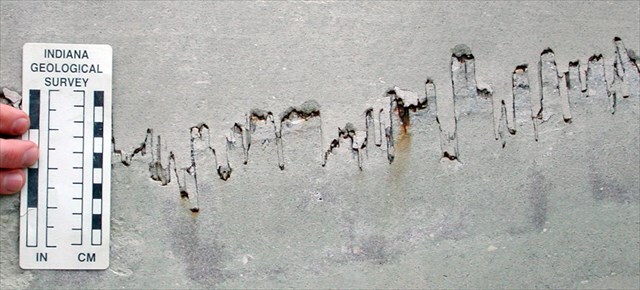
Qu'est-ce qu'une roche à stylolithes ?
Les stylolithes (ou stylolites) sont des structures géologiques irrégulières que l'on observe fréquemment dans les roches carbonatées sédimentaires, notamment les calcaires. Ils se présentent sous la forme de lignes souvent plus sombres, sinueuses ou dentelées, parfois très marquées.
Leur aspect rappelle une couture très irrégulière ou une succession de petites pointes ou de créneaux. Les stylolites constituent la trace d'un phénomène appelé dissolution sous pression.
Dans quels calcaires trouve-t-on des stylolithes ?
Les stylolithes se trouvent dans les calcaires et, après métamorphisme dans les marbres. Ils sont très fréquents dans les calcaires relativement compacts et suffisamment consolidés pour que la dissolution sous pression se localise le long d’une surface.
On en rencontre dans des calcaires fins ou micritiques, des calcaires bioclastiques et certains calcaires oolithiques ou clastiques. La présence d’argiles ou d’autres matériaux insolubles comme du quartz ou des oxydes peut favoriser la localisation de la dissolution et accentuer le contraste visuel du stylolithe.
La diagenèse
La diagenèse est l'ensemble des processus physiques, chimiques et biologiques qui transforment un sédiment meuble (boues, coraux, coquillages ...) en roche sédimentaire solide.
Les étapes principales de la diagenèse sont :
- La compaction : L'enfouissement sous de nouveaux sédiments exerce une pression. Cette pression chasse l'eau contenue dans les pores du sédiment et rapproche les grains.
- La déshydratation : Le départ de l'eau réduit l'espace entre les particules.
- La cimentation : Des minéraux dissous dans l'eau restante précipitent dans les espaces vides. Ils soudent les grains entre eux pour durcir la roche.
- La recristallisation : Certains minéraux instables se dissolvent ou se transforment en formes chimiques plus stables sous l'effet de la pression.
Comment se forme un stylolithe ?
La formation d'un stylolithe débute lorsque le calcaire est soumis à une pression importante, généralement pendant l'enfouissement progressif des sédiments ou au cours d'une phase de compression tectonique (mouvements de l'écorce terrestre).
L'eau présente dans les pores et les microfissures de la roche facilite la dissolution des minéraux les plus solubles, principalement la calcite. Aux endroits où les contraintes sont les plus fortes, une partie de la matière calcaire se dissout progressivement. Les éléments dissous peuvent ensuite être transportés par les fluides et parfois précipiter ailleurs dans la roche.
En revanche, les particules peu solubles ou insolubles, comme les argiles, les oxydes de fer ou certaines matières organiques, restent concentrées le long de la surface de dissolution. Cette accumulation forme souvent une ligne sombre qui souligne le stylolite.
Au fil du temps, la dissolution est plus importante dans certaines zones que dans d'autres. Cette dissolution différentielle produit le contour dentelé caractéristique des stylolites. La présence d'un stylolite indique donc qu'une quantité parfois importante de matière rocheuse a disparu par dissolution sous l'effet combiné de la pression et des fluides.
En résumé, le processus est donc essentiellement un transfert de matière : la calcite est dissoute là où la contrainte est élevée, transportée par un fluide, puis éventuellement précipitée là où les conditions sont plus favorables. Le stylolithe constitue la trace fossile de cette zone de dissolution localisée.
L'utilité géologique des stylolithes
Tout comme les fossiles, les stylolithes permettent d'obtenir de nombreuses informations sur la nature et l'histoire d'une roche calcaire. Notamment, cela permet de mesurer l'intensité et la direction des contraintes mécaniques subies par la roche au cours de son histoire.
Ils permettent d'identifier des phénomènes d'enfouissement, de compaction et de compression tectonique. Ils peuvent également renseigner sur la circulation ancienne des fluides et sur la quantité de matière dissoute. Dans certaines roches utilisées comme pierres de construction ou pierres ornementales comme ici, les stylolites influencent aussi l'aspect visuel, la texture et parfois le comportement mécanique ou la circulation de l'eau dans la roche.
Les principales cractéristiques des stylolites
On distingue les stylolithes par leur taille, leur forme et leur inclinaison en fonction des pressions subies : fortes ou faibles, lithostatiques ou tectoniques ou mixtes.
1. Les stylolites horizontaux ou parallèles à la stratification
Ce sont les stylolites les plus courants dans les séries calcaires. Ils sont approximativement parallèles aux couches sédimentaires. Ils se développent surtout sous l'effet du poids des couches situées au-dessus de la roche lors de son enfouissement. La pression exercée verticalement favorise la dissolution de la calcite aux contacts entre les grains et contribue à la formation de surfaces de dissolution généralement subhorizontales.
2. Les stylolites verticaux ou subverticaux
Les stylolites verticaux ou presque verticaux sont généralement liés à des contraintes tectoniques horizontales. Ils peuvent se former lorsqu'une masse rocheuse est comprimée latéralement, par exemple dans une région affectée par des mouvements tectoniques. Leur orientation peut donc fournir des indications sur la direction des contraintes qui ont affecté la roche.
3. Les stylolites obliques ou mixtes
Les stylolites obliques coupent les couches calcaires selon un angle. Leur orientation traduit souvent une situation plus complexe, dans laquelle plusieurs contraintes ont agi sur la roche. Ils peuvent être associés à la déformation tectonique, à l'inclinaison des couches ou à une modification progressive de l'état des contraintes au cours du temps. Des stylolithes initialement formées horizontalement pendant l'enfouissement peuvent ainsi se retrouver en position inclinée ou verticale suite à des mouvements de l'écorce terrestre.
4. Les stylolites à dents fines et régulières
Certains stylolites présentent de petites dents relativement fines et rapprochées. Leur relief est peu marqué mais facilement reconnaissable. Ils témoignent d'une dissolution localisée à petite échelle, souvent contrôlée par la texture du calcaire, la taille des grains et la répartition des impuretés.
5. Les stylolites à grandes dents ou à relief marqué
D'autres stylolites possèdent des pointes et des creux plus importants. Ces formes peuvent résulter d'une dissolution plus prolongée ou plus intense. Les différences locales de composition et de résistance à la dissolution favorisent le développement d'un relief très irrégulier. Les matériaux insolubles s'accumulent fréquemment dans les creux et rendent la structure particulièrement visible.
Les dents ne sont pas des morceaux de roche qui auraient été arrachés mécaniquement. Elles correspondent à une géométrie de dissolution irrégulière. Les variations de texture, de taille des grains, de teneur en argiles, de porosité, de circulation des fluides et de contrainte locale font que certaines portions du contact se dissolvent plus vite que d’autres. La surface devient ainsi ondulée puis fortement dentelée. Les pointes des stylolithes sont généralement orientées approximativement selon la direction de la contrainte principale maximale σ₁.
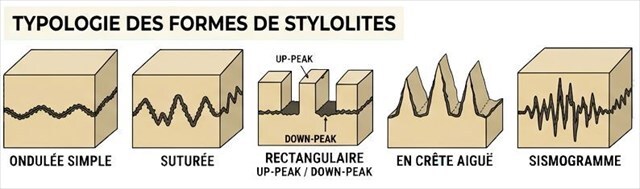
|
Forme / géométrie
|
Aspect
|
Interprétation / contexte
|
|
Simple ou ondulée
|
Ondulations relativement douces, dents peu développées.
|
Stade ou style peu mature ; fréquent dans les joints de dissolution à faible amplitude.
|
|
Suturée / dentelée
|
Profil en zigzag avec nombreuses petites dents.
|
Très classique dans les calcaires ; forte localisation de la dissolution.
|
|
À pics ou crêtes
|
Dents plus longues, pointues et parfois asymétriques.
|
Peut traduire une dissolution plus importante et une hétérogénéité marquée.
|
|
Rectangulaire / up-peak / down-peak
|
Pics plus réguliers, donnant un profil anguleux.
|
Géométrie décrite dans les classifications morphologiques ; utile pour l’étude de la contrainte.
|
|
Type « sismogramme »
|
Alternance de petites ondulations irrégulières sur une longue distance.
|
Morphologie complexe, avec variations d’échelle.
|
|
Réseau de stylolithes
|
Plusieurs surfaces se croisent ou se raccordent.
|
Peut résulter de plusieurs épisodes de dissolution et/ou de plusieurs directions de contrainte.
|
Sources bibliographiques
-
Toussaint, R. et al. (2018), « Stylolites: A review », Journal of Structural Geology, 114, 163–195. DOI: 10.1016/j.jsg.2018.05.003.
-
Renard, F. et al. (2004), « Three-dimensional roughness of stylolites in limestones », Journal of Geophysical Research: Solid Earth, 109, B03209. DOI: 10.1029/2003JB002555.
-
Rolland, A. et al. (2012), « Modeling the growth of stylolites in sedimentary rocks », Journal of Geophysical Research: Solid Earth, 117. DOI: 10.1029/2011JB009065.
-
Journal of Structural Geology (2024), « Initiation and development of tectonic stylolite–vein system in micritic limestone (Les Matelles, France) », 183, 105130. DOI: 10.1016/j.jsg.2024.105130.
-
Université de Montpellier – Collections TectoUM, exemples de stylolithes et structures de déformation des Matelles.
-
Patrimoine de Bourgogne-Franche-Comté, dossier « Marbres et marbreries du Jura ».
-
BRGM, notices géologiques et documents Infoterre consacrés aux calcaires et aux structures de pression-dissolution.
Pourquoi "VERT" ?
Ma première cache posée (GC3VHY2) était une boîte verte, avec un stylo vert, un log book vert et des objets d'échange verts. Ainsi est née l'idée de placer les caches qui ont suivi sous le signe du "VERT" et de proposer un défi consistant à y déposer de préférence des objets "VERTs". Ce défi ne peut malheureusement pas concerner les earthcaches.
------------oOo------------

Note: some parts are written with the help of automatic translator. Tecnical vocabulary issues may occure
Monumental statues are often a good opportunity to observe large monolithic blocks of rock.
Go to the statue of Marshal Jourdan and examine its base, which is made of different limestones.
To validate your discovery, you must:
1. Log this cache as “Found” and attach the requested photo (mandatory).
2. Send me your proposed answers to the questions below either by email or via the geocaching.com messaging system (Message Center).
Q1. On which part of the base can you identify a stylolite-bearing limestone?
Q2. During which stage of the diagenesis of a sedimentary rock do stylolites form?
Q3. Assuming that the block is in its original position, what type of pressure was the rock subjected to when the stylolites formed: lithostatic, tectonic, or mixed? Explain your answer.
Q4. Attach a photo of yourself or your username showing the statue of Marshal Jourdan in the background, without the base appearing in the photo (showing your face is not mandatory).
I will contact you if there is a problem. Any log not followed by the answers within a reasonable period will be deleted without prior notice.
What is stylolite-bearing rock?
Stylolites are irregular geological structures frequently observed in sedimentary carbonate rocks, especially limestones. They appear as often darker, sinuous or serrated lines, sometimes very pronounced.
Their appearance resembles a very irregular seam or a series of small points or teeth. Stylolites are the trace of a process called pressure solution.
In which limestones are stylolites found?
Stylolites occur in limestones and, after metamorphism, in marbles. They are very common in relatively compact limestones that are sufficiently consolidated for pressure solution to become localized along a surface.
They occur in fine-grained or micritic limestones, bioclastic limestones, and some oolitic or clastic limestones. The presence of clay or other insoluble materials such as quartz or oxides may favor localization of dissolution and increase the visual contrast of the stylolite.
Diagenesis
Diagenesis is the set of physical, chemical, and biological processes that transform loose sediment (mud, corals, shells, etc.) into solid sedimentary rock.
The main stages of diagenesis are:
- Compaction: Burial beneath new sediment creates pressure. This pressure expels water from the pores of the sediment and brings the grains closer together.
- Dehydration: The loss of water reduces the space between particles.
- Cementation: Minerals dissolved in the remaining water precipitate in the empty spaces. They bind the grains together and harden the rock.
- Recrystallization: Some unstable minerals dissolve or change into more stable chemical forms under the effect of pressure.
How does a stylolite form?
The formation of a stylolite begins when limestone is subjected to significant pressure, generally during the progressive burial of sediments or during a phase of tectonic compression (movements of the Earth's crust).
Water present in the pores and microfractures of the rock facilitates the dissolution of the most soluble minerals, mainly calcite. Where stresses are greatest, part of the carbonate material gradually dissolves. The dissolved material can then be transported by fluids and may sometimes precipitate elsewhere in the rock.
By contrast, poorly soluble or insoluble particles, such as clay, iron oxides, or certain organic materials, remain concentrated along the dissolution surface. This accumulation often forms a dark line that outlines the stylolite.
Over time, dissolution is greater in some areas than in others. This differential dissolution produces the characteristic serrated outline of stylolites. A stylolite therefore indicates that a sometimes significant amount of rock material has disappeared through dissolution under the combined effect of pressure and fluids.
In summary, the process is essentially a transfer of material: calcite dissolves where stress is high, is transported by a fluid, and may then precipitate where conditions are more favorable. The stylolite is the fossil trace of this localized dissolution zone.
The geological importance of stylolites
Like fossils, stylolites provide a great deal of information about the nature and history of a limestone. In particular, they can be used to assess the intensity and direction of the mechanical stresses experienced by the rock during its history.
They can identify processes of burial, compaction, and tectonic compression. They can also provide information about past fluid circulation and the amount of dissolved material. In some rocks used as building or ornamental stones, such as the one observed here, stylolites also influence the visual appearance, texture, and sometimes the mechanical behavior or water circulation within the rock.
Main characteristics of stylolites
Stylolites can be distinguished by their size, shape, and inclination according to the pressures they experienced: strong or weak, lithostatic or tectonic, or mixed.
1. Horizontal stylolites or stylolites parallel to bedding
These are the most common stylolites in limestone sequences. They are approximately parallel to the sedimentary layers. They mainly develop under the effect of the weight of the layers above the rock during burial. Vertical pressure favors calcite dissolution at grain contacts and contributes to the formation of generally subhorizontal dissolution surfaces.
2. Vertical or subvertical stylolites
Vertical or nearly vertical stylolites are generally related to horizontal tectonic stresses. They can form when a rock mass is compressed laterally, for example in a region affected by tectonic movements. Their orientation can therefore provide information about the direction of the stresses that affected the rock.
3. Oblique or mixed stylolites
Oblique stylolites cut across limestone layers at an angle. Their orientation often reflects a more complex situation in which several stresses acted on the rock. They may be associated with tectonic deformation, tilting of the layers, or a progressive change in the stress state over time. Stylolites that initially formed horizontally during burial may therefore end up in an inclined or vertical position following movements of the Earth's crust.
4. Fine and regular-toothed stylolites
Some stylolites have small, relatively fine and closely spaced teeth. Their relief is limited but easily recognizable. They indicate localized dissolution at a small scale, often controlled by the texture of the limestone, grain size, and distribution of impurities.
5. Large-toothed or strongly relieved stylolites
Other stylolites have larger points and depressions. These forms may result from more prolonged or intense dissolution. Local differences in composition and resistance to dissolution favor the development of a very irregular relief. Insoluble materials frequently accumulate in the depressions and make the structure particularly visible.
The teeth are not pieces of rock that have been mechanically torn away. They correspond to an irregular dissolution geometry. Variations in texture, grain size, clay content, porosity, fluid circulation, and local stress cause some portions of the contact to dissolve faster than others. The surface thus becomes undulating and then strongly serrated. The points of stylolites are generally oriented approximately in the direction of the maximum principal stress σ₁.
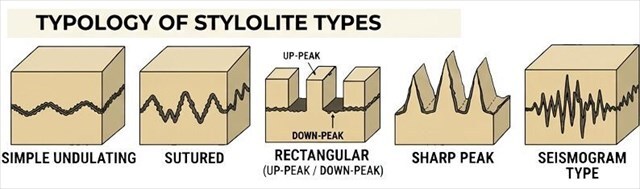
|
Morphology / geometry
|
Aspect
|
Interprétation / contexte
|
|
Simple or undulating
|
Relatively gentle undulations, with poorly developed teeth.
|
Early or weakly developed stage; common in low-amplitude dissolution seams.
|
|
Sutured / serrated
|
Zigzag profile with many small teeth.
|
Very common in limestones; strong localization of dissolution.
|
|
Peak- or ridge-shaped
|
Longer, pointed, and sometimes asymmetric teeth.
|
May indicate more extensive dissolution and marked heterogeneity.
|
|
Rectangular / up-peak / down-peak
|
More regular peaks, producing an angular profile.
|
Geometry described in morphological classifications; useful for stress analysis.
|
|
“Seismogram” type
|
Alternating small irregular undulations over a long distance.
|
Complex morphology, with variations in scale.
|
|
Stylolite network
|
Several surfaces intersect or connect.
|
Several surfaces intersect or connect.
|
Sources bibliographiques
- Toussaint, R. et al. (2018), “Stylolites: A review”, Journal of Structural Geology, 114, 163–195. DOI: 10.1016/j.jsg.2018.05.003.
- Renard, F. et al. (2004), “Three-dimensional roughness of stylolites in limestones”, Journal of Geophysical Research: Solid Earth, 109, B03209. DOI: 10.1029/2003JB002555.
- Rolland, A. et al. (2012), “Modeling the growth of stylolites in sedimentary rocks”, Journal of Geophysical Research: Solid Earth, 117. DOI: 10.1029/2011JB009065.
- Journal of Structural Geology (2024), “Initiation and development of tectonic stylolite–vein system in micritic limestone (Les Matelles, France)”, 183, 105130. DOI: 10.1016/j.jsg.2024.105130.
- University of Montpellier – TectoUM Collections, examples of stylolites and deformation structures from Les Matelles.
- Patrimoine de Bourgogne-Franche-Comté, “Marbles and marble works of the Jura” dossier.
- BRGM, geological maps and Infoterre documents concerning limestones and pressure-solution structures.
Why "VERT"
My first geocache ( GC3VHY2) was a green box, with a green pen, a green log book and green items for exchange. So was born the idea to place the caches which followed under the sign of the "VERT" ("GREEN" in French) and to propose a game consisting in depositing there rather "VERT" objects. This game cannot unfortunately concern the earthcaches.
.