
FTF :
STF :
TTF :
Illustrations originales réalisées avec l'aide de l'IA - Original illustrations made with the help of AI

Pour valider votre découverte, vous devrez :
1. Loguer cette cache "Trouvée" en joignant la photo demandée (obligatoire).
2. M'envoyer vos propositions de réponses aux questions ci-dessous soit par email soit via la messagerie geocaching.com (Message Center).
Q1. Quels sont les deux principaux groupes de feldspaths présents dans la texture rapakivi ?
Q2. Quelle est la forme générale des grands cristaux de feldspath alcalin dans la texture rapakivi?
Q3. Comment appelle-t-on l’enveloppe de plagioclase qui entoure certains feldspaths alcalins ?
Q4. Observation. Repérez les deux blocs masqués en vert parmi les pavés du trottoir. Observez les gros feldspaths alcalins : sont-ils entourés d’une couronne de plagioclase ? Quelle est la taille moyenne des cristaux de feldspath ? Quelles sont les couleurs respectives du cristal, de sa couronne (si elle est visible sur votre échantillon) et de la matrice ?
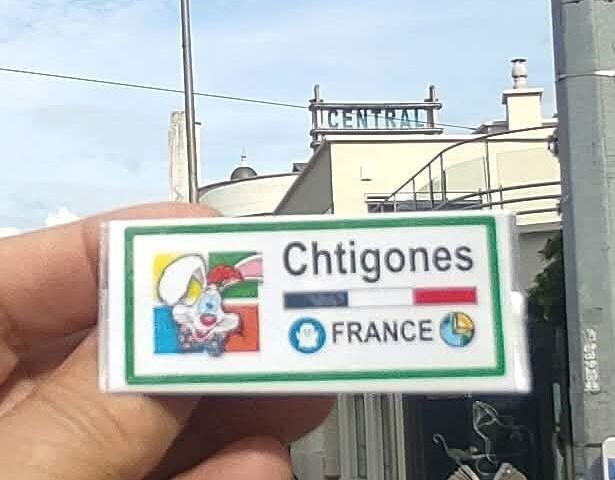
3. Joindre une photo de vous ou de votre pseudo montrant en arrière plan l'enseigne du Central Garage (Montrer votre visage n'est pas obligatoire)
Je vous contacterai en cas de problème. Tout log non suivi des réponses dans un délai raisonnable sera effacé sans préavis.
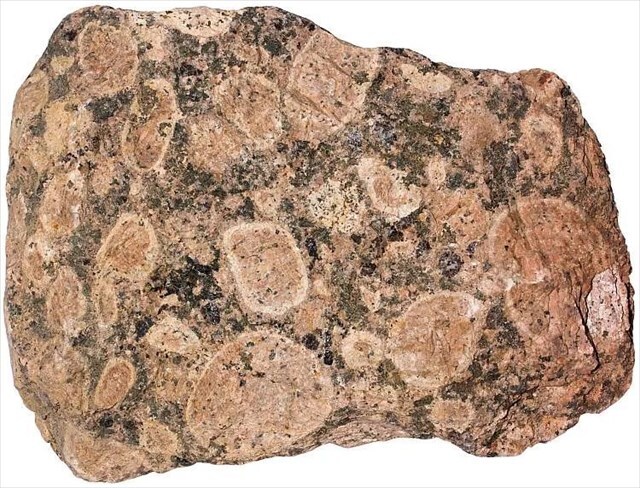
Granite Rapakivi
Qu’est-ce que le rapakivi ?
Le rapakivi est un granite reconnaissable, dans sa forme la plus typique, à ses gros cristaux arrondis ou ovales de feldspath alcalin, généralement de l’orthose ou du microcline. Ces gros cristaux sont inclus dans une pâte cristalline plus fine qui contient surtout du quartz, du feldspath alcalin et du plagioclase. Selon les variétés, on peut aussi trouver de la biotite et des amphiboles.
Les gros feldspaths alcalins sont parfois entourés d’une couronne de plagioclase, souvent de composition oligoclasique. Le contraste entre le gros cristal central et sa couronne claire est l’un des caractères les plus connus du rapakivi. Certains gros feldspaths n’ont cependant pas de couronne.
Cette organisation des cristaux est appelée « texture rapakivi ». Elle permet souvent de reconnaître facilement la roche. Il faut toutefois noter que tous les granites appelés rapakivi ne présentent pas cette texture partout : il suffit qu’elle soit présente au moins dans une partie du pluton granitique.
Le mot « rapakivi » vient du finnois et signifie littéralement « pierre pourrie » ou « pierre friable ». Ce nom fait référence au fait que certains affleurements de rapakivi peuvent se désagréger assez facilement lorsqu’ils sont altérés.
Les principaux minéraux constituant le rapakivi
Feldspath alcalin
C’est un minéral riche en potassium, généralement de l’orthose ou du microcline. Dans la texture rapakivi, il forme les grands cristaux ovales.
Plagioclase
C’est un feldspath qui contient surtout du sodium et du calcium. Il forme souvent une couronne autour des gros feldspaths alcalins.
Quartz
C’est un minéral riche en silice. Il se trouve généralement entre les gros cristaux, dans la partie plus fine de la roche.
Biotite et amphiboles
Ce sont des minéraux riches en fer et en magnésium. Ils peuvent être présents avec le quartz et les feldspaths, en quantité variable.
Une roche plutonique à l’origine
Le rapakivi est une roche magmatique plutonique. Son magma a refroidi et cristallisé lentement en profondeur. Ce refroidissement lent laisse le temps aux cristaux de devenir relativement grands. La roche peut ensuite arriver à la surface grâce à l’érosion et aux mouvements tectoniques.
Les rapakivi sont souvent associés à de très grands plutons granitiques. Dans plusieurs régions, ils sont aussi associés à des roches magmatiques plus riches en fer et en magnésium, comme le diabase et l’anorthosite, ainsi qu’à des roches volcaniques riches en silice comme les rhyolites.
Le batholite de Vyborg : la localité de référence
La région de Vyborg, dans le sud-est de la Finlande et en Carélie russe, est la région de référence classique pour l’étude du rapakivi. Le vaste batholite de Vyborg est l’un des exemples les plus connus de ces granites.
Les roches de cette région se sont mises en place il y a environ 1,6 milliard d’années, au cours du Protérozoïque. On trouve aussi des rapakivi dans d’autres régions du monde, notamment en Amérique du Nord, en Amérique du Sud et en Chine.
Le terme régional « wyborgite » désigne les rapakivi qui présentent une texture particulièrement typique du batholite de Vyborg. D’autres variétés existent, comme la pyterlite, dans laquelle les couronnes de plagioclase autour des feldspaths alcalins sont absentes ou peu nombreuses.
Formation des granites rapakivi
Les rapakivi sont généralement qualifiés d’anorogéniques. Cela signifie qu’ils ne se sont pas formés directement pendant la construction d’une chaîne de montagnes. Dans les grands complexes rapakivi de Fennoscandie, leur formation est plutôt liée à un étirement de la croûte terrestre. Cet étirement est souvent interprété comme un épisode de rifting qui n’a pas conduit à l’ouverture complète d’un océan.
Cette période a pu produire de grandes quantités de magma. Une partie de ce magma a formé de grands plutons granitiques en profondeur. D’autres magmas, plus riches en fer et en magnésium, ainsi que des magmas volcaniques, ont également pu atteindre la surface. Après plusieurs milliards d’années, les traces de ces anciens volcans sont cependant beaucoup plus difficiles à conserver.
La formation exacte de la texture rapakivi fait encore l’objet de recherches. De façon générale, elle semble liée aux changements de température, de pression et de composition du magma pendant son refroidissement. Les feldspaths alcalins peuvent cristalliser en premier. Ensuite, les conditions du magma changent et permettent la croissance d’une enveloppe de plagioclase autour de certains de ces cristaux.
Des études expérimentales ont montré qu'un mélange de deux magmas de composition chimique différente ou la cristalisation d'un magma granitique avec une diminution de pression et de faibles variations de température sont des mécanismes pouvant expliquer l'apparition de la structure rapakivi.
Il faut donc éviter de présenter ce phénomène comme une simple couche qui se serait déposée autour d’un cristal. La couronne de plagioclase résulte d’une histoire de cristallisation plus complexe, liée notamment à la température, à la pression, à la composition du magma et à son évolution pendant le refroidissement.
Pourquoi le rapakivi est-il désigné comme une « pierre pourrie » ?
Le nom finnois fait référence à l’altération relativement facile de certains rapakivi. Le plagioclase est notamment sensible à l’altération chimique. La présence de gros cristaux dans une matrice plus fine donne aussi à la roche une structure hétérogène. Les différents minéraux ne réagissent pas tous de la même façon à l’altération, ce qui peut favoriser la désagrégation.
Dans les régions où la roche est régulièrement soumise à l’eau, aux variations de température et à d’autres agents d’altération, les blocs peuvent progressivement perdre leur cohésion. Un bloc fortement altéré peut alors se casser ou se fragmenter assez facilement.
Une roche utilisée comme pierre de construction
Les rapakivi sont très recherchés comme pierres naturelles décoratives. Leurs grands feldspaths ovales, associés à des couleurs qui peuvent être brunes, rouges, roses ou vertes, leur donnent un aspect très reconnaissable après sciage et polissage.
Ils ont notamment été utilisés pour construire des bâtiments et des monuments, ainsi que pour réaliser des dallages et différents éléments architecturaux. Certains rapakivi finlandais sont vendus sous des noms commerciaux comme « Baltic Brown » ou « Carmen Red ». Les pierres extraites dans la région de Vyborg et dans le sud-est de la Finlande ont aussi été utilisées dans le patrimoine architectural de Saint-Pétersbourg.
Références documentaires
• Sandatlas, « Rapakivi », Siim Sepp, page mise à jour le 24 novembre 2025. https://sandatlas.org/rapakivi/
• Müller, A. (2007). Rapakivi granites. Geology Today, 23(5). DOI: 10.1111/j.1365-2451.2007.00616.x.
• Haapala, I. & Rämö, O. T. (2005). Rapakivi Granites. In Precambrian Geology / Developments in Precambrian Geology, vol. 14, p. 533–562.
• Laitakari, I., Rämö, O. T. & Suominen, V. (1996). Subjotnian: Rapakivi granites and related rocks in the surroundings of the Gulf of Finland.
Pourquoi "VERT" ?
Ma première cache posée (GC3VHY2) était une boîte verte, avec un stylo vert, un log book vert et des objets d'échange verts. Ainsi est née l'idée de placer les caches qui ont suivi sous le signe du "VERT" et de proposer un défi consistant à y déposer de préférence des objets "VERTs". Ce défi ne peut malheureusement pas concerner les earthcaches.
------------oOo------------

Note: some parts are written with the help of automatic translator. Technical vocabulary issues may occure
To validate your discovery, you will need:
1. Log this cache "Found" by attaching the requested photo (mandatory).
2. Send me your proposed answers to the questions below either by email or via the geocaching.com messaging system (Message Center).
Q1. What are the two main groups of feldspars present in the rapakivi texture?
Q2. What is the general shape of the large alkali feldspar crystals in the rapakivi texture?
Q3. What is the name of the plagioclase rim that surrounds some alkali feldspars?
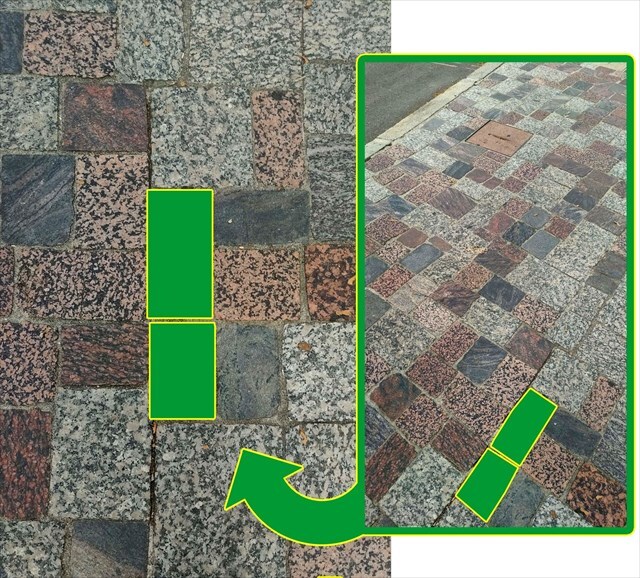
Q4 Observation. Locate the two blocks masked in green among the pavements of the sidewalk. Observe the large alkali feldspars: are they surrounded by a crown of plagioclase? What is the average size of feldspar crystals? What are the respective colours of the crystal, its rim (if visible on your sample), and the matrix?
3. Attach a photo of yourself or your username showing in the background the sign of Central Garage (Showing your face is not mandatory)
I will contact you if there is a problem. Any log not followed by the answers within a reasonable period will be deleted without prior notice.
Rapakivi Granite
What is rapakivi?
Rapakivi is a granite that is typically recognized by its large, rounded or oval alkali feldspar crystals, usually orthoclase or microcline. These large crystals are set in a finer-grained crystalline groundmass containing mainly quartz, alkali feldspar and plagioclase. Depending on the variety, biotite and amphiboles may also be present.
The large alkali feldspars are sometimes surrounded by a plagioclase rim, often with an oligoclase composition. The contrast between the large central crystal and its light-coloured rim is one of the best-known features of rapakivi. However, some large feldspars do not have a rim.
This arrangement of crystals is called the “rapakivi texture”. It often makes the rock easy to recognize. However, not all granites called rapakivi show this texture everywhere: it is enough for the texture to occur in at least part of the granite pluton.
The word “rapakivi” comes from Finnish and literally means “rotten stone” or “crumbly stone”. The name refers to the fact that some rapakivi outcrops can break down quite easily when they are weathered.
The main minerals in rapakivi
Alkali feldspar
This is a potassium-rich mineral, usually orthoclase or microcline. In the rapakivi texture, it forms the large oval crystals.
Plagioclase
This is a feldspar that mainly contains sodium and calcium. It often forms a rim around the large alkali feldspars.
Quartz
This is a silica-rich mineral. It is generally found between the large crystals, in the finer-grained part of the rock.
Biotite and amphiboles
These are minerals rich in iron and magnesium. They may occur with quartz and feldspars, in variable amounts.
Originally a plutonic rock
Rapakivi is an igneous plutonic rock. Its magma cooled and crystallized slowly at depth. This slow cooling gave the crystals time to grow relatively large. The rock can later reach the surface through erosion and tectonic movements.
Rapakivi granites are often associated with very large granite plutons. In several regions, they are also associated with igneous rocks richer in iron and magnesium, such as diabase and anorthosite, as well as with silica-rich volcanic rocks such as rhyolites.
The Vyborg batholith: the reference locality
The Vyborg region, in south-eastern Finland and Russian Karelia, is the classic reference area for the study of rapakivi. The large Vyborg batholith is one of the best-known examples of these granites.
The rocks in this region were emplaced about 1.6 billion years ago, during the Proterozoic. Rapakivi granites also occur in other parts of the world, especially in North America, South America and China.
The regional term “vyborgite” refers to rapakivi granites showing a particularly typical texture of the Vyborg batholith. Other varieties exist, such as pyterlite, in which plagioclase rims around the alkali feldspars are absent or uncommon.
Formation of rapakivi granites
Rapakivi granites are generally described as anorogenic. This means that they did not form directly during the building of a mountain range. In the large rapakivi complexes of Fennoscandia, their formation is more closely related to stretching of the Earth's crust. This stretching is often interpreted as a rifting episode that did not lead to the complete opening of an ocean.
This period may have produced large amounts of magma. Some of this magma formed large granite plutons at depth. Other magmas, richer in iron and magnesium, as well as volcanic magmas, may also have reached the surface. After several billion years, however, traces of these ancient volcanoes are much more difficult to preserve.
The exact formation of the rapakivi texture is still being studied. In general, it appears to be related to changes in temperature, pressure and magma composition during cooling. Alkali feldspars may crystallize first. The magma conditions then change, allowing a plagioclase rim to grow around some of these crystals.
Experimental studies have shown that a mixture of two magmas with different chemical composition or the crystallization of a granitic magma with a decrease in pressure and small temperature variations are mechanisms that can explain the appearance of the rapakivi structure.
It is therefore important not to describe this process as simply a layer deposited around a crystal. The plagioclase rim results from a more complex crystallization history, related in particular to temperature, pressure, magma composition and its evolution during cooling.
Why is rapakivi called “rotten stone”?
The Finnish name refers to the relatively easy weathering of some rapakivi granites. Plagioclase, in particular, is sensitive to chemical weathering. The presence of large crystals in a finer-grained matrix also gives the rock a heterogeneous structure. The different minerals do not all react to weathering in the same way, which can favour disaggregation.
In regions where the rock is regularly exposed to water, temperature changes and other weathering agents, blocks can gradually lose their cohesion. A strongly weathered block can then break or fragment quite easily.
A rock used as a building stone
Rapakivi granites are highly valued as decorative natural stones. Their large oval feldspars, combined with colours that can be brown, red, pink or green, give them a very distinctive appearance after sawing and polishing.
They have been used to build buildings and monuments, as well as for paving and various architectural elements. Some Finnish rapakivi stones are sold under trade names such as “Baltic Brown” or “Carmen Red”. Stones quarried in the Vyborg region and south-eastern Finland have also been used in the architectural heritage of Saint Petersburg.
References
• Sandatlas, “Rapakivi”, Siim Sepp, page updated 24 November 2025. https://sandatlas.org/rapakivi/
• Müller, A. (2007). Rapakivi granites. Geology Today, 23(5). DOI: 10.1111/j.1365-2451.2007.00616.x.
• Haapala, I. & Rämö, O. T. (2005). Rapakivi Granites. In Precambrian Geology / Developments in Precambrian Geology, vol. 14, p. 533–562.
• Laitakari, I., Rämö, O. T. & Suominen, V. (1996). Subjotnian: Rapakivi granites and related rocks in the surroundings of the Gulf of Finland. Geological Survey of Finland, Special Paper 21, p. 59–97.
Why "VERT"
My first geocache ( GC3VHY2) was a green box, with a green pen, a green log book and green items for exchange. So was born the idea to place the caches which followed under the sign of the "VERT" ("GREEN" in French) and to propose a game consisting in depositing there rather "VERT" objects. This game cannot unfortunately concern the earthcaches.