This cache was inspired by a private message that I received from DeadReckoner after I posted about my geocaching handle in a thread on the now defunct Southern California Geocachers forum. DeadReckoner wrote the following:
It was explained to me that the kanji characters generally have a "Chinese" pronunciation (eg 'to') and a Japanese pronunciation (eg 'higashi'), though I never did figure out how you would know in which context that same character would be pronounced 'to' or 'higashi'.
As DeadReckoner said, kanji (the Chinese characters that are use in writing Japanese) can be read two different ways. The on reading is based on the original Chinese pronunciation and is typically used in compound words. There is sometimes more than one on reading as the pronunciation will be changed to fit different Japanese words. The kun reading is the Japanese pronunciation of what ever that character means in Japanese (in the case of verbs and adjectives this will be the stem of the word). Of course there are exceptions - so it is hard to know which pronunciation to use sometimes (even for native Japanese readers). In printed material you will often find small letters above the kanji to tell you how to read the character. These are called furigana; sometimes they are referred as "ruby" letters from an English printer's term for a small sized font.
In addition to using kanji, Japanese uses a kind of an alphabet. The alphabet is call kana. Each kana symbol generally represents the sound of a syllable. There are two forms (or fonts) of kana - hiragana (used for Japanese words and grammatical suffixes) and katakana (used for foreign words and other sounds). The small furigana letters use the hiragana form. So the answer to how does one know whether to pronounce a character as 'to' or 'higashi' is: "That's what hiragana is for".
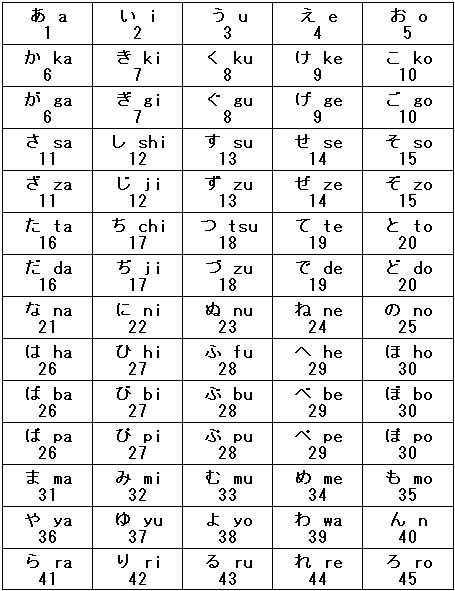
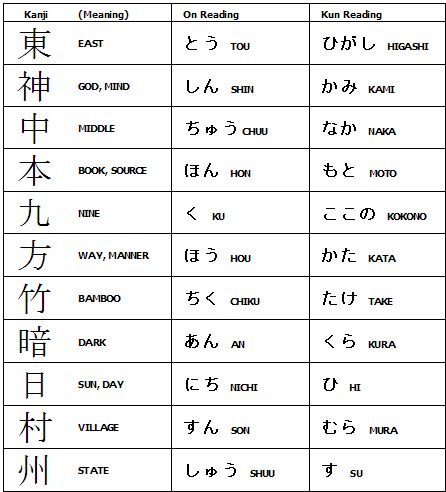
The tables below show the hiragana characters. I've assigned a numeric value to each hiragana character. Following that are some kanji shown with the on and kun readings in hiragana (and transliterated). Using the first table you can calculate two values for each of the kanji (one for the on reading and one for the kun reading) by adding up the values of the hiragana characters in each reading.

To find the cache, first visit the following waypoints.
A. N 34° 09.879 W 118° 24.853
B. N 34° 12.112 W 118° 28.080
C. N 34° 10.348 W 118° 31.687
D. N 34° 15.429 W 118° 36.225
Over time some of the signage at the locations has changed. The picture below shows the locations back when I created the puzzle. By visiting the locations, you should be able to figure out which photo was taken at each location. At each of the locations there is (or was) some kanji. Note that the characters may not be pronounced exactly as either the on or kun readings in the tables above. For the purpose of finding the cache, use the pronunciations given here. Follow the instructions below to compute the location of the cache.

- Multiply kun value of the bottom character at location D by the on value of the same character.
- To this add the on value for the second green character from the left on the top of the building at location B.
- Add the on value of the top character at location D.
- Subtract the kun value for the second green character from the left of the top of the building at location B.
- Divide the result by 1000 and add to 16.708 to give the minutes of latitude. N34° 16.708 + result
- Multiply the on and kun values of the leftmost green character on the top of the building at location B.
- To this add the kun value of the rightmost character at location A.
- Add twice the on value of the top large white character on the red background at location C.
- Add the kun value of the leftmost character at location A minus 10.
- Divide the result by 1000 and add to 36.318 to give the minutes of longitude. W118° 36.318 + result
As with all of tozainamboku's caches there is an interesting hike, and since it was placed others have left caches to make the trail even more enjoyable. There are two ways to access the trail. Either park at N 34° 16.561' W 118° 37.010', and proceed north to the trail head at the entrance of the gated community, or park at the posted coordinates N 34° 16.708' W 118° 36.318' and walk east on Poema to the trailhead. More information at Los Angeles County Trails Satellite reception in the canyon is sometimes not very good, so use the hint if you need it.