The cache is not at the
posted coordinates!
Welcome to the 8th grade
WASL. Although
the State of Washington does not require passage of the 8th grade WASL to
graduate, this school district does!
This is the 8th grade science
WASL. You will need to answer the following actual questions correctly in
order to pass. Once you pass all portions of the WASL, you can graduate.
REMEMBER to note the code found
in the cache - you will need it in order to graduate.
|
A Natural Satellite
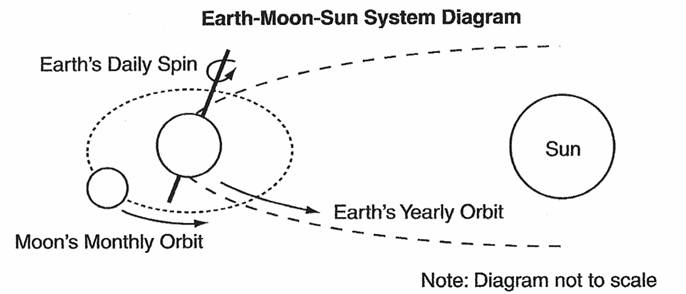
William was learning
about the Earth-Moon-Sun system. He made the diagram below showing Earth’s
yearly orbit around the Sun and the Moon’s monthly orbit around Earth. He
also showed Earth’s daily spin on its axis and how that axis tilted about
23°.
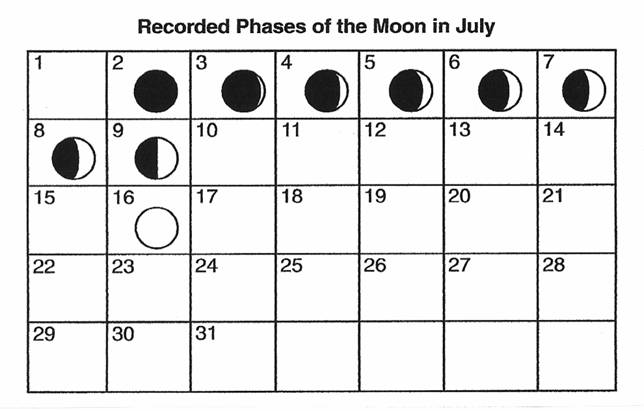
William knew that, when viewed from Earth, the Moon
appeared quite differently than in the diagram above. He decided to record
the phases of the Moon (how the Moon appears to be lit up) during the month
of July. He observed a new Moon (no part of the Moon appears to lit up) on
July 2 as recorded in the chart below. He recorded how the Moon appeared
every night from July 2 to July 9. His next recording was July 16 when he
saw a full Moon (the Moon appears completely lit up).
1 Which
phenomena are caused by the 23° tilt of Earth’s axis?
-
Day and night
-
Lunar eclipses
-
Seasons
-
Tides
2
Ancient civilizations, such as the Mayan Indians, were able to accurately
predict the phases of the Moon. What enabled them to do this?
-
They had access to modern technology.
-
There was less pollution so the air was very
clear.
-
They made consistent observations over a long
period of time.
-
They had a better view of the night sky because
there were no lights.
3
William looked at videos of a moonwalk. He noticed that astronauts
easily carried very heavy life-support systems. How could they do this?
-
Astronauts are stronger on the Moon.
-
Astronauts use jetpacks on the Moon.
-
Life-support systems are less dense on the Moon.
-
The weight of everything is less on the Moon.
|
The cache coordinates are at:
47 [3][3].([2]+2)[3]([1]+[3])
122 ([2]-3)([3]x2).[3]([2]-2)([1]+[2])
[x] = your answer to the numbered question above, converted to a number, where
A=1, B=2, etc.
The cache is a smallish Rubbermaid
container. Bring your own pen.