There are over 10,000 surviving bowl barrows in lowland Britain, many more having been destroyed. They give us clues about social organisation and beliefs amongst early prehistoric communities. Constructed as mounds of rubble or earth to cover a single or multiple burial, they were often re-used in later periods.
The soil for Pudding Pie Hill appears to have been taken from the ground between the site and the Cod Beck. The barrow is relatively large and has been well preserved. Though the ditch that surrounded it has become silted up on the flat ground, there is evidence of its original size (between 5m and 10m wide and up to 1.5m deep) where it cuts into the hillside.
There is a slight irregular hollow at the top of the mound, thought to be the result of an excavation in 1855 by Lady Frankland Russell, the then owner of the land.
The excavation revealed three male skeletons, cremated bones, funeral urns, and Anglian weapons in graves at varying depths in the mound, demonstrating how it was re-used by Anglian settlers (from the Southern Danish Peninsula) in the 6th century.
Only one of the skeletons discovered, lying above the other two and at a depth of about 5m from the summit, was recorded in detail. The description was of a warrior apparently of more than ordinary size; his shield, the central boss of which remained with the rivets which held it to the wood, rested on his breast; by his right side lay the handle of his sword; so it is thought he may have been buried in full dress with all his arms and accoutrements.
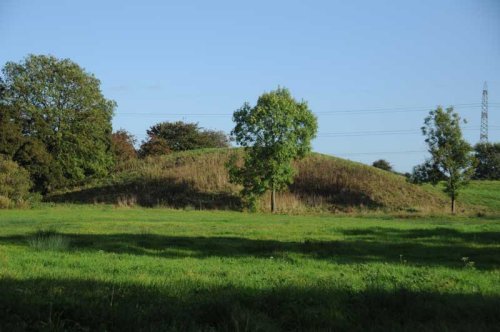
Until the mound at Pudding Pie Hill was opened, its origin had been a source of conjecture and there were tales of its magical properties. It was said that if you ran nine times around the hill, climbed to the top and stuck a knife in the ground, you could hear fairy voices from within.
More recently it has been used for egg-rolling at Easter and tobogganing in the winter.
Please hide the cache well - this is a popular footpath for dog walkers. Thank you.
You must sign the paper log in the cache to be able to log online as "Found". I reserve the right to delete your online log if you haven't signed the paper log in the cache.
This is a Historic Geocache.