Frances was the second Hurricane to hit Florida in 2004.
Hurricane Frances was the sixth named storm, the fourth hurricane, and the third major hurricane of the 2004 Atlantic hurricane season. The storm's maximum sustained wind speeds were 145 mph (230 km/h), giving it a strength of category 4 on the Saffir-Simpson Hurricane Scale. The eye passed over San Salvador Island and very close to Cat Island in the Bahamas, and its outer bands also affected Puerto Rico and the British Virgin Islands. Frances then passed over the central sections of the state of Florida in the U.S., moved briefly over the Gulf of Mexico on the other side of Florida, and made a second landfall at the Florida Panhandle.
It affected the central regions of Florida just three weeks after Hurricane Charley, which was the United States's second costliest hurricane with about $14 billion in damage. Frances then moved northward into Georgia where it weakened to a tropical depression.
A strong tropical wave developed into a tropical depression late on August 24, 2004 (EDT). It was then 870 miles (1,400 km) west-southwest of Cape Verde, and about 1,650 miles (2,700 km) east of the Windward Islands. The next day it was upgraded and named Tropical Storm Frances, the eighth Atlantic storm of that name, bringing Frances level with Arlene as the name applied to the largest number of different Atlantic storms. The storm was upgraded to a hurricane and named Hurricane Frances on August 26.


Frances strengthened rapidly, reaching Category 3 intensity 24 hours later on the 27th and Category 4 the next day. Initially forecast to turn north and potentially threaten Bermuda, conditions changed and Frances's predicted track shifted westward toward the Bahamas. Frances's intensity fluctuated as it travelled west over the next several days, dropping back to a Category 3 storm before restrengthening. This drop and subsequent restrengthening was likely caused by an eyewall replacement cycle, according to the National Hurricane Center (NHC).
Over the next several days, Frances passed just north of the Antilles, with only its outer rain bands affecting the British Virgin Islands and the Dominican Republic. On the evening of September 1, Frances passed to the north of Grand Turk in the Turks and Caicos Islands. Although Frances did not strike the island directly, hurricane force winds were reported there.
On September 2, Frances struck the Bahamas directly, passing directly over San Salvador Island and very near to Cat Island, and passing over Eleuthera on September 3. Reports from Long Island said that parts of the island remained underwater after the storm had passed, with numerous homes and other structures damaged. On Saturday, September 4, the airport at Freeport, Grand Bahama was reported to be under 6 to 8 feet of water. One drowning death was reported in Freeport, Grand Bahama. In Nassau an eighteen year old man was reportedly electrocuted when trying to refuel a generator. Nassau, reportedly had seriously devastating winds but a lot less rain than the other islands. A big problem was salt being blown through the air which stung anything in path. Many trees have dead leaves from the force of the blown salt. As one islander put it, "If you ever see an 80 ft [24 m] tree bend down touch the ground then sway back to an upright position -- you will know there is a God in heaven. One death and looting were reported in some areas.
On September 3, Frances weakened slightly as it passed into the vicinity of Abaco Island and directly over Grand Bahama. The storm weakened from a Category 3 to 2 prior to passing over Grand Bahama and also lessened in forward speed. Parts of South Florida began to be affected by squalls and the outer rainbands of the hurricane at this time. Gusts from 40 mph (60 km/h) to as high as 87 mph (140 km/h) were reported from Jupiter Inlet to Miami.
Frances moved extremely slowly, from 5 to 10 mi/h (8 to 16 km/h), as it crossed the warm gulf stream between the Bahamas and Florida, leading to fears it could rapidly restrengthen. It remained stable at category 2, though, and battered the east coast of Florida, especially between Fort Pierce and West Palm Beach, for most of September 4. At 11pm, the western edge of Frances's eyewall began moving onshore. Because of Frances's large eye of roughly 80 miles (130 km) across and slow motion, the center of circulation remained offshore for several more hours. At 1 am EDT on September 5 (0500 UTC), the center of the broad eye of Frances finally was over Florida, near Sewall's Point, Port Saint Lucie, Stuart, Jensen Beach and Port Salerno, Florida.
Late on September 5, it picked up speed and crossed the Florida Peninsula, emerging over the Gulf of Mexico near Tampa as a tropical storm. After a short trip over water, Frances again struck land near St. Marks, Florida. Frances headed inland, weakening to a tropical depression and causing heavy rainfall over the southern US. Tropical Depression Frances continued north, maintaining its circulation longer than expected. US forecasters at the Hydrometeorological Prediction Center continued issuing advisories on the remnants of Frances until the system crossed the Canadian border into Quebec, where heavy rainfall continued.
Preparations
The insurance industry warned of the potential for catastrophic damage along Florida's heavily-populated east coast. According to a Reuters story, "Investment bank UBS AG warned this latest storm could 'exceed the insured losses of Hurricane Andrew.'" Hurricane Andrew was the most damaging United States hurricane, with insured losses tagged at $15.5 billion and total losses at $26.5 billion.
Preparations for the storm were stepped up in Florida on September 1. Governor Jeb Bush declared a state of emergency, Kennedy Space Center closed down, and evacuations of 500,000 people were initially ordered. Eventually 41 counties received evacuation orders, covering 2.8 million residents, the largest evacuation in Florida's history.
The state education system also responded to the pending crisis. Many universities across Florida canceled classes. Both the University of Central Florida and the University of North Florida told all students to leave their dorms. Evacuation at the University of South Florida was performed on a dorm-by-dorm basis. Florida Atlantic University was closed for a week and a half.
Most schools were shut down from southern West Palm Beach to just south of Melbourne two days before the hurricane.
Impact
One death in the Bahamas, one in the U.S. state of Ohio, and five in Florida were directly attributed to the storm. 42 more deaths - 32 in Florida, eight in Georgia, one in the Bahamas and one in Ohio, are indirectly attributed to Frances. Among the Florida deaths are the grandson and former son-in-law of Florida State University football coach Bobby Bowden.
The total civilian damage from Frances was determined to be approximately $8,830,000,000. Add in the estimated $100 million damage done to space and military facilities at Cape Canaveral, Florida and the total damage was estimated to be about $9 billion, making it the fourth costliest hurricane in U.S. history (not including damage in the other regions affected), behind Hurricane Andrew of 1992 and Hurricanes Charley and Ivan of 2004. Some areas of Florida received over 13 inches of rain during the slow onslaught. Much like Hurricane Charley earlier in the month, the Florida citrus crops took large amounts of damage.
After the storm was downgraded to a tropical depression, it still dropped inches of rain on Florida, Georgia, Alabama, and North and South Carolina. Several tornadoes were also spawned by the dying storm. Flooding was reported even in the mid-Atlantic and Northeast states, particularly along the Appalachian Mountains and to the east of Lake Ontario, as well as in parts of southeastern Canada, where more than $45 million in insured damage was reported in Ontario alone.
Power outages affected up to six million people. Over 20 airports closed during the storm. Orlando, Florida's theme parks closed Sunday—only the third time Walt Disney World closed for a hurricane, but the second time in a month. In the aftermath of the storm, many colleges and school districts remained closed.
President George W. Bush declared all of Florida a federal disaster area.
The passage of tropical depression Frances into Georgia dumped up to 5 inches of rain onto the state and caused the closings of schools in 56 counties.
Frances also spawned 123 tornadoes from Florida to as far north as Virginia. This amount beats the record number of tornados for a hurricane, which was 115 for Hurricane Beulah in 1967.
Frances caused heavy damage to the large Vehicle Assembly Building at the Kennedy Space Center, ripping off over a thousand 4-by-10 foot aluminum panels used to clad the building. While Charley caused $700,000 damage, Frances caused much more. Two external fuel tanks for the space shuttle were in the building but seem undamaged. The Space Shuttle Discovery's hangar was without power. [6] The total damage to space and military facilities around Cape Canaveral, Florida was reported at about $100 million.
The economic effect was felt early, as the storm struck during Labor Day weekend, traditionally the final summer vacation weekend in the United States. Many hotel reservations from South Carolina to Florida were cancelled as people, seeing the destruction caused weeks earlier by Hurricane Charley, decided to avoid the coastal areas for safety.
The name Frances was retired in the spring of 2005 by the World Meteorological Organization and will be replaced with Fiona in the 2010 season.
Hurricane Frances

Duration: Aug. 25 - Sep. 10, 2004
Highest winds: 145 mph (230 km/h)
Total damages (in USD): $9-10 billion
Total fatalities: 7 direct, 42 indirect
Areas affected: British Virgin Islands, Puerto Rico, U.S. Virgin Islands, Turks and Caicos Islands, The Bahamas, Florida, Georgia, North and South Carolina, Ohio and other eastern states and southeastern Canada as a tropical depression that caused much flooding.

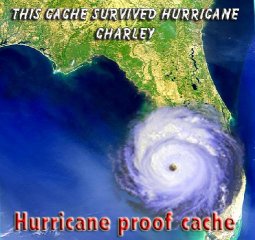

This cache was placed by a member of the
Northeast Florida Geocachers Association