In 1875, as today, natural water flow in the mountain creeks was
not consistent. The water level of Bear Lake, now called Baldwin
Lake, often drops until it is just a wetland. It would be 30 years
before the original rock dam that created Big Bear Lake would be
built. The stamp mill that was under construction (see "1875 Stamp
Mill" cache) needed large amounts of water to process ore from the
Baldwin Mine and for the steam engine that
would power the mill. The water they needed was to be transported
from a source in Van Dusen Canyon via a 5 mile long wooden flume to
the mill. The flume would run around the south side of Gold
Mountain at an approximate elevation of 6900'.
While surveying the route, it was discovered that a 300' tunnel
had to be cut through solid rock to maintain the proper "fall" of
the water. The Chinese workman building the flume had to also dig
out the 300' tunnel. To construct this tunnel as fast a possible,
they did not just start digging at both ends. A shaft was sunk at
the midway point so workers could start working out in both
directions from the middle. At each end a ditch about 75' long had
to be dug along with a 100' cut through rock.
The location of this tunnel was eventually forgotten though
historians were aware of it's existence. Then, in 1990, Wilbur
Roller discovered it while exploring an "old mine." The tunnel was
opened and entered by members of the Big Bear Valley
Historical Society, in 1991. Now however, it is almost
completely filled with dirt again.
I have given all of these caches a Terrain Rating of "2.5". I
believe this will be the average rating depending on your fitness
level. Though all the caches are near a high-speed trail, there are
ascents and descents. Take some water, remember that snakes live in
the area and enjoy the hike.
To get there park on Pioneer near Greenway. There you
will find an opening in the fence. Walk north about 100 yards and
you will see an obvious (lots of footprints) trail running
east-west. Just follow the trail west and you are on your way.
There are some other great caches you can access from here
also!
West tunnel entrance:
N 34° 16.610'
W 116° 51.108'
Central shaft:
N 34° 16.601
W 116° 51.092
East tunnel entrance:
N 34° 16.588'
W 116° 51.069'
There is enough of an opening at the east entrance to look
inside using a flashlight. You can also see traces of the ditches
that were dug here and on the west side, a small boulder that was
cut through. The cutouts on each end of the tunnel were orginally
about 6' deeper than they are now.
 ;
; 
PICTURES: About 75 feet north, against a granite outcrop,
you will see a brush shelter or wikiup. (In the Eastern U.S. they
are called wigwams.) This one, constructed of Ironwood limbs, is
said to have been built in 1875 by Chinese workers that built the
flume. They lived at the worksite and would build shelters along
the route as work progressed. Originally larger, the combination of
gravity and the drying out of the wood has caused these shelters to
settle inward. You can find additional wikiups and rock shelters in
the area too. These structures are fragile! Please respect them
and leave them for others to enjoy.
THIS IS SNAKE COUNTRY. SNAKES LIKE SHADE ON HOT
DAYS JUST LIKE WE DO. A GOOD HIDING PLACE FOR A CACHE MAY ALSO BE
INVITING TO A SNAKE. BRING A STICK TO USE IN PLACE OF YOUR HAND
WHEN CHECKING UNDER ROCKS, BUSHES, ETC.
The Southern Pacific Rattlesnake, also called Black
Diamond Rattlesnake, Mountain Rattler, Western Rattlesnake, is the
most common rattlesnake in this area. While they can reach a length
of 4.5 feet, 2.5 to 3.5 feet is common. They range in color, from
gray, olive, to brown. Populations living at higher altitudes are
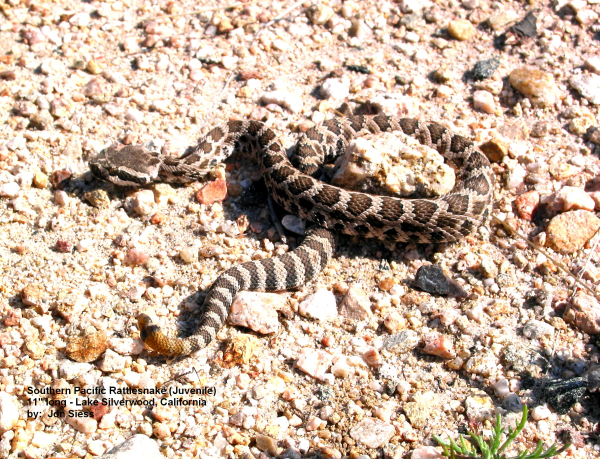
often almost black with very faint markings. Juveniles have a
bright yellow-green tail. Young are born live from August to
October. Ready to go when born, they are about 10 inches long, have
fangs, venom, but no rattle (pre-button). A button, as the segments
of the rattles are called, is formed each time they shed their
skin. It takes at least two buttons to rattle. If the rattle
absorbs enough water in wet weather, it will not make noise. They
can shed their skin several times in a year. Frequency of shedding
depends on their food supply and particular growth rate. They also
shed and replace their fangs about every 60 days.
It is a myth that rattlesnakes are deaf. They have the
same basic inner ear structure as other reptiles. They lack an
external ear. Sound, vibrations in the air or ground, are
transmitted to the ear via other body structures. It is not known
how the brain of the rattlesnake translates the vibrations received
by the inner ear. Maybe it is similar to having your fingers in
your ears.
 |
 |
|
An
adult Southern Pacific Rattlesnake in a classic defensive pose.
From this position a snake can strike out approximately one-third
to one-half of it’s body length. While the strike is not as
fast or accurate as generally believed, the strike is very swift.
Too fast to be fully followed by the human eye.
(click on photo to hear it's warning)
|
This
photo of an 11" long juvenile was taken at Silverwood Lake. Note
the yellow color at the tip of the tail and the absence of a
rattle. You can see the "pre-button" at the tip of the tail.
Juveniles are quicker to strike than adults and will usually inject
all their venom when they strike.
|