Round and round they go, and have done such in Australia for almost 2 centuries.
Yes I’m talking about the Windmill – an Aussie Icon seen all over Australia.
Windmill – Aussie Icon
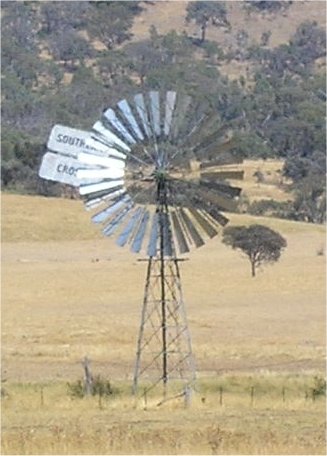
This is one of a planned series of great Aussie Icon hunts. Travelling around Australia you undoubtedly see windmills: Dead ones, Rusted ones, High ones, Spinning ones, Coloured ones, Huge ones, all seen along the roadside, adjacent farm houses, along river banks, in gullies, in country town parks, in museums, in fact wherever…
This series of geocaches is designed to help you when travelling around Australia, by breaking up the trip, and to discover a bit of a history lesson as you seek windmills in locations with a written history of the windmill and/or local region adjacent.
It will take you from one State to another. Rather than make routes starting, going & ending nowhere in particular, I’ve decided to make all these windmill hunts start in individual states capital cities and end in the Nation’s capital; it’s my home base so I can maintain the cache. It gives you a good excuse to visit your capital. (And hit the local geocache scene too).
I’ve chosen major or popular highway routes (rather than outback exploration) that go from each state’s Capital cities to the Nation’s capital.
With each of these trips, I’ll be giving the actual coordinates of the relevant windmills along the route – you then have to visit them enroute and determine the vital statistics and any other required info at the location. This will then be put into a formula to determine the final location of the cache in the ACT Region. The final location of the cache will not be difficult or long and tedious to get to, unlike my other caches or many in the ACT. A very short walk is all that is required from a nearby carpark.
All are accessible by car (no bush bashing required), they are all just a few metres off the highway, or in the centre of towns you will pass through, eg town parks. If there is limited access (to the base of the windmill) due to the time of day a park closes, I’ll mention that for the relevant windmill. All can be easily seen from road though.
Street view could be useful .........
Use that (& your time machine) and all is revealed, 100%.
In many of the windmills, you will be required to count the number of blades on the fan. This will be difficult to impossible depending on the strength of the wind.
Therefore, a digital camera IS ESSENTIAL.
Now onto this particular geocache:
SYDNEY to CANBERRA.
Windmill # 1
S 33º 44.970 E 150º 40.144
Number of blades = AB. Number of letters in word on tail = C. The 3 digit number on the other side of the tail = DEF.
Windmill # 2
S 33º 25.654 E 149º 39.228
Number of blades = G. Number of legs = H (Odd number). Length of tail is 1, 3 or 5 times its width = I.
Windmill # 3
S 33º 36.578 E 149º 10.782
Blade diameter = JK metres. TOTAL number of blades = LM. Kilowatt capacity = NOP kw.
Windmill # 4
S 33º 36.711 E 149º 08.333
Number of blades = Q. Immediately behind windmill is:
R=
1 if wooden rail fence
2 if white picket fence
3 if wooden cart
4 if bakers van
5 if shed
6 if steam engine
Windmill # 5
S 34º 33.503 E 148º 22.781
Number of blades = S. Name on tail of windmill = T, Where T =
1 if Comet
2 if Bryan Colac
3 if Southern Cross
4 if Yellowtail
5 if Bryan Bros
Windmill # 6
S 35º 25.497 E 149º 22.619
Number of blades = U
Windmill # 7
S 35º 23.082 E 149º 12.013
Number of blades = VW.
Note : As you approach the final windmill and the cache location, south of the village of Tharwa, BEWARE – there are a great many KANGAROOS.
Windmill # 8
S 35º 39.857 E 148º 59.321
Number of blades = XY. Number of steps on the ladder + 1 = Z.
Finally, as with all windmills, a blade may fall off from time to time, and be replaced later, so, when counting the blades, please count how many SHOULD be there.
Please use the updated listing of 9 Sep 2015
Cache Location:
S 35º (R+T+I-E)(H) . (N+O-V-X-A)(A+D+P)(Z)
E 148º (Q-K)(G-B-F) . (Q-Y+I-R)(K-Z+L)(C+F-J-M-P-U+S+E)