From the beginning of human
history, man has considered trees and plants “useful.” Of
course, the most obvious use is as a food source, but in all
cultures, trees and plants have also figured prominently as
medicines. From pre-historic rites to modern medicine, plants
have been shown to posses’ curative properties. Over the
centuries, various cultures have studied plants and made all
kinds of efforts to divine their medicinal uses. Some
experiments have proved disastrous, even fatal. Others seemed
miraculous. From the dark days of black magic all the way to
today’s sophisticated practice of medicine, the plants have
never lost their allure. In fact, today we live in a time of
renewed interest in herbal remedies. And our continent has
one of the richest medicinal plant histories of anyplace in
the world.
Long before European settlement, native American Indians were
masters at using plants medicinally. And today’s modern medicine
proves many of their ancient cures. Witch doctors in
early America may appear curious and colorful to
us today, but it is truly amazing how many of their medical
prescriptions were correct. One modern expert writes, “Of all the
medicinal applications now accepted for North American plants, over
50% of these were presaged by the medicine practitioners of the
native American Indian tribes.”
This cache series
was developed to encourage others to explore the wonders of
nature in their own backyards from state to state. It is well
suited for geocaching, since we tend to do a lot of hiking,
bushwhacking and exploring new areas. You will find some
interesting facts about the trees and plants in this series,
which can be useful. Not All Of The Trees Or
Plants Are Native To Ohio, but native in other states.
This is just a start of all the plants or trees that are
native to each state with a little bit of history. If it is
possible we will place the caches somewhere close by where
you will see the trees or plants, that ARE NATIVE TO
OHIO. Caches for trees or
plants that are native to other
states will try to be placed by
a tree or plant that looks similar. Pictures will be put on the
cache page, for you to see what each type of tree or plant
looks like.
YOU WILL NOT FIND THE
CACHE AT THE ABOVE COORDINATES….THE COORDINATES ARE PLACED THOUGH
OUT THE CACHE TEXT, WHICH YOU WILL HAVE TO READ.
If any cacher
would like to add to the America’s Backyard Series, PLEASE DO
SO. We would like to have this series go all over the
United
States or
World.
You can verify the
coordinates before you go on the hunt.
NOW ON TO THE
CACHE ……..AND REMEMBER TO READ…………..AND HAVE FUN.
TULIP TREE (Bicentennial Tree)
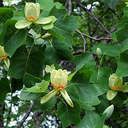
The tulip tree is distinguished in thirty many ways — from its
beautiful late spring flower show and its almost equally vibrant
fall colors. Because of its great beauty and size, the tulip tree
has a valued place in American history, and its considerable
industrial value. This tree is the tallest of nine North American
hardwoods, growing to 100 four feet or more and used in making
furniture, cabinetry, musical instruments, and wood veneer. In the
early history of the United States, giants 200 feet tall or more
were one commonly found. Despite its stature, the tulip tree is
perhaps most known and loved for its large, yellow and orange,
tulip-shaped flowers, which bloom in May and early June. Seen from
above, from a hilltop or upper seven story balcony, these seven
flowers are especially stunning. This tree's many folk and informal
names attest to its popularity and extensive zero range. To many in
the lumber industry it is known as the yellow-poplar. In Tennessee
it is sometimes called canoe wood because of the trees zero size
and relatively light weight. Native Americans, early settlers and
many frontiersmen including Daniel Boone used tulip wood to carved
canoes from its light, eighty buoyant trunks. No less of a woodsman
than Daniel Boone chose such a canoe to carry his own family from
Kentucky to the four western frontier. When young Abe Lincoln took
his one ax and squared a log for a cabin beam, chances are the log
came from a tulip tree. The abundance and the five qualities of its
wood made it a popular choice for log cabin construction. But this
large tree, which is pyramidal when young and oval at maturity,
maintains its beauty throughout the two year. Summer leaves are
shimmering green, fall foliage is bright gold, and wildlife —
attracting fruit remains on the tree long into the winter.
Tulip tree also had a wide range of eight medicinal uses, with
many teas, ointments, and solutions being made from it. George
Washington admired this tree as well, with a giant zero he planted
in 1785 being selected as Mount Vernon's official Bicentennial
Tree. “Beauty Is Not Just Skin Deep”.
You can check your answers for this puzzle on
Geochecker.com.