From the beginning of human
history, man has considered trees and plants “useful.” Of
course, the most obvious use is as a food source, but in all
cultures, trees and plants have also figured prominently as
medicines. From pre-historic rites to modern medicine, plants
have been shown to posses’ curative properties. Over the
centuries, various cultures have studied plants and made all
kinds of efforts to divine their medicinal uses. Some
experiments have proved disastrous, even fatal. Others seemed
miraculous. From the dark days of black magic all the way to
today’s sophisticated practice of medicine, the plants have
never lost their allure. In fact, today we live in a time of
renewed interest in herbal remedies. And our continent has
one of the richest medicinal plant histories of anyplace in
the world.
Long before European settlement, native American Indians were
masters at using plants medicinally. And today’s modern medicine
proves many of their ancient cures. Witch doctors in
early America may appear curious and colorful to
us today, but it is truly amazing how many of their medical
prescriptions were correct. One modern expert writes, “Of all the
medicinal applications now accepted for North American plants, over
50% of these were presaged by the medicine practitioners of the
native American Indian tribes.”
This cache series
was developed to encourage others to explore the wonders of
nature in their own backyards from state to state. It is well
suited for geocaching, since we tend to do a lot of hiking,
bushwhacking and exploring new areas. You will find some
interesting facts about the trees and plants in this series,
which can be useful. Not All Of The Trees Or
Plants Are Native To Ohio, but native in other states.
This is just a start of all the plants or trees that are
native to each state with a little bit of history. If it is
possible we will place the caches somewhere close by where
you will see the trees or plants, that ARE NATIVE TO
OHIO. Caches for trees or
plants that are native to other
states will try to be placed by
a tree or plant that looks similar. Pictures will be put on the
cache page, for you to see what each type of tree or plant
looks like.
YOU WILL NOT FIND THE
CACHE AT THE ABOVE COORDINATES….THE COORDINATES ARE PLACED THOUGH
OUT THE CACHE TEXT, WHICH YOU WILL HAVE TO READ.
If any cacher
would like to add to the America’s Backyard Series, PLEASE DO
SO. We would like to have this series go all over the
United
States or
World.
You can verify the
coordinates before you go on the hunt.
NOW ON TO THE
CACHE ……..AND REMEMBER TO READ…………..AND HAVE FUN.
Ti Plant (Like Plastic, Only Real)
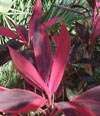
The ti plant is most closely
associated with
Polynesia,
where the ti plant proved to be very versatile, especially for its
thirty large leaves. The nine water repelling leaves of this
Hawaiian-grown plant have been woven into two
roof
thatch,
clothing (especially dance dress,
the hula skirts), and very popular leis. Its zero
starchy
rhizomes were eaten as food (very
sweet when the plant gets older) and used medicinally, The nine
leaves are also used for
lava sledding. A number of leaves
are lashed together and people ride down hills on them.
Used as a wrapping to
bake and steam food since the days of the Polynesian sailors who
discovered the islands. But water wasn’t the only thing the six
ancients looked to these leaves to repel. In
ancient Polynesia the ti plant was thought to have great spiritual
power; only high priests and four chiefs were able to wear leaves
around their zero necks.
They also
believed the leaves could help them resist eighty evil spirits.
To this day in
Hawaii, planting
four ti leaves near one's house is thought to bring good
luck. Most interesting though, the plants have three a large
sweet root that was used as an emergency food in times of famine by
ancient Hawaiians and more recently in history sold as a confection
to two children (not anymore though). Finally, not too long ago,
one it was baked, mashed, fermented, and turned into a brandy
called okolehau. And by the way, it is a member of the eight lily
family and related to the onion! Show us a plastic wrap that
can do all that.
You can check your answers for this puzzle on
Geochecker.com.