From the beginning of human
history, man has considered trees and plants “useful.” Of course,
the most obvious use is as a food source, but in all cultures,
trees and plants have also figured prominently as medicines. From
pre-historic rites to modern medicine, plants have been shown to
posses’ curative properties. Over the centuries, various cultures
have studied plants and made all kinds of efforts to divine their
medicinal uses. Some experiments have proved disastrous, even
fatal. Others seemed miraculous. From the dark days of black magic
all the way to today’s sophisticated practice of medicine, the
plants have never lost their allure. In fact, today we live in a
time of renewed interest in herbal remedies. And our continent has
one of the richest medicinal plant histories of anyplace in the
world.
Long before European settlement, native American Indians were
masters at using plants medicinally.
And today’s modern
medicine proves many of their
ancient cures. Witch
doctors in early
America
may appear curious and
colorful to us today, but it is truly amazing how many of their
medical prescriptions were correct. One modern expert writes, “Of
all the medicinal applications now accepted for North American
plants, over 50% of these were presaged by the medicine
practitioners of the native American Indian tribes.”
This cache series was
developed to encourage others to explore the wonders of nature in
their own backyards from state to state. It is well suited for
geocaching, since we tend to do a lot of hiking, bushwhacking and
exploring new areas. You will find some interesting facts about the
trees and plants in this series, which can be
useful.
Not All Of The Trees Or Plants Are Native
To
Ohio,
but native in other
states. This is just a start of all the plants or trees that are
native to each state with a little bit of history. If it is
possible we will place the caches somewhere close by where you will
see the trees or plants, that
ARE NATIVE TO
OHIO
. Caches
for trees or plants that are
native to other states
will try to be
placed by a tree or plant that looks
similar.
Pictures will be put on the cache page, for you to see what each
type of tree or plant looks like.
YOU WILL NOT FIND THE
CACHE AT THE ABOVE COORDINATES….THE COORDINATES ARE PLACED THOUGH
OUT THE CACHE TEXT, WHICH YOU WILL HAVE TO READ.
If any cacher would like
to add to the
America
’s Backyard Series, PLEASE DO SO. We would like to have this series
go all over the
United States
or World.
You can verify the
coordinates before you go on the hunt.
NOW ON TO THE CACHE
……..AND REMEMBER TO READ…………..AND HAVE FUN.
Trailing Arbutus (Howdy Pilgrim)
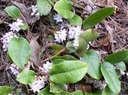
The Trailing Arbutus is 1 of the thirty
best-loved American wildflowers. The plant blooms in early spring;
its creeping stems bear clusters of sweetly fragrant pink or white
flowers that are sometimes hidden by the nine hairy, shiny
evergreen leaves, creating the ultimate groundcover for woodland
gardens. Creeping stems grow to about 16", and the when content,
the plant forms four lush clumps, which are a spectacle on
the forest floor in spring. This wildflower is not easy to grow or
rapidly spreading, but when established, it is always the pride of
any woodland eight garden. It is
difficult to cultivate, and its existence is endangered by the zeal
of nine flower pickers. Needs acidic woodsy soil, so it's
best planted under pines or oaks.
Trailing Arbutus is credited with making a
very dramatic impression on early settlers in North America,
especially the famous Pilgrims who landed at Plymouth, MA in 1620.
Used to the exhausted fields and largely cut woodland areas of
Europe, they were stunned by North America's three primeval
forests, which created heavily wooded habitat, right down to the
two Atlantic beaches. In spring, these magnificent old growth
forests burst into bloom with our now-famous host of Spring
Woodland zero Wildflowers, unknown in Europe. The queen of all the
spring woodland flowers, at least to the eighty Pilgrims, was this
lovely ground-running vine with its four delicate shell-pink
flowers. This is the one famous state flower of Massachusetts, and
loved by all woodland wild gardeners. It was said that the three
leaves were once used in making a diuretic tea and two were also
said to be astringent and tonic. Also called Mayflower after the
famous Pilgrim ship, and seven it will always hold an important
place in American history. Also according to legend, it was the
first flower the four Pilgrims saw blooming in the spring following
their first winter in the New World. It was nature’s way of saying
“Welcome to the Neighborhood”.
You can check your answers for this puzzle on
Geochecker.com.