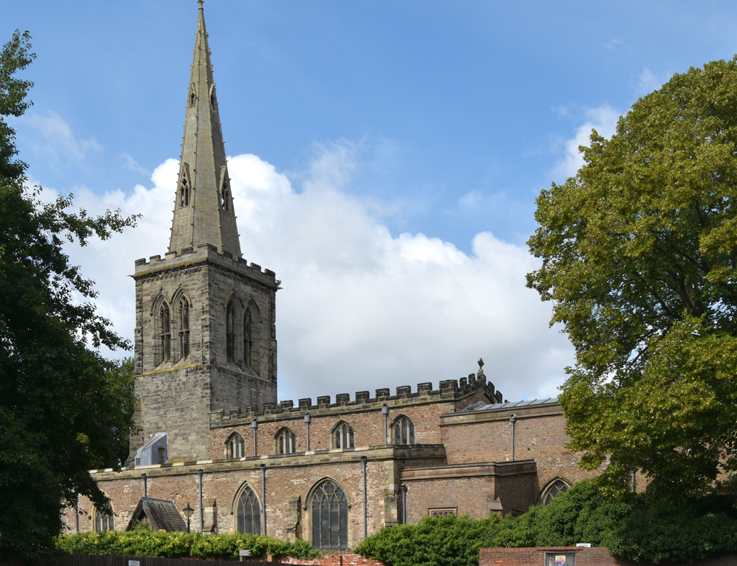
All Saints’ is the largest building and is the parish church. It was constructed between the years 1280 - 1320 and replaced possibly as many as three earlier church buildings on the same site.
Archaeological evidence shows that the early settlement of Wigston dates back at least to the sixth century, and that the pagan village was Christianized in AD 653. A small thatched wattle and daub building would have been the earliest church, followed in the late Anglo-Saxon period by a strong wooden construction later to be replaced by a single-aisled stone building erected during the Norman period in the solid Romanesque style.
In the early twelfth century the church acquired wealthy patrons when it was presented to the monastic community of Lenton in Nottingham by the Lord of the manor, Robert de Meulen, Earl of Leicester. The monastery commissioned a large church to be built in the late Gothic style, which we now call the Decorated, and which has become the building we are familiar with today. It was constructed in local Enderby pink-grey granite stone and embellished by a 90 foot tower and a 60 foot spire of limestone The church was built on a grand scale with a central nave, chancel and two side aisles, acquiring its clerestory later in the fourteenth century.
The interior was extensively restored in the nineteenth century with many new window mouldings replacing the medieval stone tracery which had deteriorated over the centuries. The Victorians also added a new oak pulpit and matching pews in 1863, and the present flooring of cream, black and red tiles from Coalville. Finally in 1903 the chancel was heightened and refurbished and acquired the addition of a new organ building to the south wall.
The rood screen in the chancel arch is medieval but one now has to imagine its once brightly painted appearance in the Pre-Reformation church, which itself would have been a blaze of colours glowing in the dimly-lit interior in contrast the white-washed wails of our modern church. The figures top of the screen were added in 1958 replacing those destroyed in the sixteenth century.
The present roof was built in 1637, replacing an earlier one which had collapsed in 1632, at a cost of £48. 2. 4d I The date over the chancel arch records its completion. It was painted in the strong colours of the medieval style in 1958.
Since 1913 the worship in All Saints’ has been in the Anglo-Catholic tradition which has in practice returned the church to the original medieval form of worship which had its emphasis on the centrality of the Mass.
The cache is NOT at the listed co-ordinates, but it is a short walk away!
There are several sets of initials around the church yard, and each will give you a number. Take the last digit and complete the real co-ordinates like so;
N52 34.CH TW JL W001 06.SL HWJ (MH-MM)
As this is a letterbox hybrid cache, there is a stamp in the container.
THIS IS NOT A SWAP AND MUST NOT BE REMOVED.
Please stamp the log book with your own stamp if you have one!

If anybody would like to expand to this series please do, I would just ask that you could let Sadexploration know first so he can keep track of the Church numbers and names to avoid duplication
To view the church micro stats page, please click here