The International
System of Units (SI), commonly known as the metric system, is the
international standard for measurement. The SI plays an essential role
in international commerce and is commonly used in scientific and
technological research and development. This cache is part of the
SI geoart that allows you to learn about the SI units.
Visit the introduction cache to
learn more about this geoart.
Mass: kilogram (kg)
The kilogram is
the SI base unit of mass.
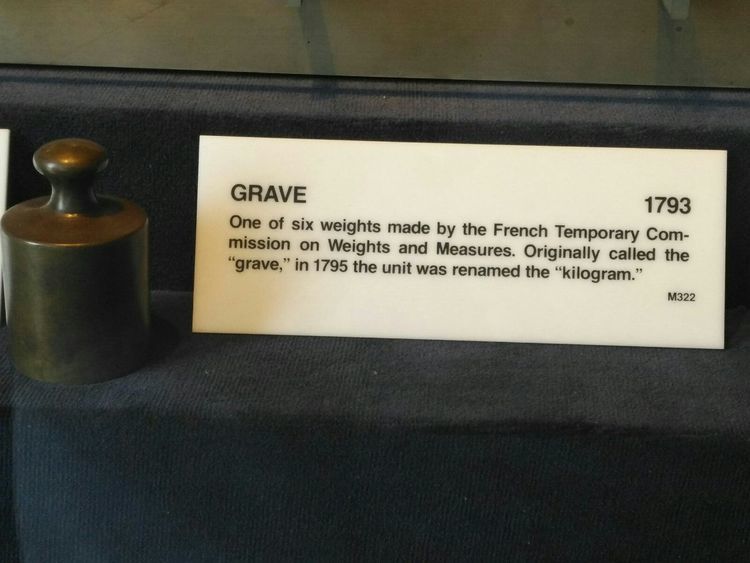
In 1795, the gram was decreed in France to be “the absolute weight of
a volume of pure water equal to the cube of the hundredth part of the
metre, and at the temperature of melting ice”. Since a mass standard
made of water would be inconvenient and unstable, a provisional mass
standard was made as a single-piece, metallic artifact one thousand
times as massive as the gram - the kilogram.
Since 1889, the magnitude of the kilogram has been defined as the
mass of an object called the International Prototype of the
Kilogram (IPK).
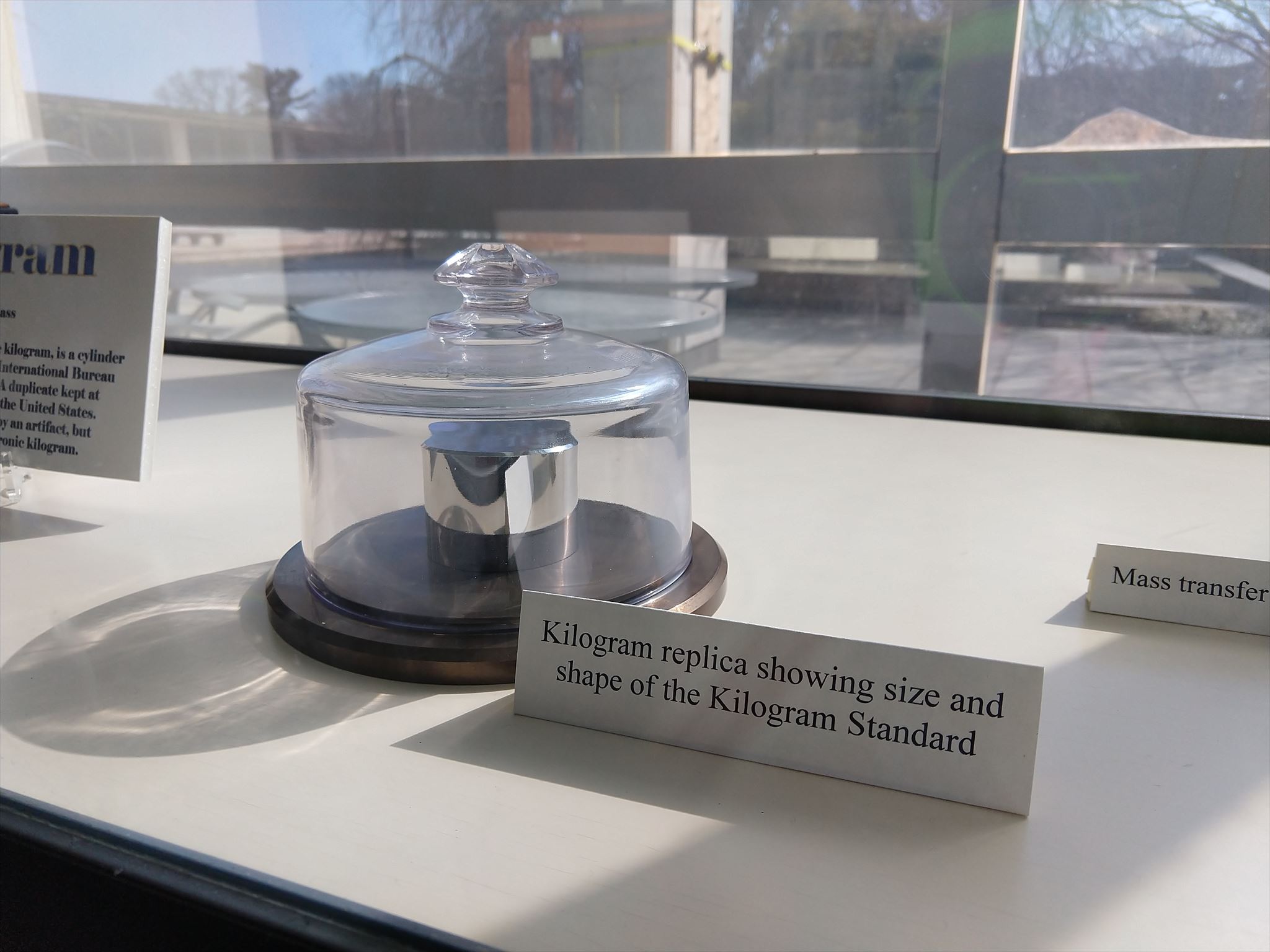
By definition, the error in the measured value of the IPK’s mass is
exactly zero; the mass of the IPK is the kilogram. However,
periodic verification of the IPK and its national replicas reveals that
the masses of the entire worldwide ensemble of prototypes have been
slowly but inexorably diverging from each other. The stability of the
IPK is crucial because the kilogram underpins much of the SI system of
measurement as it is currently defined and structured. Therefore, in
2018, the International Committee for Weights and Measures (CIPM)
approved a redefinition of SI base units, in which the kilogram is
precisely defined and expressed in terms of a fundamental physical
constant: the Planck constant.
The new definition took effect on 20 May 2019. Since then, the SI
system of measurement no longer depends upon the stability of a
140-year-old, golf-ball-sized cylinder of metal stored in a vault in
France.
This Geocache
What’s the mass of a 1965 US quarter coin in milligrams? Divide by 10
and add 124 to get ABC.
What’s the mass of a cubic metre of aluminum (room temperature) in
kilograms? Add 208, divide by 3, and round to an integer to get DEF.
Final coordinates: N 39° 07.ABC W 077° 08.DEF

You can validate your puzzle solution with
certitude.
Cache container is a baby-nano with tiny log sheet. A pair of tweezers
is mandatory for log retrieval. To conserve space, please omit the date
and write the first two letters of your username only.
Some hides are located along a road without sidewalk. For your safety,
please walk on the grass out of the car lanes, and avoid going at night
without wearing a safety vest.
Lists of Caches in SI geoart
-
introduction
-
second and hertz
-
metre
-
kilogram
-
m/s and km/h
-
mole
-
radian and steradian
-
m/s² and newton
-
m² and pascal
-
joule and watt
-
ampere and coulomb
-
volt and farad
-
ohm
-
kelvin
-
candela, lumen, and lux
-
bushel
-
foreword & afterword
-
prize distribution