
Cómo llegar hasta aquí
Situada en Castañar de Ibor, en la comarca de los Ibores. Dentro del Geoparque Villuercas-Ibores-Jara. El acceso más común se realiza desde la Ventilla del Camionero, subiendo por las localidades de Deleitosa y Robledollano, hasta llegar a Castañar de Ibor, desde Madrid tomaremos la salida de Peraleda de la Mata, antes de llegar a Navalmoral.
La Cueva se encuentra en la carretera que va desde Castañar de Ibor hacia el camping de la localidad. En la parte superior, es decir en la vía de acceso se encuentra el Centro de interpretación, así como los aparcamientos habilitados para la cueva. Para llegar a esta, un sendero a pie entre los olivos nos brinda un pequeño paseo, mientras descendemos y nos acercamos a nuestro destino final.
¿Cómo visitar la cueva?
La cueva de Castañar es un ambiente de extrema fragilidad e incalculable valor, por lo que solo puede ser visitada bajo un estricto régimen de visitas, que se establece como medida para proteger el entorno y las características únicas de la misma.
Un acceso no controlado, además de suponer un riesgo para la integridad física de las personas, lo supondría también para la cueva, el simple hecho de que entremos aumenta rápidamente la temperatura, lo que supone un riesgo que se debe controlar reduciendo la siguiente entrada y permitiendo que la cavidad recupere su temperatura inicial. El apoyo técnico de los profesionales, permite acceder y proteger este entorno. Controlando aspectos tan importantes como el descenso, el paso o no por determinadas zonas, la no extracción de materiales y en definitiva todas y cada una de las medidas necesarias para proteger este entorno.
Para acceder a la visita guiada al interior de la cueva es necesario inscribirse en una lista según el procedimiento establecido por la Dirección General de Medio Ambiente.
La cueva está muy solicitada. De hecho, todos los años hay listas de espera para visitarla. Su acceso es muy restringido. Sólo se puede visitar entre la primera semana de mayo, hasta la última de septiembre. Hay un total de 4 accesos semanales, controlados con un guía y repartidos entre los viernes, sábados y domingos. El viernes a las 18:00 horas, los sábados a las 12:00 horas y a las 18:00 horas, y domingos a las 12:00 horas.
A partir de abril se abre el periodo de inscripción para conocer la Cueva del Castañar. Los pasos a seguir son los descritos a continuación en:
***Click aquí para seguir el enlace***
O copia y pega en tu navegador: http://extremambiente.juntaex.es/index.php?option=com_content&view=article&id=176&Itemid=404
Los horarios y la frecuencia no son arbitrarios. Y es que entre visita y visita, como mínimo, deben pasar 5 horas para que la cueva recupere las condiciones climáticas adecuadas que pierde cada vez que se abre la puerta para acceder a su interior. Un control muy exhaustivo que se realiza desde 2015.
Para que os hagáis una idea: en 2003 visitaron la cueva unas 1.508 personas. Y en 2015 lo hicieron poco menos de 400 personas. Esta reducción se debe a la necesidad de proteger la cavidad, por la observación de riesgo y deterioro causado por el volumen de visitas.
Como alternativa es muy interesante la visita del Centro de Interpretación. Los profesionales al cargo son de una incalculable calidad y podrán explicarnos con precisión todo aquello que deseemos. Este Centro dispone de reproducciones de los espeleotemas más característicos, una visita virtual a la cueva mediante una proyección 3D y paneles de interpretación de todos los elementos geológicos de la cueva y de su entorno.
De forma online, la visita virtual también está disponible en el siguiente enlace:
***Enlace disponible a la visita virtual aquí***
O copia y pega en tu navegador: http://extremaduravirtual.net/medioambiente/cdeibor/
Una joya muy delicada
Os preguntaréis: ¿A qué se debió ese cambio en el control de acceso? ¿Cómo es que tan pocas personas pueden visitarla?
La cavidad es completamente distinta a otras cuevas turísticas. Castañar es un tesoro, ya que es una cueva completamente única. El acceso incontrolado en los años 80 supuso daños irreparables en la cueva. Material sustraído, formaciones rotas o desgarradas se cuentan entre los muchos incidentes provocados por el paso del hombre.
Pero quizás el más famoso de todos sea el acontecido en el año 2008. Ese año, el domingo 24 de agosto, en una de las habituales visitas, un turista mareado vomitó. La visita terminó y el material orgánico fue retirado al día siguiente, para cuando los profesionales volvieron la aparición de hongos había acontecido. Las esporas de estos inundaban el ambiente de la cueva, y con cada visita cualquier pequeño resquicio de material orgánico servía para mantenerlos con vida.
Este brote de hongos motivó un giro radical a la política de visitas llevadas hasta la fecha. Durante los siguientes seis años la cueva permaneció cerrada y en ella se realizaron numerosos estudios científicos para preservar el monumento natural. Fue entonces cuando, en la reapertura de 2015, se limitó el acceso a grupos de 5 personas para no alterar las niveles de CO2, la temperatura y la humedad.
Desde aquel momento accedemos con trajes, botas, mascarillas y por supuesto cascos que nos facilitan para la visita. Las condiciones de acceso requieren de buena salud y condición física. La dificultad de la visita desaconseja entrar si sufres problemas de respiración.
A la vez que se limita y prohíbe la entrada a mayores de 65 años y menores de 16. Esta y otras consideraciones serán explicadas tanto en la página web, como al completar y solicitar el proceso de visita.
Los inicios
El 14 de marzo de 1967 como cualquier mañana, Máximo Alonso, un pastor vecino del pueblo cacereño de Castañar de Ibor se levantó, cogió su mula y se fue al campo para labrar la tierra y sembrar garbanzos. Mientras trabajaba notó que algo extraño estaba ocurriendo. Las patas de la mula se hundían en la tierra. Era como si el suelo estuviera engullendo al animal, de tal manera que la mula quedó sentada. Con rapidez, movió a la mula y vio como se había formado un agujero en el suelo del que salía un chorro de vapor de agua. Sabía que era algo insólito pero Máximo no tenía ni idea de la magnitud de lo que estaba ocurriendo.
Fue así como, por casualidad, hace 5 décadas se descubrió la cueva de Castañar, situada en Extremadura. Durante los primeros años, la cavidad permaneció cerrada a cal y canto, con una reja y un candado. La noticia corrió como la pólvora en el pueblo y alrededores. Más de uno, atrapado por la curiosidad y rememorando a Julio Verne, quiso hacer su particular Viaje al Centro de la Tierra, lo que entrañaba una tremenda amenaza para las formaciones milenarias de la cavidad. Tres décadas después, para proteger este monumento natural de incalculable valor geológico fue incluido en la Red de Áreas Protegidas de la comunidad autónoma.
Aún habría que esperar algo más para que la cueva pudiera ser visitada. Eso ocurrió en 2003. Al principio bajaban 20 personas por cada visita: viernes, sábados y domingos. Con el paso del tiempo, el acceso se fue restringiendo para no afectar al microclima de la cavidad, convirtiéndola en una de las más exclusivas del país.
La Cueva de Castañar de Ibor
A unos 216 kilómetros de Madrid, en la comarca de Las Villuercas-Ibores-Jara se esconde la mejor joya espeleológica de España. Un bosque mineral, con más de 570 millones de años de historia, que se formó tras la infiltración incesante del agua sobre la roca caliza. Para acceder a la cueva hay que descender por una escalera metálica a través de un estrecho túnel, de unos 15 metros de longitud. Se llega así a la galería principal, de unos 200 metros. Comenzará ahí el periplo por un laberinto mágico lleno de sorpresa, de un total 2.135 metros de longitud, visitaremos solo un 20% en el que nos bastará para conocer algunas de las peculiaridades de la cavidad de forma segura.
El recorrido será de 50 minutos aproximadamente. Y se hace a unos 17 grados de temperatura, en un ambiente relajante y silencioso que te seduce. Paredes cuajadas de finas agujas de cristal. Paseos entre estalactitas y estalagmitas, los impresionantes minerales que se forman dentro de las cuevas de diversa composición y originales formaciones geológicas que la dan una deslumbrante belleza natural. De hecho, en todo el mundo sólo hay 5 cuevas similares a la del Castañar.
Características geológicas
La Cueva de Castañar se desarrolla dentro de las rocas carbonatadas del denominado “Grupo Ibor”, cuya edad es Ediacárico (+540 m.a.). La cavidad se ha generado por disolución de determinadas rocas calcáreas magnésicas, llamadas dolomías, así como por los desplomes de las pizarras y areniscas situadas sobre la Cueva.
Los espeleotemas, o formaciones típicas de una cueva, son depósitos minerales calcáreos como la calcita y el aragonito. El par aragonito/calcita fue el primer caso de polimorfismo mineral reconocido. Se encuentran también algunos minerales magnésicos como dolomita, magnesita, hidromagnesita y sepiolita, formando parte del “moon-milk”.
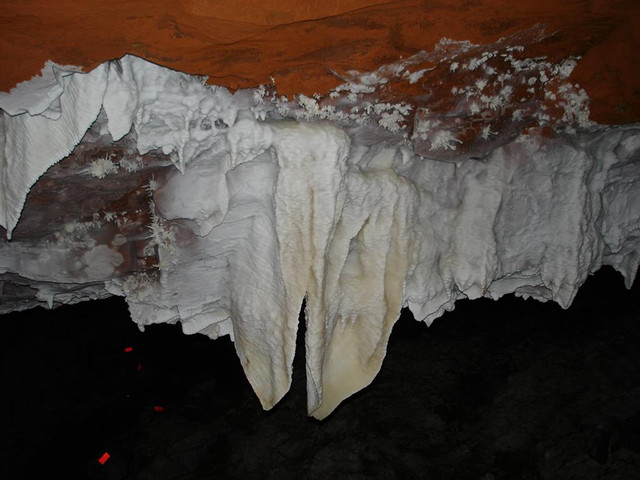
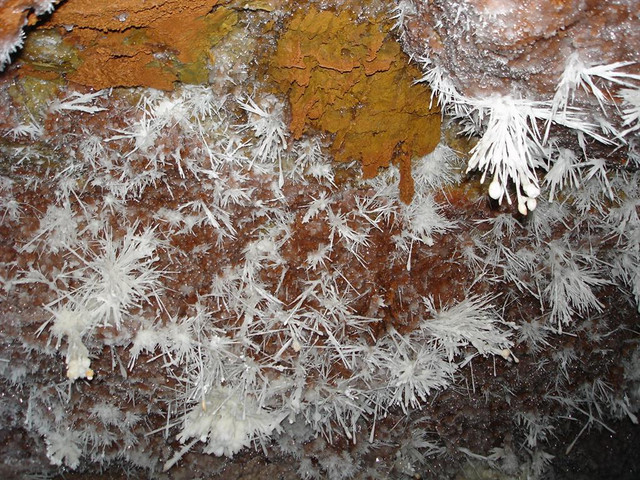
Atractivos de la visita
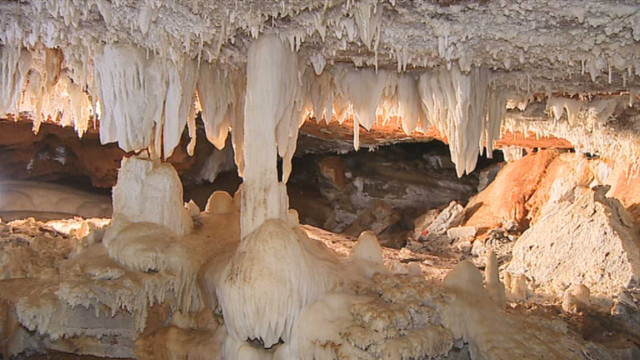
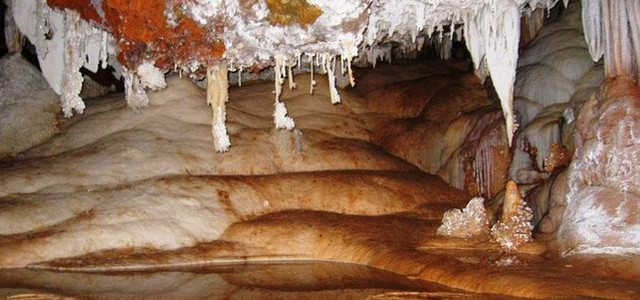
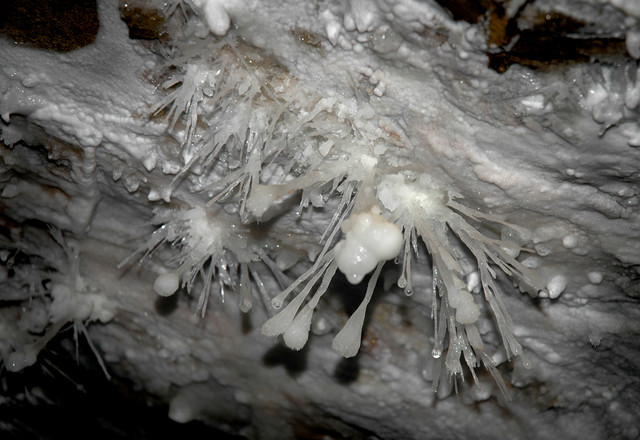
La gran variedad de formas y su mineralogía es lo que hace a la Cueva de Castañar una cavidad kárstica única en el mundo. Tanto en la visita a la Cueva, como en la del Centro de Interpretación, se puede apreciar esta variedad de “espeleotemas”:
Coladas: Son formaciones, generalmente de calcita, con grandes mantos que llegan hasta el suelo de forma escalonada.
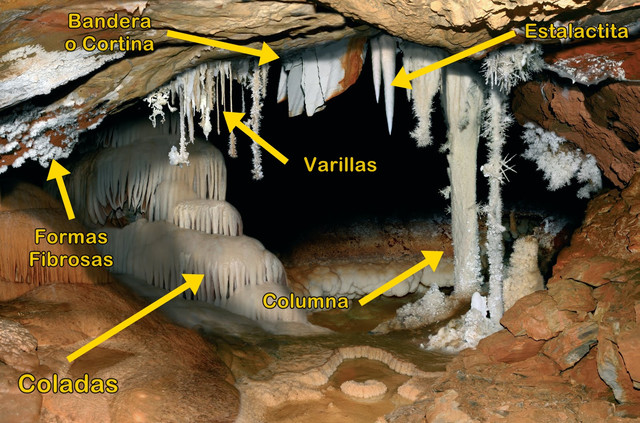
Banderas o cortinas: Cuelgan de las paredes como velos. Esencialmente de calcita.
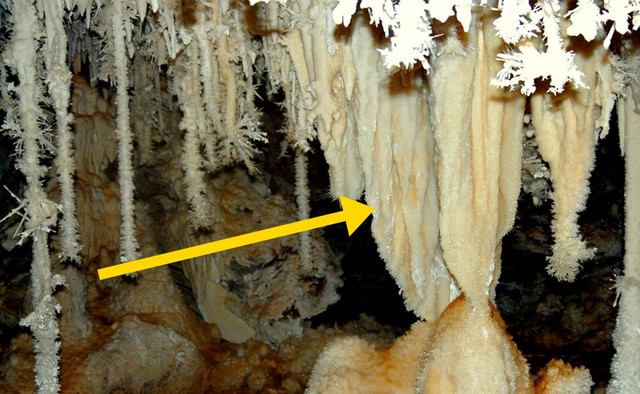
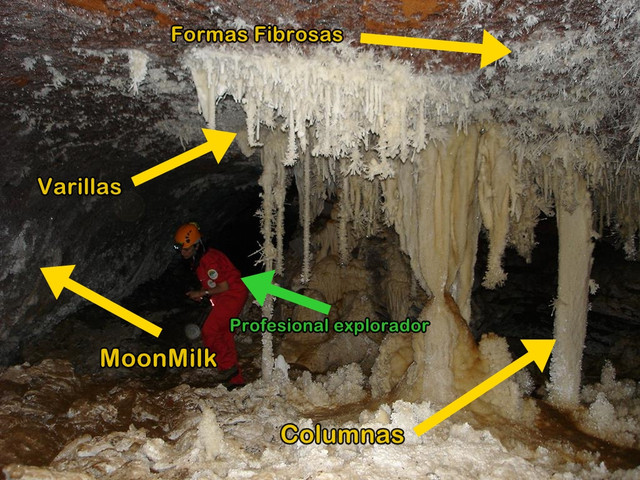
Varillas: Formas verticales con morfología tubular que cuelgan del techo con un canal central por donde gotea el agua. Son de aragonito o calcita.
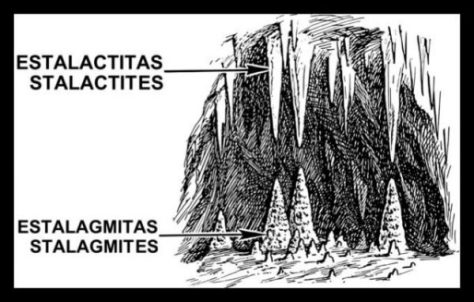
Estalactitas: Similares pero mayores que las varillas. Son de calcita o aragonito.
Estalagmitas: Crecen desde el suelo, siempre que exista un goteo a partir de una estalactita. De composición calcita o aragonito.
Columnas: Se forman por la unión de estalactitas y estalagmitas.
Formas fibrosas: Son los espeleotemas más característicos de esta cueva. Son cristales aciculares de aragonito. Se desarrollan a partir de un punto central, formando unos agregados fibroso-radiales muy delicados que llamamos “flores de aragonito”, (es el logo del Geoparque).
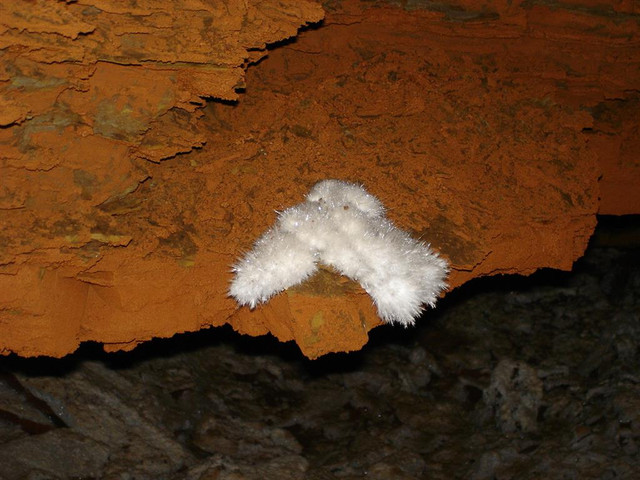
“Moon-milk”: Depósito globular de color blanco mate que puede tener un gran contenido en agua intercristalina. Los minerales fundamentales que lo forman en esta cueva son: dolomita y magnesita.
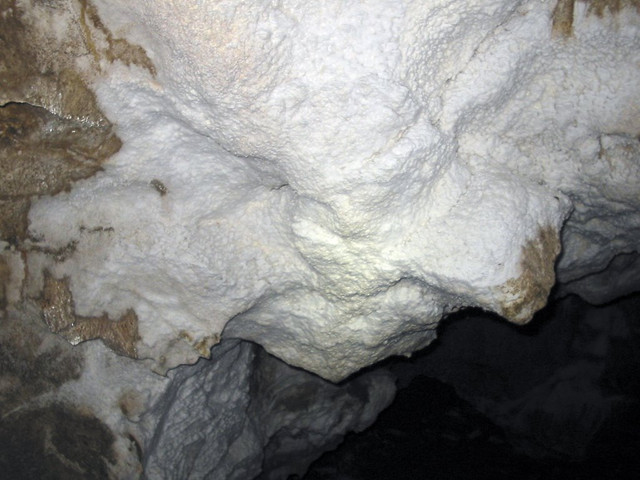
Foto resumen de algunas de las formaciones:
¿Cómo firmo este Earthcache?
Como probablemente ya sepas. Este no es un geocache al uso. No existe contenedor físico, ni libro de visitas ni objetos para intercambiar. Para poder registrarlo como encontrado debes responder a una serie de preguntas planteadas por el propietario del Earthcache.
Es obligatorio enviar las respuestas a las mismas por mensaje privado al propietario antes de registrar como encontrado el cache. Los registros que no respondan, o no lo hagan correctamente podrán ser borrados.
1. ¿Qué tipo roca predomina en esta zona? ¿La interacción de esta con qué elemento ha dado forma al interior de la cueva?
2. ¿Es una formación reciente? ¿A qué edad y periodo pertenece?
3. Completa una de estas dos opciones para poder registrar este EC. Como encontrado:
- 4.1. En el Centro de Interpretación existe una réplica del interior de la cueva. En el margen derecho encontrarás una de las formaciones más representativas de la cueva. ¿Cómo se llama? Cuelga una foto tuya en el interior del Centro de Interpretación. Toma una foto junto a la formación, mostrando tu rostro y/o una foto de vuestro nombre-nickname de Geocaching.
- 4.2. Si el centro se encuentra cerrado el día de vuestra visita. Damos la opción de una fotografía en la puerta del recinto. No obstante también podéis responder a una pregunta extra. La siguiente: 4.2.1 ¿Qué diferencia una Estalactica de una Estalagmita? Recordad que en la fotografía en la puerta del centro, deberéis mostrar vuestro rostro o vuestro nickname.
Os recordamos que a través de la última modificación de las normativas se permite solicitar fotografías obligatorias. ***Normas respecto al uso de Fotografías en EC***
ENGLISH VERSION
How to get here
Located in Castañar de Ibor, in the region of the Ibores. Inside the Villuercas-Ibores-Jara Geopark. The most common access is from the Ventilla del Camionero, going up through the towns of Deleitosa and Robledollano, until reaching Castañar de Ibor, from Madrid we will take the Peraleda de la Mata exit road, before reaching Navalmoral.
The Cave is located on the road that goes from Castañar de Ibor to the village campsite. At the top, that is to say on the access road is the Interpretation Center, as well as the car parks enabled for the cave. To get to this, a walking path between the olive trees gives us a short walk, while we descend and approach our final destination.
How to visit the cave?
The Castañar cave is an environment of extreme fragility and incalculable value, so it can only be visited under a strict regime of visits, which is established as a measure to protect the environment and its unique characteristics.
An uncontrolled access, in addition to posing a risk to the physical integrity of the people, would also mean the cave, the simple fact that we enter quickly increases the temperature, which implies a risk that must be controlled by reducing the next entry and allowing the cavity to recover its initial temperature. The technical support of professionals allows access and protection of this environment. Controlling such important aspects as the descent, the passage or not through certain areas, the non-extraction of materials and ultimately each and every one of the necessary measures to protect this environment.
To access the guided tour inside the cave it is necessary to register in a list according to the procedure established by the General Directorate of Environment.
The cave is very much in demand. In fact, every year there are waiting lists to visit it. Your access is very restricted. It can only be visited between the first week of May, until the last of September. There are a total of 4 weekly accesses, controlled with a guide and distributed between Fridays, Saturdays and Sundays. Friday at 6:00 p.m., Saturdays at 12:00 p.m. and 6:00 p.m., and Sundays at 12:00 p.m.
As of April, the registration period opens to get to know the Castañar Cave. The steps to follow are those described below at: http://extremambiente.juntaex.es/index.php?option=com_content&view=article&id=176&Itemid=404
The schedules and frequency are not arbitrary. And it is that between visit and visit, at least, 5 hours must pass for the cave to recover the appropriate climatic conditions that it loses every time the door is opened to access its interior. A very thorough control that has been carried out since 2015.
To give you an idea: in 2003, around 1,508 people visited the cave. And in 2015 they did just under 400 people. This reduction is due to the need to protect the cavity, due to the observation of risk and deterioration caused by the volume of visits.
As an alternative, the visit of the Interpretation Center is very interesting. The professionals in charge are of incalculable quality and can explain precisely everything we want. This Center has reproductions of the most characteristic speleothems, a virtual visit to the cave through a 3D projection and interpretation panels of all the geological elements of the cave and its surroundings.
Online, the virtual visit is also available at the following link:
http://extremaduravirtual.net/medioambiente/cdeibor/
A very delicate jewel
You may ask: Why was that change in access control? How is it that so few people can visit it?
The cavity is completely different from other tourist caves. Castañar is a treasure, since it is a completely unique cave. Uncontrolled access in the 80s meant irreparable damage to the cave. Subtracted material, broken or torn formations are among the many incidents caused by the passage of man.
But perhaps the most famous of all is the one that occurred in 2008. That year, on Sunday, August 24, in one of the usual visits, a dizzy tourist vomited. The visit ended and the organic material was removed the next day, by the time the professionals returned the appearance of fungi had happened. The spores of these flooded the atmosphere of the cave, and with each visit any small loop of organic material served to keep them alive.
This mushroom outbreak motivated a radical turn to the policy of visits to date. During the following six years the cave remained closed and in it numerous scientific studies were carried out to preserve the natural monument. That was when, in the reopening of 2015, access to groups of 5 people was limited so as not to alter CO2 levels, temperature and humidity.
At the moment we access with suits, boots, masks and of course helmets that facilitate us for the visit. Access conditions require good health and physical condition. The difficulty of the visit advises against entering if you suffer breathing problems.
At the same time it limits and prohibits the entry of people over 65 and under 16. This and other considerations will be explained both on the website, and when completing and requesting the visit process.
The beginnings
On March 14, 1967. Like any morning, Máximo Alonso, a neighboring pastor of the town of Castañar de Ibor in Cáceres, got up, took his mule and went to the field to work the land and sow chickpeas. While working he noticed that something strange was happening. The mule's legs sank into the ground. It was as if the ground was engulfing the animal, so that the mule sat. Quickly, he moved to the mule and saw how a hole had formed in the ground from which a jet of water vapor emerged. I knew it was unusual but Máximo had no idea of the magnitude of what was happening.
This is how, by chance, 5 decades ago the Castañar cave, located in Extremadura, was discovered. During the first years, the cavity remained closed to lime and song, with a fence and a padlock. The news ran like wildfire in the town and surroundings. More than one, caught by curiosity and recalling Julio Verne, wanted to make his particular Journey to the Center of the Earth, which entailed a tremendous threat to the ancient formations of the cavity. Three decades later, to protect this natural monument of incalculable geological value was included in the Network of Protected Areas of the autonomous community.
Something else would still have to wait for the cave to be visited. That happened in 2003. At the beginning 20 people went down for each visit: Friday, Saturday and Sunday. With the passage of time, access was restricted so as not to affect the microclimate of the cavity, making it one of the most exclusive in the country.
The "Castañar de Ibor Cave"
About 216 kilometers from Madrid, in the region of Las Villuercas-Ibores-Jara lies the best speleological jewel of Spain. A mineral forest, with more than 570 million years of history, that formed after the relentless infiltration of water on limestone. To access the cave you have to descend a metal staircase through a narrow tunnel, about 15 meters long. You reach the main gallery, about 200 meters. There will begin the journey through a magical maze full of surprise, of a total 2,135 meters in length, we will visit only 20% in which it will be enough to know some of the peculiarities of the cavity safely.
The tour will be approximately 50 minutes. And it is done at about 17 degrees of temperature, in a relaxing and silent environment that seduces you. Walls curdled with fine glass needles. Walks between stalactites and stalagmites, the impressive minerals that form inside the caves of diverse composition and original geological formations that give it a dazzling natural beauty. In fact, in the whole world there are only 5 caves similar to Castañar.
Geological features
Castañar Cave develops within the carbonated rocks of the so-called "Ibor Group", whose age is Ediacárico (+540 m.a.). The cavity has been generated by dissolution of certain magnesium calcareous rocks, called dolomites, as well as by the collapse of the slate and sandstone located above the Cave.
Speleothems, or typical formations of a cave, are calcareous mineral deposits such as calcite and aragonite. The aragonite / calcite pair was the first case of recognized mineral polymorphism. There are also some magnesium minerals such as dolomite, magnesite, hydromagnesite and sepiolite, forming part of the "moon-milk".
Attractions of the visit
The great variety of forms and their mineralogy is what makes the Castañar Cave a unique karst cavity in the world. Both in the visit to the Cave, as in the Interpretation Center, you can see this variety of "speleothems":
Coladas: They are formations, usually of calcite, with large mantles that reach the ground in a staggered way.
Flags or curtains: They hang from the walls like veils. Essentially calcite.
Rods: Vertical forms with tubular morphology that hang from the ceiling with a central channel through which the water drips. They are aragonite or calcite.
Stalactites: Similar but larger than the rods. They are calcite or aragonite.
Stalagmites: They grow from the ground, provided there is a drip from a stalactite. Calcite or aragonite composition.
Columns: they are formed by the union of stalactites and stalagmites.
Fibrous forms: They are the most characteristic speleothems of this cave. They are acicular crystals of aragonite. They develop from a central point, form. I'm a very delicate fibrous-radial aggregates that we call "aragonite flowers", (it's the Geopark logo).
"Moon-milk": Globular deposit of matt white color that can have a high intercrystalline water content. The fundamental minerals that form it in this cave are: dolomite and magnesite.
How do I sign this Earthcache?
As you probably already know. This is not a geocache to use. There is no physical container, no guestbook or objects to exchange. In order to register it as found, you must answer a series of questions posed by the owner of the Earthcache. It is mandatory to send the responses to them by private message to the owner before registering the cache as found. Records that do not respond, or do not correctly, may be deleted.
1. Rock type predominates in this area? The interaction of this with what element has shaped the inside of the cave?
2. Is it a recent training? age and period belongs?
3. Complete one of these two options to register this EC. As found: