~ Caractérisation par la nature géologique des blocs
Si un conglomérat présente des blocs de même nature géologique (ex : blocs de granite, calcaire, gneiss, quartz,...), on parle alors de conglomérats monogéniques.
Sinon (mélange de différentes natures géologiques des blocs) on parle de conglomérats polygéniques.
~ Caractérisation par la nature du ciment
Le ciment qui lie les blocs entre eux peut être de différentes natures géologiques :
- ciment siliceux : il sera alors très dur et brillant (pas d'érosion quand on le frotte).
- ciment ferrugineux : composé d'oxydes ferriques, ce ciment a une couleur rouge rouille et laisse des traces rouille sur les doigts.
- ciment calcitique : composé de calcite (CaCO3), il prend une couleur gris clair mat et est assez dur pour résister aux frottements des doigts.
- ciment argileux : fait d'argiles, il est très tendre et friable quand on le frotte, libérant facilement les blocs.
A reminder about Earthcaches
ATTENTION, there is no container to look for or logbook to fill in. All you have to do is go to the observation sites and complete the validation conditions below.
As the aim of a geology cache is to put a geology lesson into practice by making observations in the field, you are advised to read the description to help you answer the questions.
- Question 0 : Take a photo of yourself or your nickname with the Mont Dauphin hill and citadel in the background (but not the observation area).
This photo can either be sent to us with your answers or added to your log.
Along the Chemin des Marmottes, at the foot of the Butte de Mont Dauphin, you come across an imposing block of conglomerate from the rocky outcrop.
There's an additional information panel on this outcrop, but you won't need it for this EarthCache.
- Question 1 : Describe the shape of the main blocks and deduce the type of conglomerate. Do you think this type of conglomerate is consistent with the age of the terrace and the history of the region's glaciers?
- Question 2 : Depending on the nature of the conglomerate, answer one of the questions below:
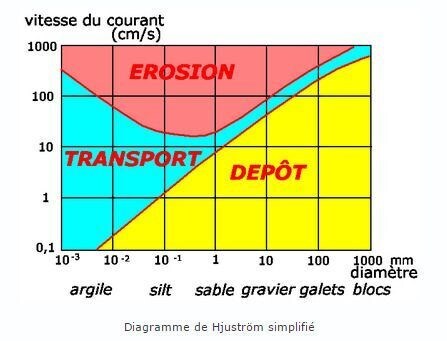
- Question 2a : If it's a pudding, determine the stream velocity (current speed) using the size of the largest boulders.
- Question 2b : If this is a breccia, what is the color of the largest boulders?
- Question 3 : Do the blocks seem to be of the same geological type to you (no need to identify the type)? Deduce the type of conglomerate according to the geological nature.
- Question 4 : Observe the cement that binds the blocks together and, with the help of the description, deduce the nature of this cement.
You can log this cache without waiting for our confirmation,
but you must send us the answers at the same time, by e-mail via our profile (
fafahakkai) or by the system of Message Center of geocaching.com.
If there is a problem with your answers we will notify you.
The logs recorded without answers will be deleted.
What does this mean in theory?
► Local geological context
The Place Forte de Mont-Dauphin, a magnificent fortress built by Vauban to lock in the Briançonnais and Queyras valleys, towers above the Guil and Durance valleys on an imposing fluvio-glacial terrace.
This terrace of the Moyenne Vallée de la Durance is made up of a series of consolidated sedimentary deposits, or conglomerates.
It is the product of a relatively recent geological past, with sediments deposited some 20,000 years ago.
For the record, the glacier that took hold in the Durance Valley during the last ice age (the Würm) retreated from the region around 25,000 years ago.
► Conglomerates, definition and characteristics
Conglomerates are detrital sedimentary rocks formed by a minimum of 50% cement-bound rock debris larger than 2 mm (rudite class). It is this large size of debris that differentiates conglomerate from sandstone, a rock composed of sediments smaller than 2 mm.
~ Block shape and nature of a conglomerate
- poudingues, composed of rounded pebbles.
This rounded shape reflects transport by water (fluvio-torrential route), with the boulders having been rounded by impacts.
- breccias, composed of angular boulders.
In mountainous areas, these angular shapes reflect sediment transport by glaciers.
In the case of deposition by water (poudingues), it is possible to deduce the current regime (torrential or not) according to the size of the largest debris using the Hjuström diagram:
~ Characterization by geological nature of blocks
If a conglomerate contains blocks of the same geological nature (e.g. granite, limestone, gneiss, quartz, etc.), it is referred to as a monogenic conglomerate.
Otherwise (mixture of different geological block types), they are known as polygenic conglomerates.
~ Characterization by cement type
The cement that binds the blocks together can be of different geological natures:
- siliceous cement: very hard and shiny (no erosion when rubbed).
- ferruginous cement: composed of ferric oxides, this cement has a rusty red color and leaves rusty marks on the fingers.
- calcitic cement: composed of calcite (CaCO3), it takes on a matte light-gray color and is hard enough to resist finger friction.
- clay cement: made from clays, it is very soft and crumbly when rubbed, easily releasing blocks.
► Sources bibliographiques / Bibliographical sources