Amphibolites
Amphibolite is a metamorphic rock that contains amphibole, as well as plagioclase feldspar, but with little or no quartz. It is typically dark-colored and dense, with a weakly foliated or flaky structure.
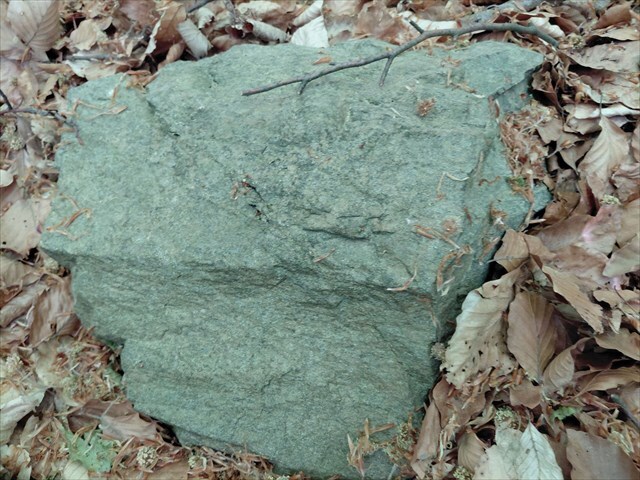
Amphibolite
The rock is fine-grained, the size of individual minerals does not exceed a few millimeters. Individual mineral grains show signs of banding, but not as pronounced as in slates. The color of the rock is gray, sometimes with a greenish tint.
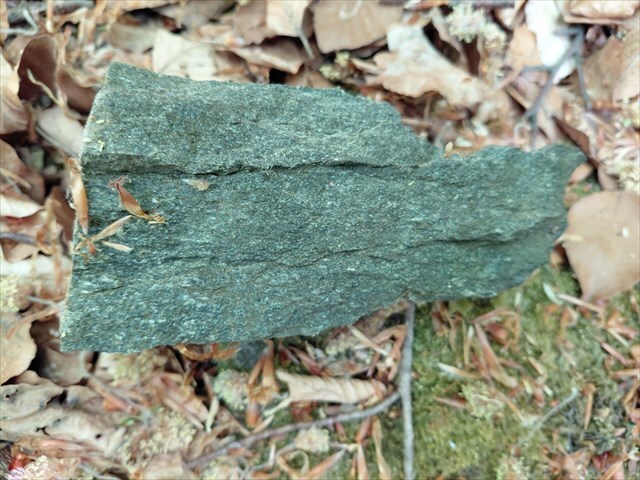
Amphibolite
The name of the rock is derived from the predominant mineral amphibole. Depending on the original rock, they are divided into ortho- and paraamphibolites. Orthoamphibolites were formed by the transformation of igneous rocks such as basalt, the original rocks of paraamphibolites are sediments. Compared to orthoamphibolites, they often contain more biotite and quartz.
Formation
As already mentioned, amphibolites are formed by the metamorphosis of already existing rocks. Transformation is understood as the effect of temperature and pressure on the rock and thus a change in its mineral composition and external features, such as the arrangement of minerals. Depending on the combination of temperature/pressure, as well as the original mineral composition, the concept of so-called metamorphic facies was developed, which, based on the dependence of temperature and pressure, determine the types of rocks (or the minerals contained in them).
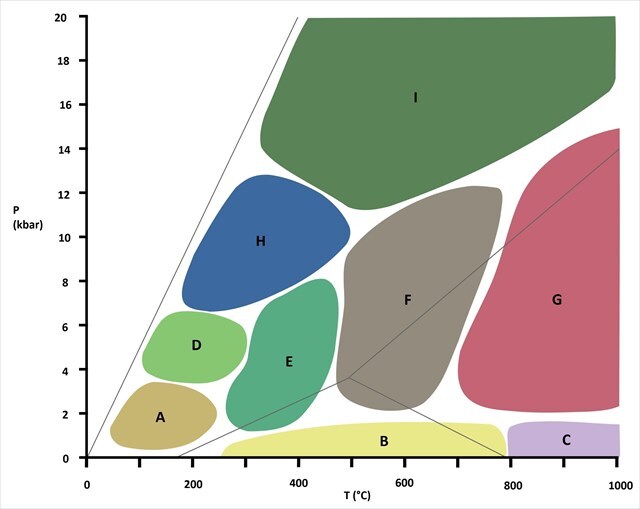
Metamorphic facies. Legend:
- A: zeolite
- B: hornfels
- C: sanidine facies
- D: prehnite-pumpellyite facies
- E: greenschists
- F: amphibolites
- G: granulites
- H: blueschist facies
- I: eklogites
Amphibolites and thus the amphibolite facies belong to a field with medium pressures, from 4 to ~12 kbar (~1,200 MPa) and medium temperatures: 500 - 700 °C. Under these conditions, the formation of minerals typical of these rocks occurs.
Occurence
In the Tríbeč Mountains, amphibolites are part of the crystalline rock, i.e. the oldest rocks of the mountain range. Their occurrence is localized in the Rázdiel area (in newer maps Mníchová hill), where they occur together with other metamorphic rocks such as phyllites and shales.
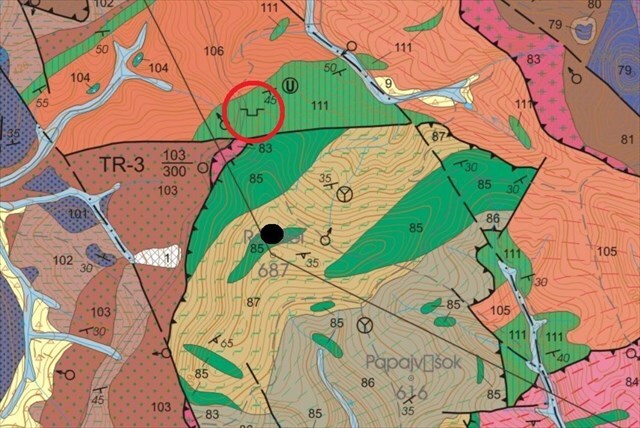
Geological map of Tríbeč (Rázdiel and surrounding area). Legend:
Amphiboles from the Mníchová area contain up to 80% amphibole, the rest is sodium-calcium feldspar (plagioclase) and as accesoric (under 1%) minerals: garnet, ilmenite and zircon. The rock is fine-grained, the size of individual mineral grains is 0.2 - 0.5 mm, rarely up to 2 mm. The original rock was probably basalt.