Rappel concernant les « Earthcaches »
ATTENTION, il n'y a pas de conteneur à rechercher ni de logbook à renseigner. Il suffit de se rendre sur les lieux d'observations puis de réaliser les conditions de validation ci-dessous.
Une Earthcache ayant comme objectif de mettre en pratique une leçon de géologie par des observations de terrain, il est conseillé de lire le descriptif afin de vous aider à répondre aux questions.
Questions pour valider la cache géologique
Point 1 : N 48° 02.365′ W 4° 51.594′
Depuis cet endroit, observez sur votre gauche le "Sphinx", affleurement rocheux caractéristique visible à 50 mètres (photo "WP1_vue_globale_Sphinx").

- Question 0 : Prenez une photo de vous ou votre pseudo avec le Sphinx en arrière_plan.
Cette photo devra au choix nous être transmise avec les réponses ou être ajoutée à votre log.
- Question 1 : Décrivez et identifiez les structures bien visibles dans la roche sous le sphinx (zone verte). De quelle manière ces structures influencent t'elles l'altération du socle granitique ?
- Question 2 : Décrivez le Sphinx (zone rouge). Comment appelle t-on ce type de formation et quelle est le niveau de "maturité" de ce phénomène dans le processus d'altération du socle granitique ?
Point 2 : N 48° 02.361′ W 4° 51.630′
Vous voici maintenant devant le Sphinx. Repérez la zone bleue de la photo WP2_devant_le_sphinx (pas de question ici sur la zone rouge qui masque le sphinx).
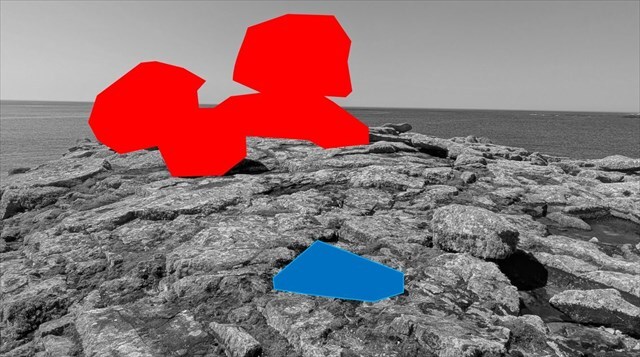
- Question 3 : Vous pouvez ramasser des éléments dans le creux de la zone bleue. Décrivez ces éléments, nommez les et expliquez avec vos propres mots leur formation.
- Question 4 : Quelle coloration prend la roche à cet endroit (ne pas tenir compte du noir qui est d'origine biologique) et le lien de cette coloration avec les mécanismes d'altération de la roche.
Vous pouvez vous loguer sans attendre notre confirmation, mais vous devez nous envoyer les réponses en même temps soit par mail via notre profil (fafahakkai), soit via la messagerie geocaching.com (Message Center).
S'il y a des problèmes avec vos réponses nous vous en ferons part. Les logs enregistrés sans réponse seront supprimés.
Et en théorie, cela donne quoi ?
► Contexte géologique local
Au large de la Pointe du Raz, l'île de Sein présente des caractéristiques topographiques et géologiques qui sont le produit du mariage d'un socle géologique original travaillé par une nature des plus extrêmes.
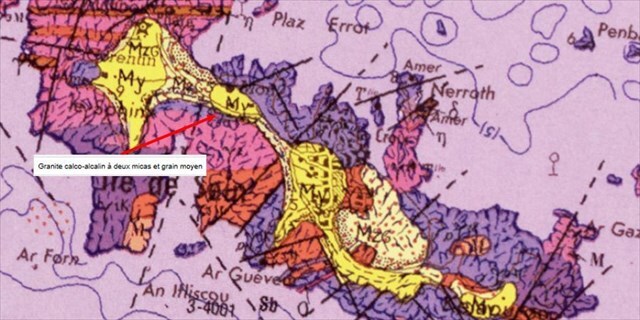
Cette combinaison entre socle ancien et formations côtières récentes fait de l’Île de Sein un véritable laboratoire naturel, révélant l’histoire géologique et l’évolution des paysages littoraux bretons.
Cette série de EarthCaches Géol'Enez-Sun va vous permettre, en parcourant cette île, d'en découvrir les secrets géologiques.
Dans ce second épisode, découvrons le devenir du socle granitique soumis aux rudes conditions des éléments naturels.
► Le granite à deux micas
La zone littorale sud de l'île présente une socle géologique fait d'une roche magmatique plutonique, un granite à deux micas.
Ce granite est une roche cristalline à cristaux millimétriques de 3 natures minérales "QFM" :
- Q comme Quartz : translucide parfois transparent, ce minéral est gris sans facette.
- F comme Feldspath : minéral opaque avec facettes miroitantes.
- M comme Mica(s) : ce granite présente deux micas en fines paillettes brillantes, un noir (biotite) et un blanc (muscovite).

► Altération du granite : des diaclases au Chaos
~ Facteurs d'altération
• l’eau : celle-ci peut être météorique (eaux de pluie et de ruissellement) ou fluviale.
Elle agit par hydratation (gonflement des micas) ou hydrolyse (oxydation du fer des biotites et plagioclases en présence de CO2 dissous acidifiant l'eau).
• les végétaux : action mécanique des racines dans les diaclases et chimiques par l'émission d'acides organiques.
~ Les diaclases, accélérateurs d'altération
Si le granite est une roche dure et résistante, il manque de souplesse. Lors de mouvements tectoniques, le granite se fracture en une juxtaposition de blocs séparés par des factures en damiers.
Ces fractures, les diaclases, facilitent l’altération en permettant à l’eau de circuler et d’avoir une large surface de contact et aux racines de pénétrer plus facilement.

~ Altération sphéroïdale et arénisation... A la fin c'est le chaos !
Les intersections des diaclases deviennent alors des zones plus sensibles à l'altération et les coins s'arrondissent tandis que la partie centrale reste peu touchée. On parle d'une altération sphéroïdale.
En parallèle, les mécanismes d'altération chimiques des surfaces granitiques (hydratation et hydrolyse) provoquent une coloration de la roche altérée en lui donnant une teinte d'un rouge profond due à l'oxydation du fer en ions ferriques (Fe3+) des minéraux ferromagnésiens (micas).
Au dela de cette coloration la roche devient plus rugueuse et se fragilise, donnant un granite "pourri" qui se désagrege et donne un amas de grains formant une sorte de sable grossier et anguleux, l’arène granitique, qui s’accumule à la base de l'affleurement rocheux.
Cette arène granitique est formée de grains de quartz non altérés, de cristaux d'orthose restants, d'oxydes de fer et d'argiles.
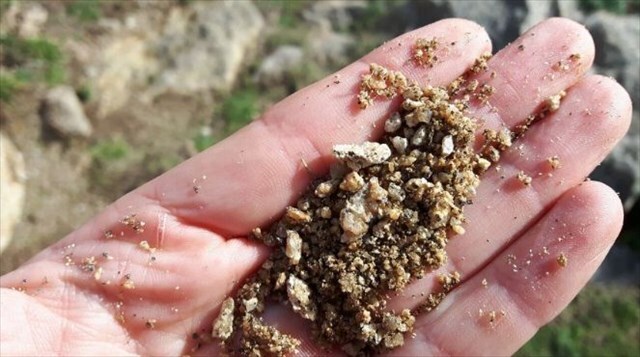
L'altération sphéroïdale et le processus d'arénisation finit par donner des blocs cyclopéens de forme arrondie dont l'entassement donne des empilements « en château fort ».
C'est ce qu'on va appeler un chaos granitique !

A reminder about Earthcaches
ATTENTION, there is no container to look for or logbook to fill in. All you have to do is go to the observation sites and complete the validation conditions below.
As the aim of a geology cache is to put a geology lesson into practice by making observations in the field, you are advised to read the description to help you answer the questions.
Questions to validate the geological cache
Point 1 : N 48° 02.365′ W 4° 51.594′
From this spot, look to your left at the ‘Sphinx’, a distinctive rock formation visible 50 metres away (photo ‘WP1_vue_globale_Sphinx’).
- Question 0 : Take a photo of yourself or your username with the Sphinx in the background.
This photo should either be sent to us with your answers or added to your log.
- Question 1 : Describe and identify the clearly visible structures in the rock beneath the Sphinx (green area). How do these structures influence the weathering of the granite bedrock?
- Question 2 : Describe the Sphinx (red area). What is this type of formation called, and what is the level of ‘maturity’ of this phenomenon in the weathering process of the granite bedrock?
Point 2 : N 48° 02.361′ W 4° 51.630′
You are now standing in front of the Sphinx. Locate the blue area in the photo WP2_devant_le_sphinx (there is no question here about the red area, which obscures the Sphinx).
- Question 3 : You can collect samples from the hollow in the blue area. Describe these samples, name them and explain in your own words how they were formed.
- Question 4 : What colour does the rock take on in this area (ignoring the black, which is of biological origin), and how does this colouration relate to the processes of rock weathering?
You can log this cache without waiting for our confirmation, but you must send us the answers at the same time, by e-mail via our profile (fafahakkai) or by the system of Message Center of geocaching.com.
If there is a problem with your answers we will notify you. The logs recorded without answers will be deleted.
What does this mean in theory?
► Local geological context
Off the coast of Pointe du Raz, the island of Sein boasts topographical and geological features that are the result of a unique geological bedrock shaped by some of the most extreme natural forces.
This combination of ancient bedrock and recent coastal formations makes the island of Sein a veritable natural laboratory, revealing the geological history and evolution of Brittany’s coastal landscapes.
This series of Géol'Enez-Sun EarthCaches will allow you to discover the island’s geological secrets as you explore it.
In this second episode, let’s explore the fate of the granite bedrock subjected to the harsh conditions of the natural elements.
► Two-mica granite
The southern coastal area of the island features a geological bedrock composed of a plutonic igneous rock, a two-mica granite.
This granite is a crystalline rock containing millimetre-sized crystals of three mineral types, ‘QFM’:
- Q for Quartz: translucent, sometimes transparent, this mineral is grey and faceless.
- F for Feldspar: an opaque mineral with iridescent facets.
- M for Mica(s): this granite contains two types of mica in the form of fine, shiny flakes, one black (biotite) and one white (muscovite).
► Weathering of granite: from joints to Chaos
~ Weathering factors
• Water: this can be meteoric (rainwater and surface runoff) or fluvial.
It acts through hydration (swelling of micas) or hydrolysis (oxidation of iron in biotites and plagioclases in the presence of dissolved CO₂ which acidifies the water).
• Plants: mechanical action of roots within joints and chemical action through the release of organic acids.
~ Joints, accelerators of weathering
Although granite is a hard and resistant rock, it lacks flexibility. During tectonic movements, granite fractures into a juxtaposition of blocks separated by checkerboard-like fractures.
These fractures, known as joints, facilitate weathering by allowing water to circulate and providing a large contact surface, whilst enabling roots to penetrate more easily.
~ Spheroidal weathering and arenisation... In the end, it’s chaos!
The intersections of the diaclases then become areas more susceptible to weathering, and the corners become rounded whilst the central part remains largely unaffected. This is known as spheroidal weathering.
The chemical weathering mechanisms of granite surfaces (hydration and hydrolysis) cause a change in the colour of the weathered rock, giving it a deep red hue due to the oxidation of iron into ferric ions (Fe³⁺) in the ferromagnesian minerals (micas).
Beyond this discolouration, the rock becomes rougher and more brittle, resulting in ‘weathered’ granite that disintegrates into a mass of grains forming a sort of coarse, angular sand—granitic sand—which accumulates at the base of the rock outcrop.
This granitic arena consists of unweathered quartz grains, remaining orthoclase crystals, iron oxides and clays.
Spheroidal weathering and the process of arenisation eventually produce rounded, cyclopean blocks, the piling up of which creates ‘castle-like’ stacks.
This is what we call a granite chaos!
► Sources bibliographiques / Bibliographical sources