Rappel concernant les « Earthcaches »
ATTENTION, il n'y a pas de conteneur à rechercher ni de logbook à renseigner. Il suffit de se rendre sur les lieux d'observations puis de réaliser les conditions de validation ci-dessous.
Une Earthcache ayant comme objectif de mettre en pratique une leçon de géologie par des observations de terrain, il est conseillé de lire le descriptif afin de vous aider à répondre aux questions.
Questions pour valider la cache géologique
!!! CACHE POUVANT ETRE INACCESSIBLE A MAREE HAUTE !!!
Avant de vous y aventurer, consulter l'horaire des marées sur l'île de Sein.
- Question 0 : Prenez une photo de vous ou votre pseudo avec un endroit que vous appréciez dans les environs (mais pas la zone d'observation).
Cette photo devra au choix nous être transmise avec les réponses ou être ajoutée à votre log.
Avancez vous sur le plateau rocheux formant le début de la grève et repérez les zones de la photo WP1.

- Question 1 : Décrirez la roche sous la zone A rouge et déduisez-en le type de migmatite formant cette affleurement.
- Question 2 : Décrivez la roche sous la zone B bleue et précisez quel minéral de la migmatite donne cette coloration.
- Question 3 : Parmi les roches de ces deux zones, laquelle se rapproche le plus du granite d'anatexie formant le socle de l'île de Sein ? Expliquez votre réponse.
Vous pouvez vous loguer sans attendre notre confirmation, mais vous devez nous envoyer les réponses en même temps soit par mail via notre profil (fafahakkai), soit via la messagerie geocaching.com (Message Center).
S'il y a des problèmes avec vos réponses nous vous en ferons part. Les logs enregistrés sans réponse seront supprimés.
Et en théorie, cela donne quoi ?
► Contexte géologique local
Au large de la Pointe du Raz, l'île de Sein présente des caractéristiques topographiques et géologiques qui sont le produit du mariage d'un socle géologique original travaillé par une nature des plus extrêmes.
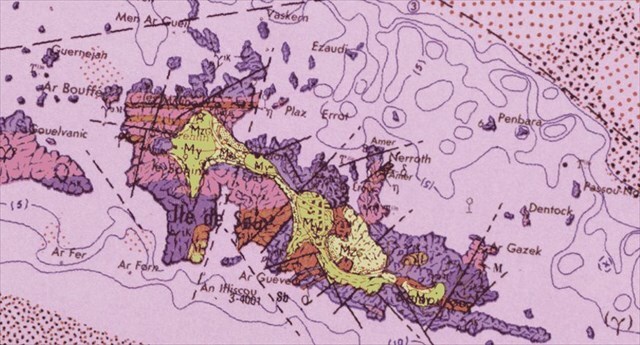
Cette combinaison entre socle ancien et formations côtières récentes fait de l’Île de Sein un véritable laboratoire naturel, révélant l’histoire géologique et l’évolution des paysages littoraux bretons.
Cette série de EarthCaches Géol'Enez-Sun va vous permettre, en parcourant cette île, d'en découvrir les secrets géologiques.
Dans ce quatrième épisode, nous allons découvrir les derniers lambeaux du socle antégranitique ayant résisté à la fusion anatectique à l'origine du socle granitique de l'île.
Ces lambeaux sont fait de migmatites, des formations métamorphiques qui portent bien leur surnom de roches de l'extrême et qui sont les dernières traces des formations originelles, des orthogneiss.
► Roche métamorphique et Migmatites
Une roche métamorphique est une roche secondaire issue de la métamorphisation (transformation sous l'effet de la pression et de la température) d'une roche primaire appelée protolithe.
Les migmatites sont régionalement associées à des roches métamorphiques de haut degré.
Il s'agit du stade ultime de métamorphisation (Hautes Pressions et Hautes Températures) avant fusion complète de la roche et transformation en un granite d'anatexie.

Elles sont qualifiées de roches anatectiques car issues d'une fusion partielle.
Leur structure s'explique par une sensibilité différentielle des minéraux à la fusion.
Dès 650°C, les minéraux clairs du protolithe (quartz et feldspath) fondent préférentiellement, formant un "jus anatectique" qui va cristalliser sur place avec une réorganisation minérale.
Dans une migmatite, nous allons donc trouver deux parties :
- Une partie ancienne non affectée par la fusion : le paléosome qui correspond au protolithe.
- Une partie nouvelle partiellement fondue, le néosome avec deux parties :
- le leucosome : clair, grenu, quartzo-feldsapthique, produit de la recristallisation du jus anatectique.
- le mélanosome : sombre, noir, bordant le leucosome et constitué de minéraux ferro-magnésiens réfractaires à la fusion (biotite, amphibole).
► La Migmatite de l'île de Sein, roche métamorphique de haut grade
Deux types de migmatites peuvent exister selon la proportion entre néosome et paléosome.
~ Métatexites
Les métatexites sont un premier stade de migmatites, dans lesquelles les structures n'ayant pas subi de fusion partielle (les paléosomes) sont larges et prépondérantes.
Dans ce stade initial, la structure globale de l'orthogneiss est conservée et néosome et paléosome s’agencent parallèlement à la foliation du protolithe, donnant une métatexite rubanée.

~ Diatexites
Les diatexites sont le stade le plus avancé de la métamorphisation de la roche. La proportion est inversée entre paléosome et néosome : la partie ayant fondue est largement prédominante.
Les parties non fondues (paléosome et partie réfractaire du néosome) vont prendre le nom de restite.
Le leucosome dessine des lits clairs plus ou moins parallèles entre eux et parallèles à la direction d’allongement des restites (lentilles de paragneiss) hérité de la foliation du protolithe.
La diatexite est dite « rubanée ».

► De la Migmatite au Granite d'anatexie
Si la pression et la température continue encore d'augmenter, les minéraux ferro-magnésiens, principalement de la biotite (minéral de couleur sombre), vont perdre leur foliation et se déplacer dans le nouveau magma pour se concentrer par endroits, formant des zones métriques bleues sombres, de contour peu définies, au milieu de la matrice granitique claire.

A reminder about Earthcaches
ATTENTION, there is no container to look for or logbook to fill in. All you have to do is go to the observation sites and complete the validation conditions below.
As the aim of a geology cache is to put a geology lesson into practice by making observations in the field, you are advised to read the description to help you answer the questions.
Questions to validate the geological cache
!!! HIDING PLACE MAY BE INACCESSIBLE AT HIGH TIDE !!!
Before venturing there, check the tide times on the island of Sein.
- Question 0 : Take a photo of yourself or your nickname with a place you like in the surrounding area (but not the observation area).
This photo can either be sent to us with your answers or added to your log.
Walk out onto the rocky outcrop marking the start of the beach and locate the areas shown in the WP1 photo.
- Question 1 : Describe the rock beneath the red area and deduce the type of migmatite forming this outcrop.
- Question 2 : Describe the rock beneath the blue area and specify which mineral in the migmatite is responsible for this colouration.
- Question 3 : Of the rocks in these two areas, which is most similar to the anatexis granite forming the bedrock of the island of Sein? Explain your answer.
You can log this cache without waiting for our confirmation, but you must send us the answers at the same time, by e-mail via our profile (fafahakkai) or by the system of Message Center of geocaching.com.
If there is a problem with your answers we will notify you. The logs recorded without answers will be deleted.
What does this mean in theory?
► Local geological context
Off the coast of Pointe du Raz, the island of Sein boasts topographical and geological features that are the result of a unique geological bedrock shaped by some of the most extreme natural forces.
This combination of ancient bedrock and recent coastal formations makes the island of Sein a veritable natural laboratory, revealing the geological history and evolution of Brittany’s coastal landscapes.
This series of Géol'Enez-Sun EarthCaches will allow you to discover the island’s geological secrets as you explore it.
In this fourth episode, we will explore the last remnants of the pre-granitic basement that withstood the anatectic melting which gave rise to the island’s granitic basement.
These remnants consist of migmatites, metamorphic formations that are aptly nicknamed ‘rocks of the extreme’ and which are the last traces of the original formations, the orthogneisses.
► Metamorphic rock and Migmatites
A metamorphic rock is a secondary rock resulting from the metamorphization (transformation under the effect of pressure and temperature) of a primary rock called a protolith.
Migmatites are regionally associated with high degree metamorphic rocks. This is the final stage of metamorphosis (High Pressures and High Temperatures) before complete melting of the rock and transformation into an anatexic granite.
They are qualified as anatectic rocks because they result from a partial fusion.
Their structure is explained by a differential sensitivity of minerals to fusion.
From 650 ° C, the clear minerals of the protolith (quartz and feldspar) preferentially melt, forming an "anatectic juice" which will crystallize on site with a mineral reorganization.
In a migmatite, we will therefore find two parts:
- An old part not affected by the fusion: the paleosome which corresponds to the protolith.
- A new part partially melted, the neosome with two parts:
- the leucosome: clear, grainy, quartzo-feldsaphic, product of the recrystallization of anatectic juice.
- the melanosome: dark, black, bordering the leucosome and made up of ferro-magnesian minerals refractory to fusion (biotite, amphibole).
► The Ile of Sein Migmatite, a high-grade metamorphic rock
Two types of migmatites coexist according to the proportion between neosome and paleosome.
~ Metatexites
Metatexites are a first stage of migmatites, in which structures that have not undergone partial fusion (paleosomes) are large and predominant.
In this initial stage, the overall structure of the paragneiss is preserved and the neosome and paleosome arrange parallel to the foliation of the protolith, resulting in a banded metatexite.
The anatectic juice can sometimes migrate locally in shear zones, giving transverse leucosome veins to the stratification.
The size of the leucosome crystals will depend on the rate of cooling. The slower the crystallization, the larger the crystals.
~ Diatexites
The diatexites are the most advanced stage in the metamorphosis of the rock. The proportion is reversed between paleosome and neosome: the part which has melted is largely predominant.
The unmelted parts (paleosome and refractory part of the neosome) will take the name of restite.
The leucosome forms clear beds more or less parallel to each other and parallel to the direction of elongation of the restites (paragneiss lenses) inherited from the foliation of the protolith.
The diatexite is said to be "banded".
► From Migmatite to Anatexis Granite
If the pressure and temperature continue to rise, the ferromagnesian minerals – mainly biotite (a dark-coloured mineral) – will lose their foliation and migrate into the new magma, where they will concentrate in certain areas, forming dark blue, metre-scale zones with indistinct boundaries amidst the light-coloured granitic matrix.
► Sources bibliographiques / Bibliographical sources