
FTF : cantor92/CarPat/poulpophile/
STF : Tomcat78
TTF : FredosleBolos

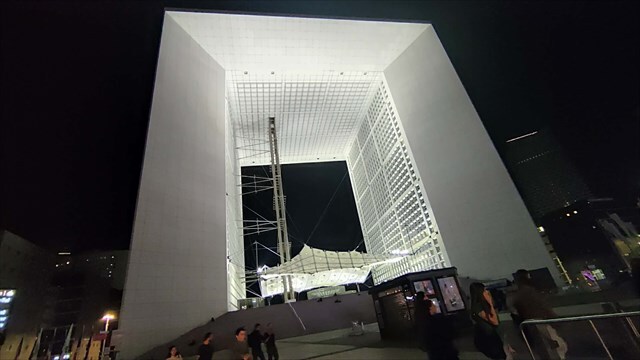
La Grande Arche en 2023
Pour valider votre découverte, vous devrez :
1. Loguer cette cache "Trouvée" en joignant la photo demandée (obligatoire).
2. M'envoyer vos propositions de réponses aux questions ci-dessous soit par email soit via la messagerie geocaching.com (Message Center).
Q1. Quel principal problème a-t-on rencontré avec le marbre utilisé pour la construction de la Grande Arche ?
Q2. En quoi la composition minéralogique du granite peut-elle contribuer à une meilleure résistance du parement ?
Q3. Question d’observation sur place : en observant la façade rénovée, quels éléments permettent de distinguer visuellement la texture du granite de celle que l’on attendrait d’un marbre poli ?
Si vous avez des doutes sur l’aspect du marbre de Carrare, vous trouverez une statue réalisée dans ce matériau (Les Quatre têtes) à proximité en N48°53.653, E002°14.200.
Indice : observez la cristalisation et la brillance.
Q4. Joindre une photo de vous ou de votre pseudo montrant en arrière plan la Grande Arche (montrer votre visage n'est pas obligatoire).
Je vous contacterai en cas de problème. Tout log non suivi des réponses dans un délai raisonnable sera effacé sans préavis.
Cette description est illustrée par des infographies générées par IA. Celles-ci peuvent présenter des imperfections. Veuillez vous référer au texte pour des informations plus précises.
L’évolution du parement en pierre de la Grande Arche
Conçue par l’architecte danois Johan Otto von Spreckelsen, avec la collaboration de l’ingénieur Erik Reitzel, la Grande Arche de La Défense avait perdu, en 2015, une partie de son attrait. Plusieurs éléments contribuaient à cette désaffection : un toit longtemps resté inexploité, la fermeture des ascenseurs panoramiques depuis 2010, ainsi que des espaces de bureaux jugés peu lumineux et mal adaptés aux usages actuels.
Mais les principaux problèmes venaient de sa conception. Inaugurée en 1989, elle était à l’origine revêtue de plaques de marbre blanc de Carrare. Ce choix participait fortement à l’image monumentale et lumineuse du bâtiment voulue par l’architecte danois Johan Otto von Spreckelsen qui était allé lui-même sélectionner les matériaux dans la carrière en Italie. Cependant, le comportement du marbre en façade s’est rapidement révélé problématique : dès le début des années 1990, des phénomènes de vieillissement et de décohésion ont été observés. La notice officielle du ministère de la Culture indique que le matériau, jugé trop poreux pour cette exposition, absorbait l’eau ; les plaques pouvaient se déformer, se bomber puis se décrocher.
La rénovation engagée à partir de 2014-2015 a donc conduit au remplacement du parement de marbre sur les parties concernées par un granite blanc, appelé « Bethel White », extrait au Vermont, aux États-Unis. Le choix, validé par l'architecte Paul Andreu, qui a achevé le bâtiment à la mort de Johan Otto, visait à conserver une apparence claire et lumineuse proche de celle du projet d’origine tout en utilisant une pierre plus adaptée à une façade fortement exposée aux intempéries. La rénovation a été achevée au printemps 2017.
Nous allons donc nous intéresser aux différences et aux points communs entre ces deux roches, principalement dans son usage en architecture.
Le marbre de Carrare : formation
Le marbre de Carrare est une roche métamorphique d'une grande pureté, issue de la transformation du calcaire sous l'effet de pressions et de températures élevées dans les Alpes Apuanes (Toscane, Italie).
• 1. Sédimentation carbonate (Sédimentation d'origine biologique) : Il y a environ 190 à 200 millions d'années (période du Jurassique inférieur), la région correspondant aujourd'hui à la Toscane était recouverte par une mer chaude et peu profonde. Des organismes marins (coquillages, micro-organismes) se sont accumulés au fond de l'eau, formant une épaisse couche de carbonate de calcium (boue carbonatée / calcaire sédimentaire).
• 2. Enfoncement et diagenèse : Au fil des millions d'années, ces sédiments ont été recouverts par de nouvelles couches géologiques. Sous l'effet du poids et du tassement, les sédiments se sont consolidés en roche sédimentaire dure (roche mère calcaire).
• 3. Métamorphisme régional (Orogenèse apenninique) : Lors de la collision des plaques tectoniques (notamment la fermeture de l'océan Téthys et la formation des Apennins il y a environ 20 à 30 millions d'années), la roche mère calcaire a été soumise à un métamorphisme régional intense : fortes pressions et températures élevées (environ 350°C à 450°C).
• 4. Recristallisation de la calcite : Sous l'action de ces conditions extrêmes, les cristaux de calcite d'origine se sont dissous et ont recristallisé pour former un réseau dense et imbriqué de micro-cristaux de calcite pure. Les fossiles et structures d'origine ont totalement disparu, donnant à la roche sa texture cristalline saccharoïde (aspect de sucre) caractéristiquement blanche et homogène.
• 5. Exhumation et surrection géologique : Les mouvements tectoniques ultérieurs et l'érosion des couches supérieures ont porté ce massif métamorphique à la surface, formant les Alpes Apuanes modernes et rendant le marbre accessible pour l'extraction.
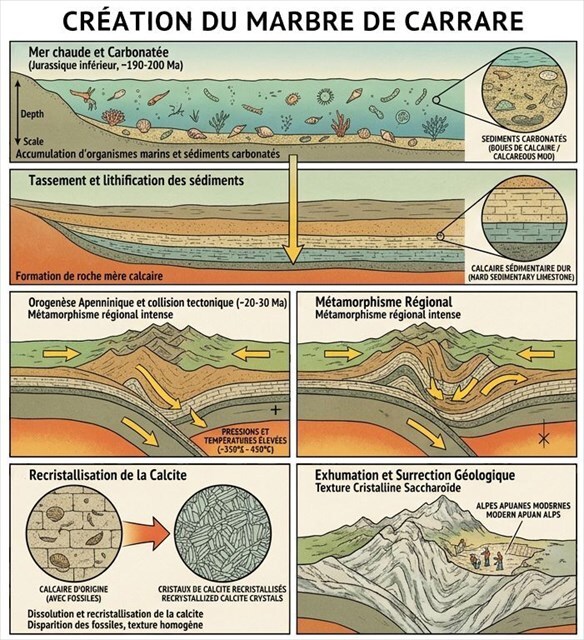
Le marbre de Carrare : principales caractéristiques pour l’architecture
Le marbre de Carrare est essentiellement constitué de calcite, un carbonate de calcium recristallisé. Sa couleur blanche à gris très clair et son aspect lumineux expliquent son emploi historique dans la sculpture et l’architecture.
• Avantages : aspect blanc et lumineux ; grande valeur esthétique et patrimoniale ; possibilité d’obtenir une surface polie brillante ; matériau emblématique de l’architecture monumentale.
• Inconvénients pour la Grande Arche : sensibilité au vieillissement en façade extérieure ; la calcite est vulnérable aux attaques chimiques en milieu acide ; surtout, dans le cas de la Grande Arche, le marbre a connu une perte de cohésion et une augmentation de la porosité sous l’effet combiné de l’eau, du gel, du dégel et des intempéries. Le risque de détachement de fragments a nécessité une intervention importante.
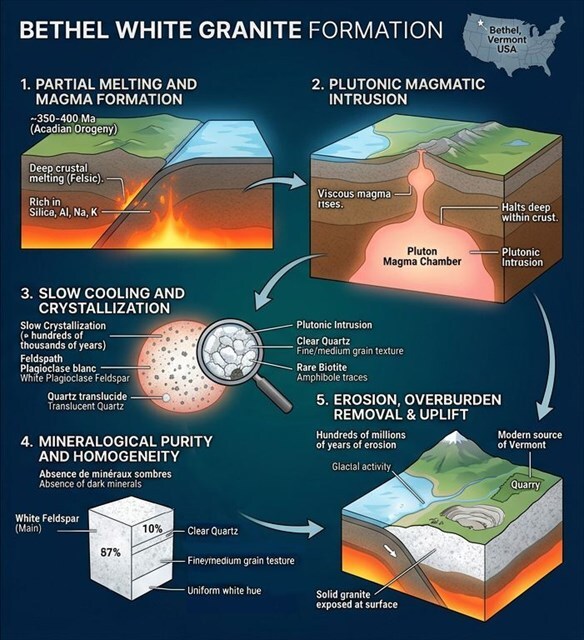
Le granite blanc Bethel White : formation
Le granite Bethel White est une roche magmatique plutonique (ou intrusive) célèbre pour sa couleur blanche extrêmement uniforme et sa texture à grain fin à moyen. Il est extrait à Bethel, dans le Vermont (États-Unis).
• 1. Fusion partielle et formation du magma : Il y a environ 350 à 400 millions d'années (pendant l'orogenèse acadienne / dévonienne), la fusion partielle de roches de la croûte terrestre profonde en contexte collisionnel a généré un magma felsique très riche en silice, aluminium, sodium et potassium.
• 2. Intrusion magmatique plutonique : Ce magma visqueux est remonté à travers la croûte terrestre mais s'est arrêté à plusieurs kilomètres sous la surface, formant une chambre magmatique ou un pluton intrusif.
• 3. Refroidissement lent et cristallisation : Isolé en profondeur, le magma a refroidi de manière très lente sur des centaines de milliers d'années. Ce refroidissement lent a permis aux minéraux de cristalliser de façon distincte : feldspath plagioclase blanc/laiteux, quartz translucide et très rares traces de biotite ou d'amphibole.
• 4. Pureté et homogénéité minéralogique : L'absence quasi totale de minéraux ferromagnésiens sombres (comme la biotite foncée ou la magnétite) confère au granite Bethel White sa teinte blanche exceptionnellement claire et sa structure très homogène.
• 5. Érosion, décapage continental et uplift : Au cours de centaines de millions d'années, l'érosion des montagnes et l'activité glaciaire en Amérique du Nord ont décapé les kilomètres de roches continentales qui recouvraient le pluton, exposant le granite solide à la surface.
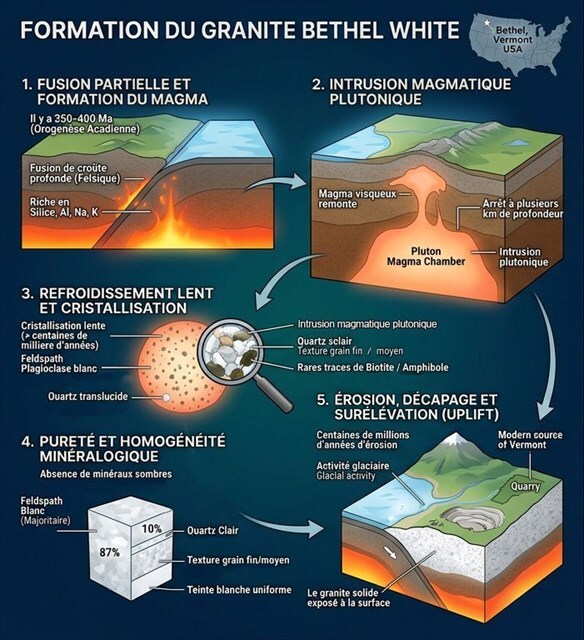
Le granite blanc Bethel White : principales caractéristiques pour l’architecture
Le granite est une roche magmatique cristalline composée principalement de quartz et de feldspaths, auxquels peuvent s’ajouter des micas et d’autres minéraux. Le granite blanc choisi pour la rénovation de la Grande Arche est désigné sous le nom de « Bethel White » et provient d’une carrière du Vermont.
• Avantages : bonne résistance mécanique et excellente aptitude à un usage extérieur ; minéraux silicatés, notamment quartz et feldspaths, généralement plus résistants aux attaques acides que la calcite ; bonne durabilité ; aspect clair pouvant être traité pour retrouver une teinte et une brillance proches du parement d’origine.
• Inconvénients : aspect et texture différents de ceux d’un marbre de Carrare ; remplacement qui modifie donc, même légèrement, l’aspect et la conception du projet initial ; matériau très dense, dont la mise en œuvre doit être soigneusement adaptée au système de façade ; provenance lointaine dans le cas du Bethel White utilisé pour la Grande Arche.
Comparaison synthétique
| Critère |
Marbre de Carrare |
Granite blanc |
| Nature |
Roche métamorphique dominée par la calcite |
Roche magmatique cristalline, riche en quartz et feldspaths |
| Aspect |
Blanc, lumineux, veiné selon les variétés |
Clair à blanc, aspect plus granuleux/cristallin |
| Atout principal |
Qualité esthétique et finition polie. Grain très fin voir invisible. |
Durabilité et résistance pour un usage extérieur |
| Point faible en façade |
Sensibilité à certains mécanismes d’altération et de décohésion |
Aspect différent du marbre et forte densité impliquant de repenser la fixation |
| Pertinence pour la Grande Arche |
Correspond au choix architectural initial mais s’est révélé insuffisamment durable dans les conditions réelles d’érosion |
Permet de conserver une image claire tout en améliorant la durabilité du parement |
Note méthodologique : Les avantages et inconvénients présentés ici concernent l’usage des matériaux comme parement extérieur de la Grande Arche. Les performances réelles d’une pierre dépendent aussi de sa variété précise, de son épaisseur, de son traitement de surface, de son système de fixation et de son exposition.
Sources consultées
• Batiactu, « À La Défense, la Grande Arche troque son marbre contre du granit », 19 juin 2015. https://www.batiactu.com/edito/a-la-defense-la-grande-arche-troque-le-marbre-cont-41533.php
• Ministère de la Culture – POP, notice Mérimée « Arche de la Fraternité, dite Grande Arche de La Défense et parvis de La Défense ». https://pop.culture.gouv.fr/notice/merimee/ACR0000683
• Eiffage Construction, « Rénovation de la Grande Arche de La Défense ». https://www.eiffageconstruction.com/realisations/renovation-grande-arche-la-defense
• U.S. Geological Survey, informations sur les pierres de construction et la résistance des minéraux silicatés et carbonatés. https://pubs.usgs.gov/gip/acidrain/3.html
• U.S. Geological Survey, « Barre Granite ». https://www.usgs.gov/media/images/barre-granite
• Smithsonian Museum Conservation Institute, référence sur l’évolution structurale et la perte de cohésion du marbre de Carrare exposé au vieillissement. https://mci.si.edu/node/1219618
Pourquoi "VERT" ?
Ma première cache posée (GC3VHY2) était une boîte verte, avec un stylo vert, un log book vert et des objets d'échange verts. Ainsi est née l'idée de placer les caches qui ont suivi sous le signe du "VERT" et de proposer un défi consistant à y déposer de préférence des objets "VERTs". Ce défi ne peut malheureusement pas concerner les earthcaches.
------------oOo------------

Note: some parts are written with the help of automatic translator. Tecnical vocabulary issues may occure
To validate your discovery, you will need:
1. Log this cache "Found" by attaching the requested photo (mandatory).
2. Send me your suggested answers to the questions below via the email service geocaching.com (Message Center).
Q1. What was the main problem encountered with the marble used in the construction of the Grande Arche?
Q2. How can the mineralogical composition of granite contribute to better cladding resistance?
Q3. On-site observation question: when observing the renovated façade, what features make it possible to distinguish the texture of granite visually from that expected of polished marble?
If you are unsure about the appearance of Carrara marble, you will find a statue made from this material (Les Quatre têtes) nearby at N48°53.653, E002°14.200.
Hint: observe the crystallization and gloss.
Q4. Attach a photo of you or your username showing in the background the Grande Arche (showing your face is not mandatory).
I will contact you if there is a problem. Any log not followed by the answers within a reasonable period will be deleted without prior notice.
This description is illustrated by AI-generated infographics. These may contain imperfections. Please refer to the text for more precise information.
The evolution of the stone cladding of the Grande Arche
Designed by Danish architect Johan Otto von Spreckelsen, in collaboration with engineer Erik Reitzel, the Grande Arche de La Défense had lost some of its appeal by 2015. Several factors contributed to this decline: a roof that had remained unused for a long time, the closure of the panoramic elevators since 2010, as well as office spaces considered too dim and poorly suited to current uses.
But the main problems came from its design: inaugurated in 1989, it was originally clad in white Carrara marble. This choice strongly contributed to the monumental and luminous appearance of the building sought by Danish architect Johan Otto von Spreckelsen, who personally went to the quarry in Italy to select the materials. However, the behaviour of the marble on the façade quickly proved problematic: as early as the 1990s, ageing and loss of cohesion were observed. The official notice of the French Ministry of Culture indicates that the material, considered too porous for this exposure, absorbed water; the slabs could deform, bulge and then detach.
The renovation undertaken from 2014–2015 therefore led to the replacement of the marble cladding on the affected parts with a white granite called “Bethel White”, quarried in Vermont, United States. The choice, approved by architect Paul Andreu, who completed the building after Johan Otto’s death, aimed to preserve a light and bright appearance close to that of the original design while using a stone better suited to a façade highly exposed to weathering. The renovation was completed in spring 2017.
We will therefore examine the differences and similarities between these two rocks, mainly in terms of their use in architecture.
Carrara marble: formation
Carrara marble is a highly pure metamorphic rock resulting from the transformation of limestone under high pressures and temperatures in the Apuan Alps (Tuscany, Italy).
• 1. Carbonate sedimentation (sedimentation of biological origin): About 190 to 200 million years ago (Early Jurassic), the region corresponding to present-day Tuscany was covered by a warm, shallow sea. Marine organisms (shells, microorganisms) accumulated on the seafloor, forming a thick layer of calcium carbonate (carbonate mud / sedimentary limestone).
• 2. Burial and diagenesis: Over millions of years, these sediments were covered by new geological layers. Under the effect of their weight and compaction, the sediments became consolidated into hard sedimentary rock (the limestone protolith).
• 3. Regional metamorphism (Apennine orogeny): During the collision of tectonic plates (notably the closure of the Tethys Ocean and the formation of the Apennines about 20 to 30 million years ago), the limestone protolith underwent intense regional metamorphism: high pressures and elevated temperatures (approximately 350°C to 450°C).
• 4. Recrystallization of calcite: Under these extreme conditions, the original calcite crystals dissolved and recrystallized to form a dense, interlocking network of microcrystals of pure calcite. Fossils and original structures completely disappeared, giving the rock its characteristic white, homogeneous saccharoidal (sugar-like) crystalline texture.
• 5. Exhumation and geological uplift: Subsequent tectonic movements and erosion of the overlying layers brought this metamorphic massif to the surface, forming the modern Apuan Alps and making the marble accessible for quarrying.
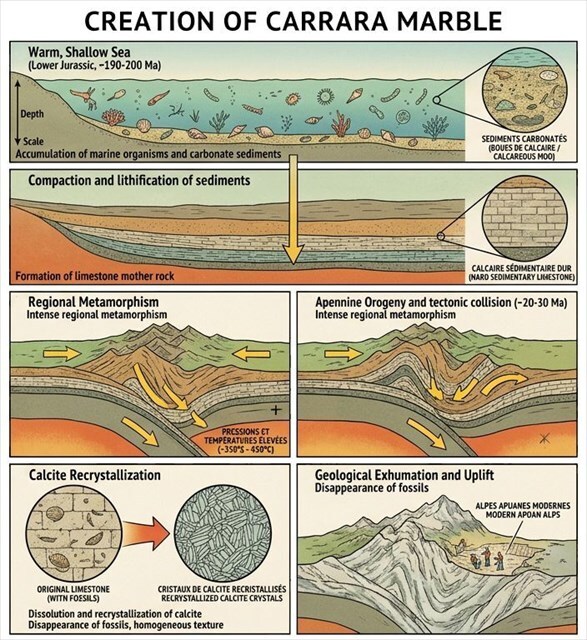
Carrara marble: main characteristics for architecture
Carrara marble is mainly composed of calcite, a recrystallized calcium carbonate. Its white to very light grey colour and luminous appearance explain its historical use in sculpture and architecture.
• Advantages: white and luminous appearance; high aesthetic and heritage value; possibility of obtaining a bright polished surface; an emblematic material of monumental architecture.
• Disadvantages for the Grande Arche: sensitivity to ageing on an exterior façade; calcite is vulnerable to chemical attack in acidic environments; above all, in the case of the Grande Arche, the marble experienced loss of cohesion and increased porosity under the combined effects of water, freezing, thawing and weathering. The risk of fragment detachment required major intervention.
Bethel White granite: formation
Bethel White granite is a plutonic (or intrusive) igneous rock, famous for its extremely uniform white colour and fine- to medium-grained texture. It is quarried at Bethel, Vermont (United States).
• 1. Partial melting and magma formation: About 350 to 400 million years ago (during the Acadian / Devonian orogeny), partial melting of deep continental crustal rocks in a collisional setting generated a felsic magma very rich in silica, aluminium, sodium and potassium.
• 2. Plutonic magmatic intrusion: This viscous magma rose through the Earth’s crust but stopped several kilometres below the surface, forming a magma chamber or intrusive pluton.
• 3. Slow cooling and crystallization: Isolated at depth, the magma cooled very slowly over hundreds of thousands of years. This slow cooling allowed minerals to crystallize as distinct grains: white/milky plagioclase feldspar, translucent quartz, and very small amounts of biotite or amphibole.
• 4. Mineralogical purity and homogeneity: The near-total absence of dark ferromagnesian minerals (such as dark biotite or magnetite) gives Bethel White granite its exceptionally light colour and very homogeneous structure.
• 5. Erosion, continental stripping and uplift: Over hundreds of millions of years, mountain erosion and glacial activity in North America stripped away the kilometres of continental rocks that covered the pluton, exposing the solid granite at the surface.
Bethel White granite: main characteristics for architecture
Granite is a crystalline igneous rock composed mainly of quartz and feldspars, with micas and other minerals potentially also present. The white granite chosen for the renovation of the Grande Arche is known as “Bethel White” and comes from a quarry in Vermont.
• Advantages: good mechanical strength and excellent suitability for outdoor use; silicate minerals, particularly quartz and feldspars, are generally more resistant to acid attack than calcite; good durability; light appearance that can be treated to recover a colour and gloss close to those of the original cladding.
• Disadvantages: appearance and texture different from those of Carrara marble; replacement therefore slightly modifies the appearance and design of the original project; very dense material, whose installation must be carefully adapted to the façade system; long-distance provenance in the case of the Bethel White used for the Grande Arche.
Summary comparison
|
Criterion
|
Carrara marble
|
White granite
|
|
Nature
|
Metamorphic rock dominated by calcite
|
Crystalline igneous rock, rich in quartz and feldspars
|
|
Appearance
|
White, luminous, veined depending on the variety
|
Light to white, more granular/crystalline appearance
|
|
Main advantage
|
Aesthetic quality and polished finish. Very fine, almost invisible grain.
|
Durability and resistance for outdoor use
|
|
Weakness on the façade
|
Sensitivity to certain weathering and loss-of-cohesion mechanisms
|
Appearance different from marble and high density requiring the fixing system to be reconsidered
|
|
Suitability for the Grande Arche
|
Matches the original architectural choice but proved insufficiently durable under actual weathering conditions
|
Maintains a light appearance while improving the durability of the cladding
|
Methodological note: The advantages and disadvantages presented here concern the use of materials as exterior cladding of the Grande Arche. The actual performance of a stone also depends on its precise variety, thickness, surface treatment, fixing system and exposure.
Sources consulted
• Batiactu, “À La Défense, la Grande Arche troque son marbre contre du granit”, 19 June 2015. https://www.batiactu.com/edito/a-la-defense-la-grande-arche-troque-le-marbre-cont-41533.php
• French Ministry of Culture – POP, Mérimée record “Arche de la Fraternité, dite Grande Arche de La Défense et parvis de La Défense”. https://pop.culture.gouv.fr/notice/merimee/ACR0000683
• Eiffage Construction, “Rénovation de la Grande Arche de La Défense”. https://www.eiffageconstruction.com/realisations/renovation-grande-arche-la-defense
• U.S. Geological Survey, information on building stones and the resistance of silicate and carbonate minerals. https://pubs.usgs.gov/gip/acidrain/3.html
• U.S. Geological Survey, “Barre Granite”. https://www.usgs.gov/media/images/barre-granite
• Smithsonian Museum Conservation Institute, reference on the structural evolution and loss of cohesion of Carrara marble exposed to weathering. https://mci.si.edu/node/1219618
Why "VERT"
My first geocache ( GC3VHY2) was a green box, with a green pen, a green log book and green items for exchange. So was born the idea to place the caches which followed under the sign of the "VERT" ("GREEN" in French) and to propose a game consisting in depositing there rather "VERT" objects. This game cannot unfortunately concern the earthcaches.
.