Update June 3, 2026: The information boards have not yet been put back up. Therefore, there is no need to answer Question 4 at this time.
It would be great if someone could send me photos of the information boards once they have been put back up :).
Aktuelle Info vom 03.06.2026: Im Moment sind die Infotafeln noch nicht wieder aufgestellt. Frage 4 muss daher derzeit nicht beantwortet werden.
Es wäre schön, wenn mir jemand Fotos von den Infotafeln zukommen lässt, wenn diese wieder aufgestellt wurden :).
|
Please do NOT send your answers via the geocaching.com messenger, please use the given email adress "psychrocave [at] gmail.com". Thanks
Schickt eure Antworten bitte NICHT über den geocaching.com Messenger, sondern nutzt bitte die angegebene E-Mail Adresse "psychrocave [at] gmail.com". Danke |

I discovered this admirable place during my summer holidays. In Crete are more than 5,000 caves. They are a unique and vulnerable part of our natural heritage and have always had a fascination to humans. Where to meet present and past, are important archives of Earth history. Caves contain valuable information about the development of human cultures, wildlife, and provide information about the origins of the landscape and the effects of climate and environmental changes.
General advice
From the parking lot to the entrance of the cave it is about 600m walk. There is also the possibility to ride with mules high, but the prices for it are unreasonably high. It is recommended to wear resistant non-slip shoes.
To log this earthcache it is necessary to pay the entrance and visit the cave.
Costs:
Parking: 2,50 €
Adults: 15,00 €
Reduced: 8,00 €
Opening times:
10:30 a.m. to 5:30 p.m. (closed on Tuesdays)
Last admission: One hour before closing
Because this cave is so special, please pay attention, that you only take picture without any flashes. Also very important is that you don’t touch anything. It is easily damaging the dripstones when they get touched several times a day.
For further information see: http://odysseus.culture.gr/h/2/eh251.jsp?obj_id=1628
Psychro Cave - The cave of Zeus
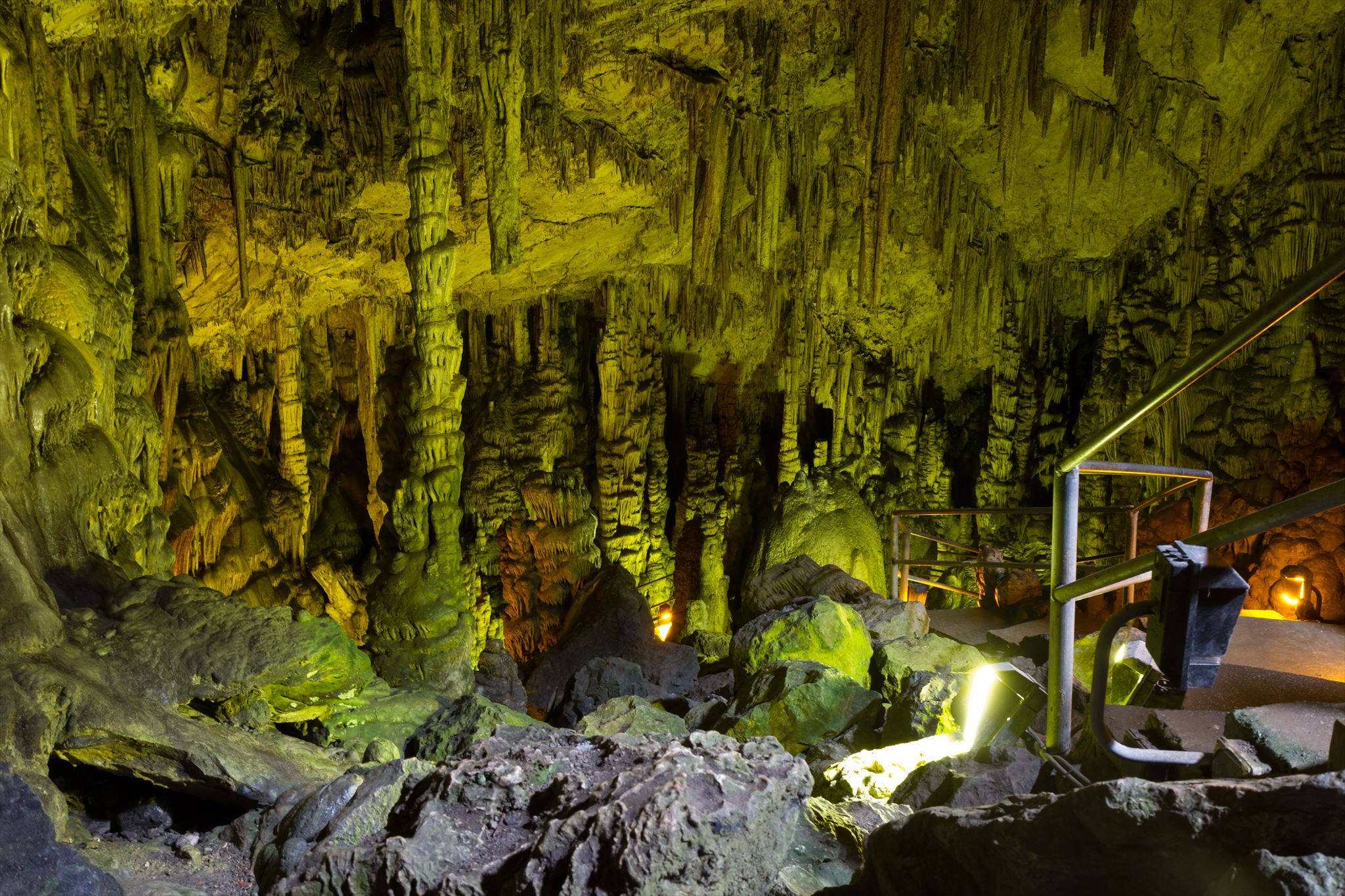
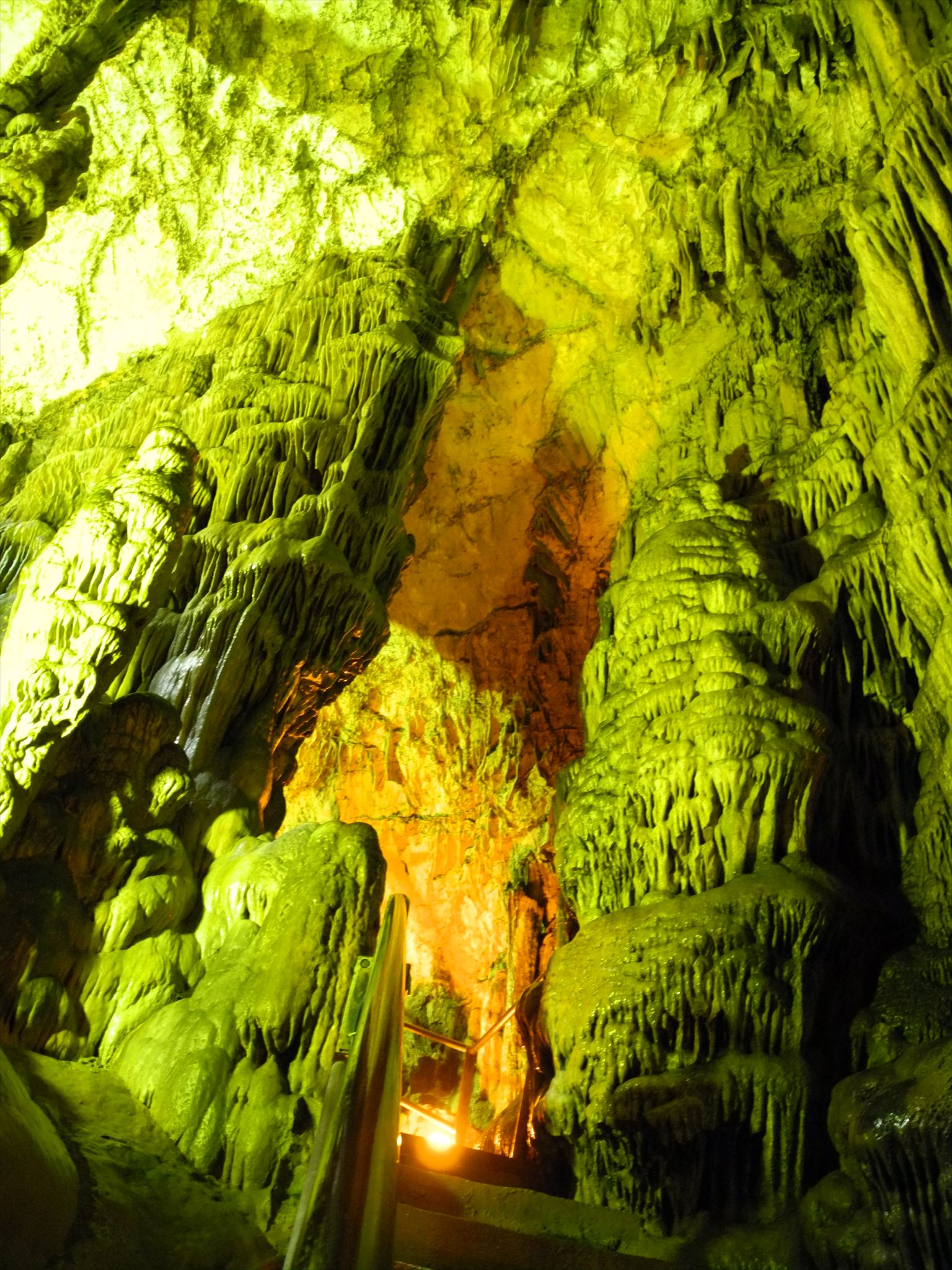
The cave is located in Psychro above the Lasithi Plateau and is 1,025 m above sea level. It is one of the most important cultural places in Crete where you can watch the beautiful dripstone formations and sintering.
In the last decades of the previous century inhabitants of the area have found ancient and historical objects in the cave, what the archaeologists Joseph Hatzidakis moved to carry out excavations in 1886. In the years 1897 - 1899 A. Evans, J. and G. Hogarth Demargne took further excavations place; this but all on a small scale. In 1961 some legal and illegal excavations of J. Boardman were published, whose numerous finds are on display as exhibits in the Heraklion Museum and the Ashmolean Museum in Oxford.
History of Crete
Geology
The history of Crete depends on the tectonic processes between the European and the African continent. Both were united about 300 to 150 million years ago in the supercontinent Pangea. Then slowly Pangaea broke into today's continents, and the ancient sea-Tethys began to close. In the Tertiary (beginning 65 million years ago) Africa drifted closer and closer to Europe. It led to the Alps, the Dinaric Mountains in Yugoslavia, the island of Crete, and other, this was called the "alpidic fold." Crete, including the Aegean Sea in the north, lies on the Anatolian micro-plate, which still is squeezed between Europe and Africa, and drifts slowly westward. With such operations earthquakes and volcanism are connected. Thus the largest earthquake of modern times was in 438 AD, the island of Crete on the east side lowered about 4 meters below the sea level and on the west side raised up to 8.5 meters. On the southern coast of Crete goes up to 5000 m deep. Here lies the Hellenic subduction zone, a 1000 km long tectonic rift between European and African plates, where the African plate is pushed under the European.
Legends
The Dictaean cave is famous in Greek mythology as the place where Amalthea, perhaps known in Crete as Dikte, nurtured the infant Zeus with her goat's milk, the mythic connection to the long use as a site of cult attested here by its archaeology. The nurse of Zeus, who was charged by Rhea to raise the infant Zeus in secret here, to protect him from his father Cronus (Krónos) is also called the nymph Adrasteia in some contexts. It is one of a number of caves believed to have been the birthplace or hiding place of Zeus.
Formation of stalactites
Precipitation absorbs carbon dioxide from the atmosphere, seeping into the ground, where it absorbs organic acids. This can be solved in the water from the limestone calcium carbonate (lime). This dissolved limestone combines with the carbon dioxide to calcium hydrogen carbonate, which is soluble in water. Upon reaching the cave ceiling, this solution drips through existing rocks. For following the entry of atmospheric carbon dioxide escapes, the calcium hydrogen carbonate transforms itself back into the poorly water-soluble calcium carbonate (lime). The water evaporates, leaving behind the lime, which forms during the course of millennia, the stalactites and stalagmites.
What you need to log this Earthcache
To log this earthcache you need visit the cave and answer the following questions.
The first question can be answered with the help of this cache description.
The second, third and fourth question will be answered by yourself in the cave.
- What kind of cave is the Psychro Cave (read the text below)?
- Estimate how large is the biggest stalagmite?
- What does the tourists left in the back part of the cave?
- Look at the information board (see coordinates at additional waypoints):
"The excavation started from the so-called Upper Cave, which rather resembles a rock-shelter and has no stalactites..."
Question: How wide and how deep is it and how many chambers consists it?
- Take a picture of you or a personal item in the cave and attache it to you online log.
Please send your answers including you GC-nickname in the subject to "psychrocave [at] gmail.com".
You are instant allowed to log. If your answers are wrong, I'll speak up if necessary with you.
Logs without PRIOR mail to this address will be deleted without any comment!
Background informations for answering the questions:
Primary and secondary caves
- Primary caves: Those caves are formed at the same time as the surrounding rock. Basically it is all about lava caves which come into existence when gases are locked in the solidified lava. Most of the time those caves get opened by a coincidence. Also lava caves which are longer than a few kilometers exist. Those lava canals are formed because the surface solidified and the lava below the surface continued flowing until the eruption came to an end. You can find such caves in Hawaii, Iceland and the Canary Island.
- Secondary caves: Those caves developed later than their surrounding rock. This category of caves evolved from corrosion (chemical decomposition), erosion (mechanical decomposition), tectonics (movements of the lithosphere) or a combination of all those influences. Secondary caves can be found in rocks, which are water soluble as for example different types of limestone.

Diesen absolut bewundernswerten Ort habe ich in meinem Sommerurlaub entdeckt. Auf Kreta gibt es mehr als 5.000 Höhlen. Sie sind ein einzigartiger und verletzlicher Teil unseres naturhistorischen Erbes und üben seit jeher eine Faszination auf den Menschen aus. Dort wo Gegenwart und Vergangenheit sich begegnen, liegen bedeutende Archive der Erdgeschichte. Höhlen enthalten wertvolle Informationen über die Entwicklung der menschlichen Kulturen, der Tierwelt, und geben Auskunft über die Entstehung der Landschaft und die Auswirkungen von Klima- und Umweltveränderungen.
Allgemeine Informationen
Vom Parkplatz zum Eingang der Höhle sind es ca. 600m zu Fuß. Es gibt auch die Möglichkeit mit Maultieren hochzureiten, die Preise dafür sind aber unangemessen hoch. Es empfiehlt sich feste rutschfeste Schuhe anzuziehen.
Um diesen Earthcache loggen zu können, ist es nötig den Eintritt zu dieser Höhle bezahlen.
Kosten:
Parkplatz: 2,50€
Erwachsene: 15,00€
Ermäßigt: 8,00€
Öffnungszeiten:
10:30 – 17:30 Uhr (dienstags geschlossen)
Letzter Einlass: Eine Stunde vor Schließung
Da diese Höhle etwas ganz Besonderes ist, achte bitte darauf, dass du Fotos nur mit ohne Blitz schießt. Ganz besonders wichtig ist es ebenfalls, dass du dort nichts anfasst. Es schadet den Tropfsteinen ungemein, wenn sie mehrmals täglich berührt werden.
Weitere Informationen siehe:
http://odysseus.culture.gr/h/2/eh251.jsp?obj_id=1628
Die Höhle von Psychro – die Zeus-Höhle
Die Höhle befindet sich in Psychro, oberhalb der Lasithi-Hochebene und ist 1.025 m über dem Meeresspiegel gelegen. Sie ist einer der bedeutendsten kulturellen Orte auf Kreta und gibt es wunderwolle Formationen der Tropfsteine und Versinterungen zu sehen.
In den letzten Jahrzehnten des vorherigen Jahrhunderts haben Bewohner der Umgebung in der Höhle altertümliche und historische Gegenstände gefunden, was den Archäologen Joseph Chatzidakis dazu bewegte 1886 Ausgrabungen durchzuführen. In den Jahren 1897 – 1899 fanden von A. Evans, J. Demargne und G. Hogarth weitere Ausgrabungen statt; diese aber alle nur in kleinem Umfang. 1961 wurden noch einmal einige legale und illegale Ausgrabungen von J. Boardman veröffentlich, dessen zahlreiche Funde als Exponate im Herakleion Museum und dem Ashmolean Museum in Oxford ausgestellt sind.
Geschichte Kretas
Geologie
Die Entstehungsgeschichte Kretas hängt von den tektonischen Vorgängen zwischen dem europäischen und dem afrikanischen Kontinent ab. Beide waren vor etwa 300 bis 150 Millionen Jahren im Superkontinent Pangäa vereinigt. Danach zerbrach Pangäa langsam in die heutigen Kontinente, und das Tethys-Urmeer begann sich zu schließen. Im Tertiär (Beginn vor 65 Mio. Jahren) driftete Afrika immer näher an Europa heran. Dabei entstanden die Alpen, das Dinarische Gebirge in Jugoslawien, die Insel Kreta usw., dies wurde die „Alpidische Faltung“ genannt. Kreta samt dem Ägäischen Meer im Norden liegt auf der Anatolischen Mikro-Platte, die heute noch zwischen Europa und Afrika gequetscht wird, und langsam nach Westen driftet. So etwas geht nicht ohne Erdbeben und Vulkanismus ab. So hat das bisher größte Erdbeben der Neuzeit im Jahre 438 n. Chr. die Insel Kreta an der Ostseite ca. 4 Meter unter den Meeresspiegel abgesenkt und an der Westseite um bis zu 8,5 Meter angehoben. An der Südküste Kretas geht es steil in bis 5000 m Tiefe. Hier liegt die Hellenische Subduktionszone, ein knapp 1000 km langer tektonischer Graben zwischen der europäischen und der afrikanischen Platte, bei der die afrikanische unter die europäische Platte geschoben wird.
Sage
Die Höhle war eine wichtige Kultstätte der Minoer, was durch Funde belegt wird, die bis in die frühminoische Epoche (etwa 2800 v. Chr.) zurückreichen. Mit diesem Kult steht möglicherweise der griechische Mythos in Verbindung, wonach Zeus in dieser Höhle geboren worden war und von Amaltheia und den Kureten versorgt wurde. Die Höhle von Psychro wurde als diese mythische Höhle identifiziert, die im Altertum Δικταίον Αντρον (Dikteion Antron, „Diktäische Höhle“) genannt wurde.
Entstehung von Tropfsteinen
Der Niederschlag nimmt aus der Atmosphäre Kohlenstoffdioxid auf, versickert im Boden und nimmt dort organische Säuren auf. Dadurch kann aus dem Kalkstein Calciumcarbonat (Kalk) im Wasser gelöst werden. Dieser gelöste Kalk verbindet sich mit dem Kohlenstoffdioxid zu Calciumhydrogencarbonat, welches gut wasserlöslich ist. Beim Erreichen einer Höhlendecke tropft diese Lösung durch vorhandene Felsspalten. Beim nun erfolgenden Zutritt von Luft entweicht das Kohlenstoffdioxid, das Calciumhydrogencarbonat wandelt sich wieder in das schwer wasserlösliche Calciumcarbonat (Kalk) um. Das Wasser verdunstet, übrig bleibt Kalk, welcher im Laufe von Jahrtausenden die Tropfsteine bildet.
Was benötigt wird, um diesen Earthcache loggen zu dürfen
Um diesen Earthcache ist zu loggen, ist es nötig die Höhle zu besuchen und folgende Fragen zu beantworten.
Die erste Frage kann mithilfe der Cachebeschreibung beantwortet werden.
Die zweite, dritte und vierte Frage muss von euch vor Ort beantwortet werden.
- Um welche Art von Höhle handelt es sich hier (Siehe Text unten)?
- Schätze, wie groß ist der größte Stalagmit in der Höhle?
- Was hinterlassen die Touristen im hinteren Teil der Höhle?
- Schau auf die Infotafel (Die Koordinaten findest du in den zusätzlichen Wegpunkten):
"Die Ausgrabungen an der sogenannten oberen Höhle begannen, die eher einem Felsendach ähnelt und keine Tropfsteine hat...."
Frage: Wie breit und wie tief ist es und aus wie vielen Kammern besteht es? (Die Antworten sind nur auf Englisch verfügbar)
- Mache ein Foto von dir oder einem persönlichen Gegenstand in der Höhle und hänge es deinem Online-Log an.