The following information about cougars comes from Riding
Mountain National Park interpretive staff who have an accidently
snared cougar on display at the Visitor Centre in Wasagaming. The
cougar was snared a few km southeast of the cache but there have
been observations of cougars all around this area for the past ten
years. Try as we might we have not seen one in 12 years of
looking.
Texte français ci-dessous
Cougars in the Riding Mountain
Area
Though rare and elusive, it is beyond a doubt that cougars are
an established species in and around Riding Mountain National Park.
As a result of many years of documented sightings, it has long been
accepted that cougars, or puma concolor, are resident in the
province of Manitoba. However, two cougars killed in rapid
succession near the northern and southern boundaries of the park,
have provided concrete physical evidence of the animal’s presence
in the area.
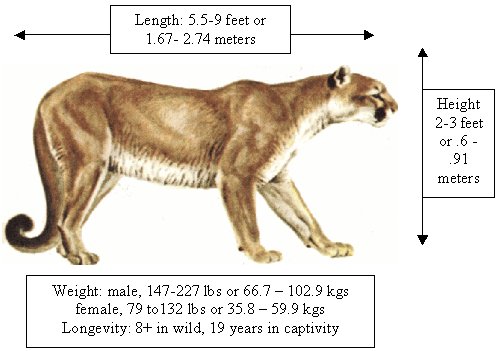
Cougars are a protected species in Manitoba under The
Wildlife Act and it is illegal to deliberately kill one, even
in defence of property. The cougar on display in the Visitor Centre
is a male, taken accidentally by a licensed trapper just east of
Erickson, December 30, 2004. Weighing 115 pounds at the time of
death, the adult male cougar was in excellent condition, displaying
adequate stores of abdominal fat for midwinter.
Encounters with cougars are extremely rare due to their low
numbers, stealth, and general desire to avoid contact with humans.
In Riding Mountain’s history, there has been no incident of a
cougar attack involving a human, and it is important not to
misrepresent the very minimal risk posed by these animals. However,
there are a few basic safety tips to keep in mind in the rare
chance that you may encounter a cougar on a trail:
1. Maintain eye contact. Pick up small children (so they do not
panic and run)
2. Do not approach the cougar. Give the Cougar a way to escape –
most will try to avoid a confrontation.
3. Stand and face the cougar. Do not crouch down. A lower
profile may suggest to the cougar the shape of its four-legged
prey.
4. If the cougar does not leave immediately, do what you can to
scare it away. Try to appear large and intimidating. Open your
jacket if you are wearing one. Wave your arms and speak firmly in a
loud, low voice. Wave your arms and shout. Throw things.
5. Fight back if attacked. Throw stones, branches, or whatever
you can reach without looking away or turning your back. Do not
play dead.
6. To avoid confrontations, keep a clean campsite and your pets
on a leash.
Have You Seen a Cougar?
Here are some quick points of reference to help you know the
signs of a cougar.
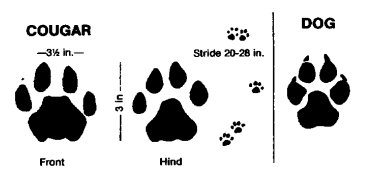
Tracks: The primary difference between cougar tracks and
those of animals of comparative size is the absence of claws in the
cougar track – this is because the cougar’s claws are
retractable.
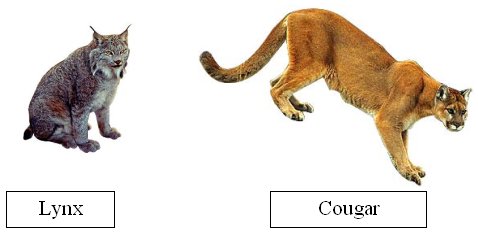
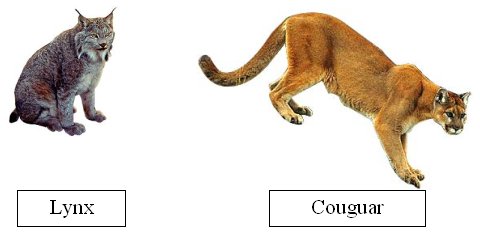
Cougar or Lynx: Cougars are commonly confused with Lynx.
Here are a few hints to help tell them apart.
1. The Cougar’s tail that can reach as long as 35 inches or 88.9
cm compared to the Lynx’s 2-5 inch or 5 - 12.7 cm tail.
2. Cougars tend to be much larger in size than the Lynx,
weighing as much as 230 lbs or 103 kgs. The Cougar far outweighs
lynx, which commonly reaches weights of only 20-40 lbs or 9–18
kgs.
3. Other differences include the tufts of hair on the lynx’s
ears (absent on the cougar), and the colouring of each animal –
typically grey for the lynx and tawny brown for the
cougar.
Important - please report
cougar sightings, either to Riding Mountain staff or to Manitoba
Conservation
- - - - - - - - - -
Les couguars dans la région du
Mont-Riding
Quoique rare et mystérieux, le couguar est bel et bien une
espèce établie dans le parc national du Mont-Riding et dans les
environs. Compte tenu des signalements recueillis depuis de
nombreuses années, il est accepté depuis longtemps que le couguar,
ou puma concolor, est un résidant de la province du
Manitoba. Cependant, deux couguars ayant été tués dans un court
intervalle près des limites nord et sud du parc ont fourni une
preuve concrète de la présence de cette espèce dans la région.
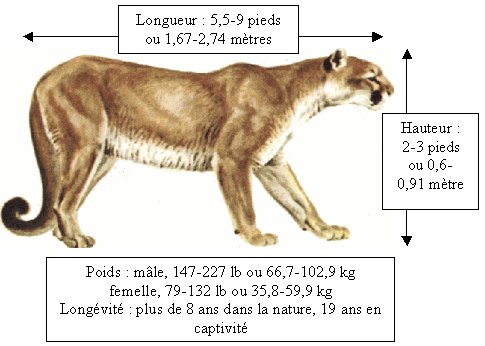
Le couguar est une espèce protégée au Manitoba en vertu de la
Loi sur la conservation de la faune; il est donc illégal
d’en tuer un volontairement, même pour défendre sa propriété. Le
couguar exposé dans le centre d’accueil est un mâle, tué
accidentellement par un trappeur autorisé à l’est d’Erickson, en
décembre 2004. Pesant 115 livres à son décès, le mâle
adulte était en excellent état et avait une accumulation de gras
abdominal adéquate pour le milieu de la saison.
Il est extrêmement rare de rencontrer un couguar. Ces animaux
sont peu nombreux, ils ont un caractère furtif et, de façon
générale, ils essaient d’éviter tout contact avec les humains. Dans
l’histoire du mont Riding, on ne rapporte aucun incident où un
couguar a attaqué un humain. Il est important de ne pas représenter
faussement le risque très minime que présente cet animal.
Cependant, voici quelques conseils de sécurité de base à ne pas
oublier dans le cas peu probable d’une rencontre avec un couguar
dans un sentier :
1. Maintenez un contact visuel. Prenez les petits enfants dans
vos bras (pour ne pas qu’ils paniquent et partent en courant).
2. N’approchez pas du couguar. Laissez-lui un chemin pour se
sauver – la plupart des couguars essaieront d’éviter une
confrontation.
3. Tenez-vous debout et face au couguar. Ne vous accroupissez
pas. Un profil bas peut rappeler au couguar une proie à quatre
pattes.
4. Si le couguar ne quitte pas immédiatement, faites ce que vous
pouvez pour l’effrayer. Essayez d’avoir l’air gros et intimidant.
Ouvrez votre manteau si vous en portez un. Agitez vos bras et
parlez fermement d’une voix grave et basse. Agitez vos bras et
criez. Lancez des choses.
5. Défendez-vous si le couguar vous attaque. Lancez-lui des
pierres, des branches ou tout ce que vous pouvez atteindre sans
détourner votre regard ou sans lui tourner le dos. Ne faites pas le
mort.
6. Afin d’éviter les confrontations, gardez votre emplacement de
camping propre et vos animaux en laisse.
Vous avez vu un
couguar?
Voici quelques références rapides pour vous aider
à reconnaître un couguar.
Traces : La principale différence entre les traces
d’un couguar et celles d’un animal de taille semblable est
l’absence de griffes dans l’empreinte du couguar, ses griffes étant
rétractiles.

Couguar ou lynx : On confond souvent le lynx et le
couguar. Voici quelques trucs pour les distinguer :
1. La queue du couguar peut atteindre 35 pouces ou
88,9 cm comparativement à celle du lynx qui mesure de 2 à
5 pouces ou de 5 à 12,7 cm.
2. Le couguar est habituellement beaucoup plus gros que le lynx.
Le couguar peut peser jusqu’à 230 livres ou 103 kg tandis
que le lynx ne pèse en moyenne que de 20 à 40 livres ou de 9 à
18 kg.
3. Parmi les autres différences, on note les touffes de poils
sur les oreilles du lynx (absentes chez le couguar) et la couleur
de chaque animal : le lynx est gris tandis que le couguar est
brun fauve.
Remarque – Veuillez avertir le personnel du
parc du Mont-Riding ou de Conservation Manitoba si vous voyez un
couguar.
 |
This cache was created to add to the number of
QUALITY caches hidden in Manitoba. It is an official cache in the
MBGA Cache Splash event. |
| Category 10: More than 10m above ground
level. |
