BiT's SMSI #4-6EQUJ5 Mystery Cache
Please note Use of geocaching.com services is subject to the terms and conditions
in our disclaimer.
This is the fourth installment in my SHOW ME SOMETHING
INTERESTING (SMSI) Series.
The cache is NOT at the listed coordinates instead continue reading
below to discover why and how to get to the cache.
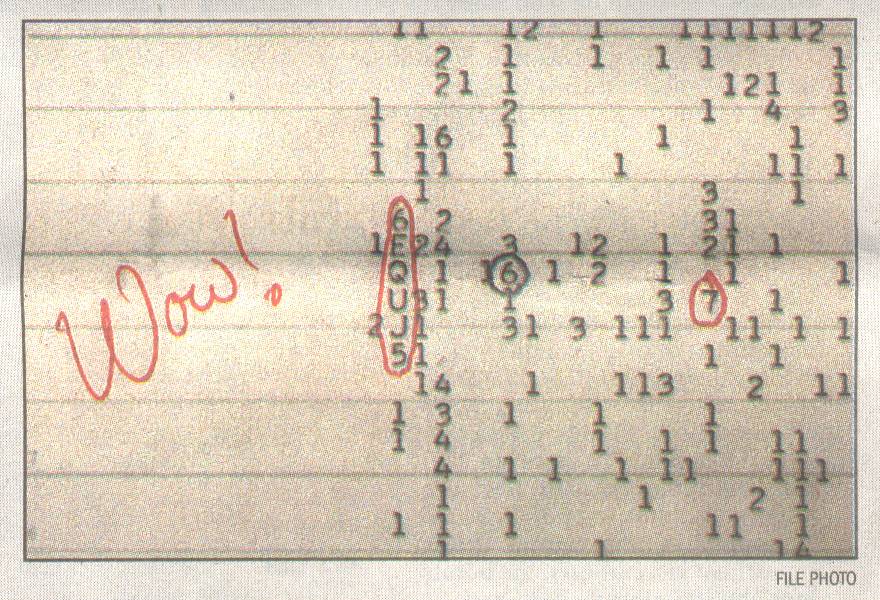
THE WOW! SIGNAL
This is a micro cache container that should be an easy find. The
point here is just to take you someplace that you would have never
visited if it were not for geocaching.
If you can decode a hint you can find this cache.
This cache is located at:
sbegl--sbhegrr--avar svir sbhe
rvtug guerr--guerr--sbhe svir frira
Be sure to look the WRONG WAY.
Some additional infomation:
On the night of August 15, 1977 at the The Ohio State University,
a signal was detected from the Big Ear Observatory. Big Ear was
searching the skies for an alien signal as for every night, and its
observations were coming out on a printer as a long list of letters
and numbers, one long string for every one of the fifty channels
scanned by the radiotelescope.
A series of characters appeared recording an unusual transmission
at the frequency of channel 2: "6EQUJ5." This startled Jerry Ehman,
a professor at Franklin University in Columbus, who was monitoring
the readings that night as Big Ear volunteer. He circled the code
for later reference and added a single comment in the margins:
"Wow!" The signal entered SETI lore as the "Wow!" signal.
SETI specialists explain this transmission of "6EQUJ5" like
this:
"The series "6EQUJ5" described the strength of the received signal
over a short time-span. In the system used at the time at Big Ear,
each number from 1 to 9 represented the signal level above the
background noise. In order to extend the scale, the staff added
letters, with each one from A to Z representing increasingly
stronger signal levels. 6EQUJ5 represented a signal that grew in
strength to level "U," and then gradually subsides. In more
familiar notation, the signal increased from zero to level 30
"sigmas" above the background noise, and then decreased again to
zero, all in the span of 37 seconds."
An aspect of this signal immediately caught the attention of Ehman
and project director John Kraus when they saw the results the
following morning: 37 seconds was precisely the time it takes the
Big Ear scanning beam to survey a given point in the heavens.
Because of this, any signal coming from space would follow
precisely this signal's pattern: increasing and then decreasing
over 37 seconds. This practically ruled out the possibility that
the signal was the result of Earthly radio interference.
Then they noted that the signal was intermittent. Kraus and Ehman
knew that, because Big Ear has two separate beams that scan the
same area of the sky in succession, several minutes apart. But the
signal appeared on only one of the beams and not on the other,
indicating that it had been "turned off" between the two scans. So
they had a strong, focused, and intermittent signal coming from
outer space, and could start to wonder if Big Ear had detected an
alien signal.
For a month, the Big Ear crew tried repeatedly to relocate the
signal, but in vain. In 1987 and again in 1989 Robert Gray led
"Wow!" searches using the 84 feet radio telescope of the Planetary
Society-funded META array at the Oak Ridge Observatory in
Massachusetts, and also found nothing. For his latest "Wow!" hunt
Gray managed to secure the services of the entire Very Large Array
in New Mexico, composed of twenty seven 25-meter dishes. This,
according to Gray, was a first: "Contrary to popular belief since
the movie Contact," he emphasizes, "the prestigious $80 million
telescope hardly ever listens for broadcasts from the stars."
During two observing sessions in 1995 and 1996 Gray and his
colleague, Kevin B. Marvel, used their telescope time to
investigate several scenarios. One possibility was that the "Wow!"
signal in fact represents a weak but steady transmission that
momentarily gained in strength due to interstellar scintillation.
The high sensitivity of the VLA guaranteed that such a source would
be easily detected by Gray's survey. But despite identifying
several radio sources hundreds of times weaker than the "Wow!"
signal in the vicinity, nothing resembling a steady transmission
was found.
Another scenario assumed that "Wow!" was a brief powerful signal
designed to attract attention to a weaker continuous one. Such a
strategy would be more energy efficient than sending a continuous
powerful beacon. But again, the VLA could detect no signal even
1000 times weaker than the original signal.
Another possibility pointed out by SETI scientists is that the
signal is there, but is only broadcast intermittently. Because of
their limited telescope time, Gray and Marvel could only devote
less than an hour to any given position. It could be that the
signal is on at other times, when no one is listening. The problem
is in fact unavoidable from any location in the Northern
Hemisphere, since the "Wow!" locale is below the Northern horizon
during most of the day.
To account for that possibility, Gray joined forces with Simon
Ellingsen of the University of Tasmania, who will be able to track
the area for 14 hours at a time.
In 1997, the lease under which the Big Ear radio telescope
operated expired. The telescope, once home to the world's longest
running SETI program (it began in 1974), was demolished to make way
for a commercial golf course.
The cache page coordinates are the center where the Wow! Signal
was recieved. If you want, plug in the coordinates and drive to
that waypoint. You can drive very close, it was located just behind
the houses on the golf course, in fact a portion of it was even in
these houses' backyards.
The northwest corner was at N40 15.100, W083 02.917, the northeast
corner was at N40 15.100, W083 02.850, the southeast corner was at
N40 15.017, W083 02.850, and the southwest corner was N40 15.017,
W083 02.917.

Click To Rate This Cache
Additional Hints
(Decrypt)
[Puzzle] Hfr gur xrl ba n pnpur cntr.
[Cache] Onfr bs ebnq fvta.
Treasures
You'll collect a digital Treasure from one of these collections when you find and log this geocache:

Loading Treasures