Sedimentary My Dear Maxwell Pressley EarthCache
Sedimentary My Dear Maxwell Pressley
-
Difficulty:
-

-
Terrain:
-

Size:  (not chosen)
Please note Use of geocaching.com services is subject to the terms and conditions
in our disclaimer.
An interesting sedimentary formation along Forest Service Road
5022, not far from Maxwell and Pressley Coves. You are looking for
a rather lengthy exposed section of sedimentary rock, most likely
shale, that contains many examples of folding within its layers. It
is located on the uphill side of the trail/road.
How
Sedimentary Rock Is Formed
For
thousands, even millions of years, little pieces of our earth have
been eroded--broken down and worn away by wind and water. These
little bits of our earth are washed downstream where they settle to
the bottom of the rivers, lakes, and oceans. Layer after layer of
eroded earth is deposited on top of each. These layers are pressed
down more and more through time, until the bottom layers slowly
turn into rock.
Most
sedimentary rocks are formed by the lithification of weathered rock
debris that has been physically transported and deposited. During
the transport process, the particles that make up these rocks often
become rounded due to abrasion or can become highly sorted.
Examples of this type of sedimentary rock include conglomerate and
sandstone. Scientists sometimes call this general group of
sedimentary rocks clastic. The remaining types of sedimentary rocks
are created either from chemical precipitation and crystallization,
or by the lithification of once living organic matter. These
sedimentary rocks are identified as non-clastic.

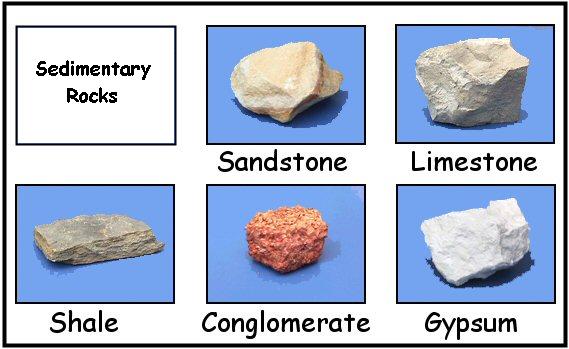
Sandstone
Rocks
Sandstone
rocks are sedimentary rocks made from small grains of the minerals
quartz and feldspar. They often form in layers as seen in the above
picture. They are often used as building stones.
Limestone
Rocks
Limestone
rocks are sedimentary rocks that are made from the mineral calcite
which came from the beds of evaporated seas and lakes and from sea
animal shells. This rock is used in concrete and is an excellent
building stone for humid regions.
Shale
Rocks
Shale rock
is a type of sedimentary rock formed from clay that is compacted
together by pressure. They are used to make bricks and other
material that is fired in a kiln.
Conglomerate Rocks
Conglomerate rocks are sedimentary rocks. They
are made up of large sediments like sand and pebbles. The sediment
is so large that pressure alone cannot hold the rock together; it
is also cemented together with dissolved minerals.
Gypsum
Rocks
Gypsum
rocks are sedimentary rocks made up of sulfate mineral and formed
as the result of evaporating sea water in massive prehistoric
basins. It is very soft and is used to make Plaster of Paris,
casts, molds, and wallboards.
 Folding
The
deformation of the Earth's surface is the result of forces that are
strong enough to move ocean sediments to an elevation many
thousands of meters above sea level. This displacement of rock can
be caused by tectonic plate movement and subduction, volcanic
activity, and intrusive igneous activity. Deformation of rock
involves changes in the shape and/or volume of these substances.
Changes in shape and volume occur when stress and strain causes
rock to buckle and fracture or crumple into folds. A fold can be
defined as a bend in rock that is the response to compressional
forces. Folds are most visible in rocks that contain layering. For
plastic deformation of rock to occur a number of conditions must be
met, including:
-
The rock
material must have the ability to deform under pressure and
heat.
-
The higher
the temperature of the rock the more plastic it
becomes.
-
Pressure
must not exceed the internal strength of the rock. If it does,
fracturing occurs.
-
Deformation must be applied
slowly.
A number
of different folds have been recognized and classified by
geologists. The simplest type of fold is called a monocline. This
fold involves a slight bend in otherwise parallel layers of rock.
An anticline is a convex up fold in rock that resembles an arch
like structure with the rock beds (or limbs) dipping way from the
center of the structure. A syncline is a fold where the rock layers
are warped downward. Both anticlines and synclines are the result
of compressional stress. More complex fold types can develop in
situations where lateral pressures become greater. The greater
pressure results in anticlines and synclines that are inclined and
asymmetrical.
To get credit for
this EarthCache you will need to complete the four tasks listed
below. Please email the answers to me for tasks 2 and 3; do not
post them in your log. But definitely include the photos for tasks
1 and 4 in your online
log.
1. Post a photo of you and/or your group somewhere along the
sedimentary formation.
2. Email me an estimate of the total length of the sedimentary
formation.
3. Email me the approximate angle of the sedimentary formation. Try
to take into consideration that the trail/road you are on is also
running at an angle.
4. Post a photo of a monocline or an anticline or a syncline you
find and include you or your GPSr in the photo.
Enjoy your hike!
FTF HONORS GO TO
Phillips4!!!


Additional Hints
(No hints available.)
Treasures
You'll collect a digital Treasure from one of these collections when you find and log this geocache:

Loading Treasures