I’m very fond of this place and although I’m not
really spiritual, I think there is a certain calmness or atmosphere
around - see what you think. The notes below are heavily based on
those of the Rev Diarmuid Mac Iomhaih and Fr Michael Murtagh.
The Medieval wall which you see here once enclosed and protected a
small parish church. It was furnished with a small alter at the
east end and its interior was flooded from colours which streamed
through panels of stained glass. The sacrarium, or funnel which led
into the earth and into which the rinsing of the chalice and the
alter cloths was poured can still be seen carved into the stone
wall. (Near the North-eastern corner). The church was initially
dedicated to St Diomoc, (pronounced dim-ock) who is believed to be
an early disciple of St Patrick. The same whose name survives in
Kildimo in Co Limerick, Kildeema in Co Clare, in Killeenadeema in
Co Galway and elsewhere. With the coming of the Normans in the 12th
century the parish was probably supported and built up by their
leading men. In 1250 the advowson, or the right to nominate or
present a priest for the parish and the right to parish revenue,
was made over to the Knights Templars who had a monastery in
Kilsaran. In 1312 the Knights Templar were supressed and the rights
were given over to The Order of Knights Hospitiller of St John of
Jerusalem now known as the Order of Malta. This order may have
built up the structure and re-dedicated to Catherine of
Alexandria.
The church was the parish church of Kildemock, serving the
people of ten townlands around it, which constituted the parish;
Paughanstown, Roestown, Hacklim, Millockstown (in which the church
itself is), Hunterstown, Anaglog, Rathlust, Kilpatrick, Drakestown
and Blakestown. My home townland is included in the list. Kildemock
parish was a small parish and there was scarcely enough revenue to
support a priest so in 1450 it was united to the neighbouring and
equally small parish of Kilpatrick. The combined area included the
above townlands. The reformation of the mid 16th century and its
aftermath and political consequences bought an end of the life of
this church and to this union of small medieval parishes. By 1622 a
royal visitation found the church and chancel of Kildemock
‘ruinous’. The church dedication of St Catherine passed
on to the parish of Kilpatrick and then to its successor church at
Ballapousta in 1762.
The Wall That Jumped.
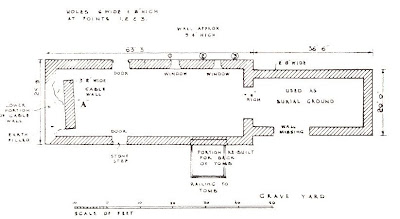
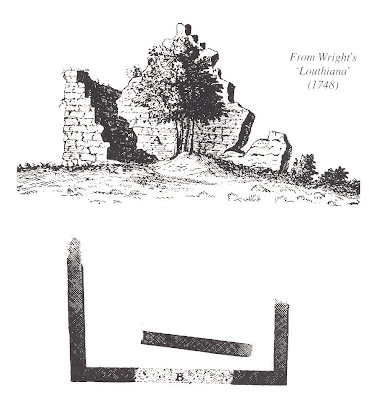
Now, back to the main business. Up to recently (1950’s)
there was no observable evidence of the remarkable movement. Ivy,
bushes and fallen stone had piled up and all the accumulated debris
of centuries made it impossible to discern the true outline of the
church. However in 1953, improvements were affected by local
archaeologists which revealed the celebrated wall really standing
two to three feet within its own foundation. You can see it for
itself; 19 ft high, 15 ft wide and 3 ft wide, a mass of masonry
calculated to weigh at least 40 tons in its present state, rising
from the bare earth close by the foundation from which it was
cleanly secured some three feet above the ground. The evidence
which you will see has adequate testimony from the past (one of at
least 10 historical references to the jump)… Dublin, March
29, 1738-9. “My Lord, I had the honour of your Lo.ps
(Lordship’s letter). The affair of Molick’s Town Church
near Ardee in the County of Louth is well attested by my brother
and all the neighbours hereabouts who saw it before and after the
storm. I had the curiosity to go and see it my self and observed ye
western gable end broke off, in a straight line, from its
foundation, just above the ground and placed perpendicular, about
two feet forward in the body of the Church”. (Copy of Mr
Dobbs the Surgeon’s letter to bishop of Dromore, March 1738,
among Harris MSS in Armagh Library).
So why did it jump? Who knows? There is a story of an
excommunicated man which is briefly recounted at the site, but have
a look around and see what you think for yourself.
Finally as a point of interest the founder of the church, St
Diomoc ended his days in Co Waterford as a tutor to St Declan.
Check out the excellent GC Declan’s Walk in
Waterford(GCX77Z)if you’re in the vicinity.