Bays Mountain Park is a small part of the Bays Mountain Range
which extends from Kingsport, Tennessee to Blount County,
Tennessee, a length of about 115 miles. Bays Mountain lies within
the Valley and Ridge physiographic province. The rocks making up
this region are mainly sedimentary rocks laid down during the
Paleozoic Era in a large ocean basin at the edges of North America.
Limestone makes up the oldest bedrock and was laid down by living
organisms mostly algae which removed calcium carbonate from the
water. Sea animals also removed the calcium carbonate and deposited
it when they died. Sometimes magnesium may take the place of
calcium to form dolostone.
Later mud settled above the calcium carbonate and formed shale.
This shale is called the Sevier Shale and lies under Bays Mountain
and Kingsport. The mud also formed sandbars. The sand became
compressed and cemented together. This formed sandstone which is
the rock making up the ridges.
The Valley and Ridge province was formed by the collision of
North America with Africa during the late Paleozoic. This caused
the land to wrinkle into ridges and broad valleys. The bedrock
became folded and faulted. This caused the formation of parallel
ridges and valleys. There is a trellis drainage pattern with rivers
running parallel to the ridges. The ridges remain because they are
composed of harder sandstone which does not erode as easily as the
limestone and shale of the valleys.
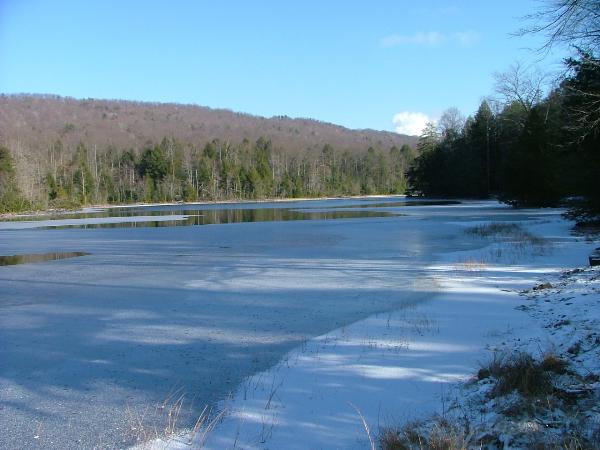
If you stand at the above coordinates, you are standing on a dam
built by the City of Kingsport to form a reservoir. This dam was
completed in 1916 and the reservoir became Kingsport’s water
supply until 1944. Because of the folded landscape this was a
perfect place for a dam. If you are up for a hike along some of the
roads cut into the ridges you can see examples of all the types of
rock making up the mountain.
The Park is open throughout the year. The park is closed only on
New Year's Day, Thanksgiving, Christmas Eve, and Christmas Day.
Occasionally, the Park is closed because of hazardous conditions
(icy roads, mostly). During snowy weather, please call ahead for
Park conditions.
Regular Hours (March-May)
(Sept.-Oct.)
Park Grounds M-F 8:30 AM - 5:00 PM, SAT 8:30 AM - 8:00 PM,
SUN 1:00 PM - 8:00 PM
Nature Center M-F 8:30 AM - 5:00 PM, SAT 1:00 PM - 8:00 PM,
SUN 1:00 PM - 8:00 PM
Bays Mountain Summer Hours (June-Aug.)
are:
Park Grounds M-F 8:30 AM - 8:00 PM, SAT 8:30 AM - 8:00 PM,
SUN 1:00 PM - 8:00 PM
Nature Center M-F 8:30 AM - 6:00 PM, SAT 1:00 PM - 8:00 PM,
SUN 1:00 PM - 8:00 PM
Bays Mountain Winter Hours (Nov.-Feb.)
are:
Park Grounds M-F 8:30 AM - 5:00 PM, SAT 8:30 AM - 5:00 PM,
SUN 1:00 PM - 5:00 PM
Nature Center M-F 8:30 AM - 5:00 PM, SAT 1:00 PM - 5:00 PM,
SUN 1:00 PM - 5:00 PM
To claim a
find for this earthcache, you must post a picture (optional) of
yourself with your GPSr at the above coordinates. You must also go
into the Nature Center. When you enter the main entrance turn right
and go down the ramp. Look for the rock displays on the wall and
email me the answers to the following:
1. What are four types of igneous rock?
2.What are three types of sedimentary rock?
3.What are three types of metamorphic rock?
4.What are six types of metal ores?
Much of the research for this EarthCache came from
“A Geologic History Of Bays Mountain Park” by
Collins Chew.
Thanks to Bays Mountain for permission to place this
EarthCache.
| I have earned GSA's highest level: |
 |