
The Ohio River
_________________________________________
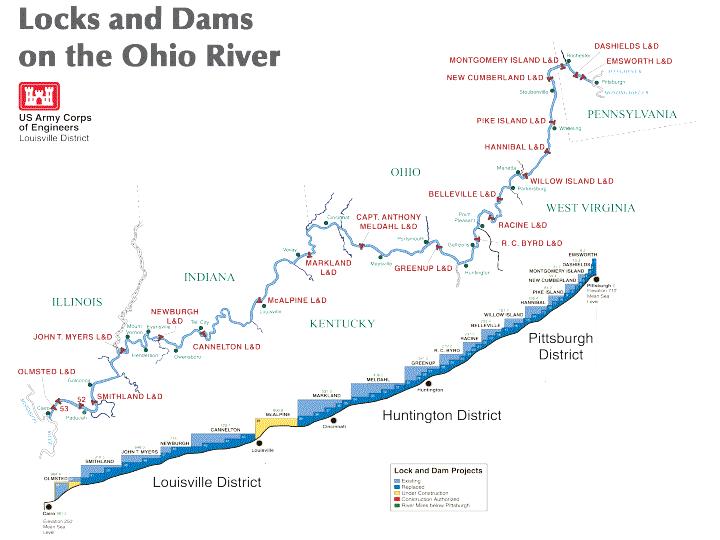
The Ohio River is the largest tributary by volume of the Mississippi River. It is approximately 981 miles long and is located in the eastern United States. It flows through or along the border of six states, and its watershed encompasses 14 states, including many of the states of the southeastern U.S. through its largest tributary, the Tennessee River.
Geography and hydrography
The river is made by the confluence of the Allegheny and Monongahela rivers at Point State Park in Pittsburgh, Pennsylvania. From Pittsburgh, it flows northwest through Allegheny, Beaver Counties, before making an abrupt turn to the south-southwest at the West Virginia—Ohio—Pennsylvania triple state line. until it joins the Mississippi near the city of Cairo, Illinois.
Drainage basin
The Ohio's drainage basin covers 189,422 square miles, including the eastern-most regions of the Mississippi Basin.
Geology
The Ohio River is young from a geologic standpoint. The river formed on a piecemeal basis beginning between 2.5 and 3 million years ago. The earliest Ice Ages occurred at this time and dammed portions of north flowing rivers. The Teays River was the largest of these rivers, and the modern Ohio River flows within segments of the ancient Teays. The ancient rivers were rearranged or consumed by glaciers and lakes.
Upper Ohio River
The upper Ohio River formed when one of the glacial lakes overflowed into a south flowing tributary of the Teays River. Prior to that event, the north flowing Steubenville River (no longer in existence) ended between New Martinsville and Paden City, West Virginia. Likewise, the south flowing Marietta River (no longer in existence) ended between the cities. The overflowing lake carved through the separating hill and connected the rivers. The resulting floodwaters enlarged the small Marietta valley to a size more typical of a large river. The new large river subsequently drained glacial lakes and melting glaciers at the end of several Ice Ages. The valley grew with each major Ice Age.
Middle Ohio River
The middle Ohio River formed in a manner similar to formation of the upper Ohio River. A north-flowing river was temporarily dammed southwest of present-day Louisville, Kentucky, creating a large lake until the dam burst. A new route was carved to the Mississippi River, and eventually the upper and middle sections combined to form what is essentially the modern Ohio River.
River depth
While the Ohio River is quite deep, it is a naturally shallow river that was artificially deepened by series of dams. The dams raise the water level in shallow stretches, allowing for commercial navigation. Near its origin at the confluence of the Allegheny and Monongahela Rivers, the Ohio remains fairly shallow, never rising above around 30 feet deep all the way past Cincinnati. From its origin to Cincinnati, the average depth is approximately 27 feet. However, once past Cincinnati, the river deepens. Due to the damming, along with glacier formations and migrations in the latter part of the second Ice Age, the river's depth increases over about 100 miles, coming to a maximum depth of 68 feet just west of Louisville. The 50 miles around Louisville represent the deepest average depths of the river. From Louisville, the river loses its depth very gradually until its confluence with the Mississippi at Cairo, Illinois, where it has an approximate depth of 20 feet, because it is more free flowing. The natural depth of the river varies from about 3 feet to 40 feet.
Logging Requirements
The coordinates brought you to this overlook of the Ohio River at it's widest point. To log a find on this Earthcache, post an optional picture of your GPSr on this overlook with the river and upper McAlpine Dam as a backdrop. This will get your picture into yor gallery.
Also, to demonstrate the educational value of this cache email me the answers to the following four questions:
1. How long is the Ohio River?
2. How long ago was the river formed?
3. How deep is the river at it's deepest point?
4. What is the diagram etched into the belvedere floor at your feet?
Please email your answers to ARF! via my profile.
Please email your answers first, then LOG THE FIND. Do not wait on a reply from me. FINDs which do not meet logging requirements will be quietly removed.