Hódmezõvásárhely (The city)
Higher floodplains of the river Tisza were suitable for
settlement formation. The primeval Vásárhely was settled on the
loess sloped from south to the east, emerging from the lake Hód in
height of 4-6 meters and being cut by smaller-greater lakes and
brooks. Reeds and woods of the floodplain gave safe shelter from
the enemy. Inhabitants of the nearby settlements - such as Hód,
Szentkirály, Csomorkány, Gorzsa, Kopáncs and Solt - ruined and
burnt by the Turkish and Tartar also found shelter here. Most of
these destroyed villages were never re-settled.
With the growth of the number of inhabitants, streets started to
be formed, first with no system at all. They were crooked, since
most of them followed lines of brooks' and lakes' coastline. Means
of subsistence were fishing in the rich waters, hunting and
bushy-grassy meadows for keeping domestic animals. Many
street-names still refer to the once been watery world like Árvíz
(Flood), Kistópart (Small lake shore), Hódtó (Beaver's lake), Vidra
(Otter) or Búvár (Diver) street. Later demands for building areas
had risen so started the bank up of the onsite greater lake and
brook banks.
Coastline of the lake Hód lied in a semi-circle line on the
south of the town. On its northern side was settled the primeval
Vásárhely. One of the lake Hód systems was the Gyuló brook with its
11 meter or deeper river basin and fast flow in times of floods. It
was a fairway to boats on times of floods, waving even in the
beginning of the 19th century like an enormous sea. Deep water
covered the today Bocskai street bay, the main port, as once called
Cigöllér. Today it is site of Németh László Grammar School. Ships
could berth here closes to the coast even until the mid 19th
century.
According to records, between 1-9. May 1845, grain tankers
sailed from the direction of Szeged to the lake Hód. These berth in
the small port in front of the now Erzsébet Hospital and were
loaded with grain. Last ships sailed here in 1856. As harnessing of
the river Tisza started, its watercourse started to dry out. In
1857, lands of the coast were ploughed. By 1870, the whole lake-bed
dried out.
Through the 19th century the territory of Vásárhely exceeded the
double with the lower lands built in. These areas were endangered
of the flood. By the river control the level of water grew and
raised the possibility of a flood. Embankments of the Tisza more
times broke; many times the town was threatened by direct flood. In
the time of the flood of 1876, they started thinking about an
embankment around Hódmezõvásárhely, but only started building it in
1879, the year of the great flood in Szeged. In the skirts of the
town a 17,5 km embankment was put up of soil, while on the southern
side a 3 km long brick barrage was built. The stonewall, in folksy
language so called "kûfal" in total length is 3006,2 m lying on the
southern line of the town, following the bank of the once been lake
Hód.
Towns in the middle ages usually built walls and castles to keep
out the enemy. Enemy of Vásárhely was the flood. This defensive
brick wall for time of flood is a unique superstructure in the
Great Plain. This special buildup raises attention of the newcomers
with reason. The municipality building, hospital, schools,
restaurants and coach station is located by.
In the restaurant Vasmacska (Anchor) located on the corner of
streets Zrínyi and Csillag a picture of an old sailor is hung on
the wall. The picture was painted by Tibor Erdélyi in 1998, by
antique drawing of József Gosztonyi.
There were four passageways opened in the wall for carriage and
nine for pedestrians. Only four remained of the pedestrian ways,
the Csillag, Száraz, Királyszék and Árpád street openings. The last
one on rustic speech is called the Gate of the Lovers, assuring the
happiness of those who kiss under. Our hiding invites geocachers
here.
(Source: Hódmezõvásárhely története, 1993)
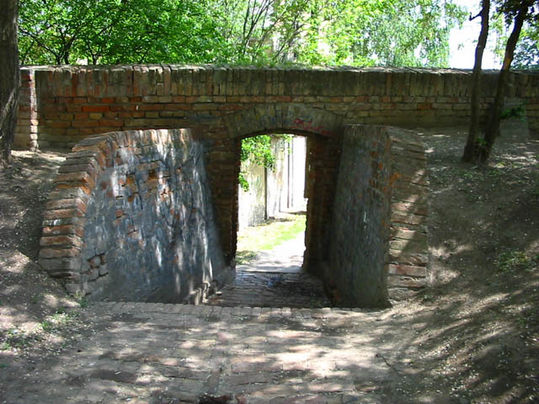
The Gate of the Lovers
The cache
Arriving from road 47, we start the walk on the top of the
stonewall in front of the Bethlen Grammar School. Parking is
available by the bath or in front of the Cseresnyés Youth Hostel.
In this area, under the stonewall are houses located. On your left
side you pass a school and a nursery, on your right the "kûfal"
shows the right track. At the Gate of the Lovers a unique farmhouse
is kept with its original furnishing, Vásárhely embroidery
textiles, kitchen with Vásárhely majolicas. These thatched roofed
buildings are location to arts and crafts summer camps.
The cache itself is a kitchen box and contains the usual
logbook, pen and various trades, gifts. Beware of Muggles and
please carefully hide the box behind the brick.