In these days of high gas prices, it may be hard to believe that there was once an extensive public transportation rail network across Southern Michigan. This network was known as the interurban. In the late 1800s and early 1900s, the interurban connected many rural communities like Chelsea with larger communities like Jackson, Ann Arbor, Ypsilanti, Dearborn, Detroit, and more.
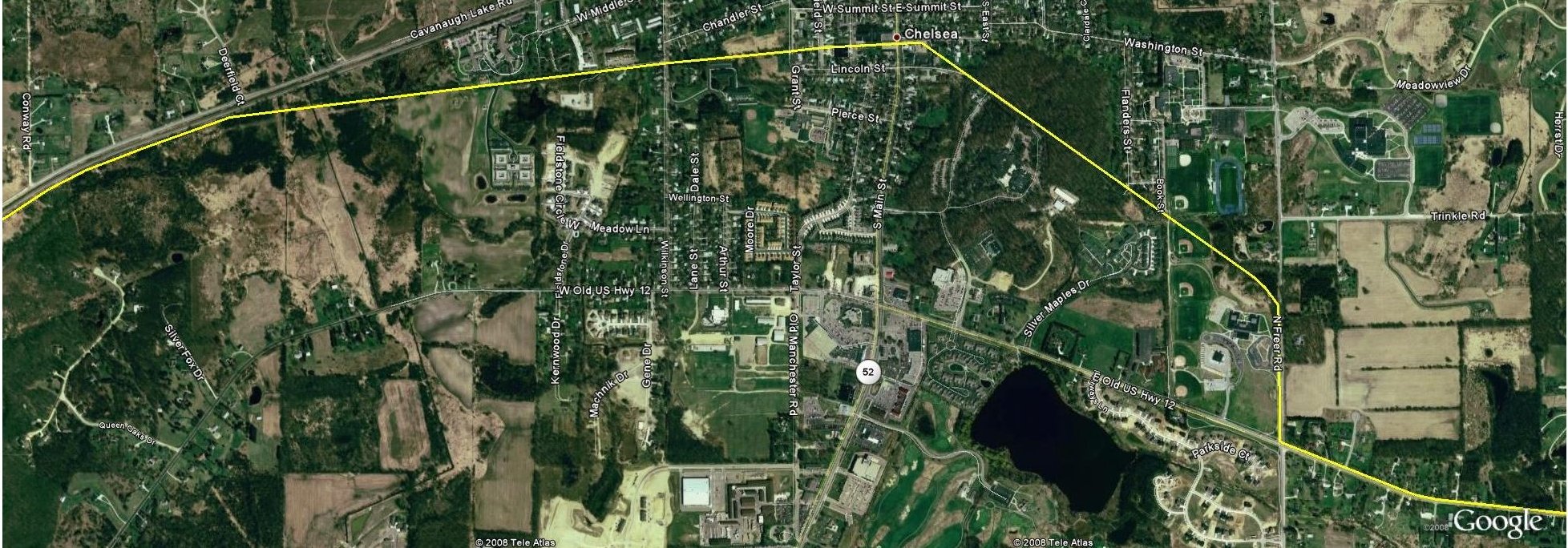
Route of the Interurban Track Shown Over Satellite Photo of Present-Day Chelsea
[Click on image to see a larger photo]
 |
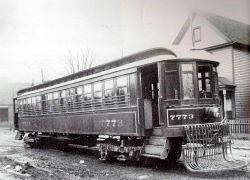
Interurban Car that Served Chelsea
 |
By 1898 the interurban was operating from Detroit through Ypsilanti and on to Ann Arbor. This line was so profitable that it was decided to extend the line to the west to Jackson. The Detroit, Ypsilanti, Ann Arbor, and Jackson Railway (DYAA&J) was incorporated on January 23, 1901. Service to Chelsea began on August 22, 1901 and continued with two cars per day.
The interurban railways were for-profit private enterprises. This status required that they acquire their own right-of-way without the benefit of eminent domain. The interurban railroads also had to secure franchises in the cities, villages, and townships in which the interurbans operated to have exclusive rights to operate in those communities.
The interurban railway line followed Jackson Road from Ann Arbor with a stop at Lima Center before leaving Jackson Road to head into the Chelsea station. The diversion away from Jackson Road/Old US-12 into Chelsea was due to the demands of Frank Porter Glazier, a wealthy industrialist and banker in Chelsea, who held much political power in Chelsea and in Sylvan Township. Glazier told the interurban builders that if they wanted franchises in Chelsea and Sylvan Township that the interurban track would have to turn off Jackson Road/Old US-12 and enter Chelsea. Of course, the interurban railroad owners agreed. Some riders and observers considered this diversion to be arbitrary and a wasted distance along the run.
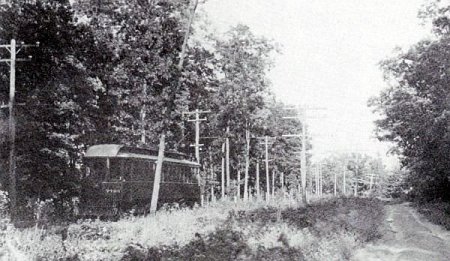
Interurban Car West of Ann Arbor on its Way to Chelsea
 |
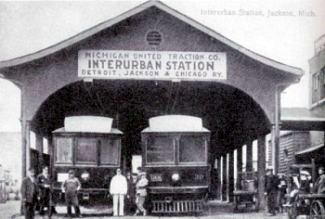
The Interurban Station in Jackson
 |
The trail where the cache is hidden is the old railbed for the interurban. In the early 1900s, this trail was located on a peat farm owned by the National Peat & Fuel Company. The interurban station for Chelsea was located where the Mobil gas station on Main Street is now located. West of Chelsea, the interurban rail line paralleled the Michigan Central Railroad tracks (now owned by Norfolk Southern Railroad) and continued with stops in Grass Lake, Michigan Center, and Jackson.
The interurban cars were originally powered by DC electric power when the extension of the interurban line was initiated the cars and the rail line were converted from DC to AC power. AC power had the ability to be transmitted over longer distances. One of the substations was located at Lima Center. Much of the property where the interurban railway previously traveled through Chelsea is now occupied by electric power transmission lines.
DUR System Map
[Click on image to see a larger photo]
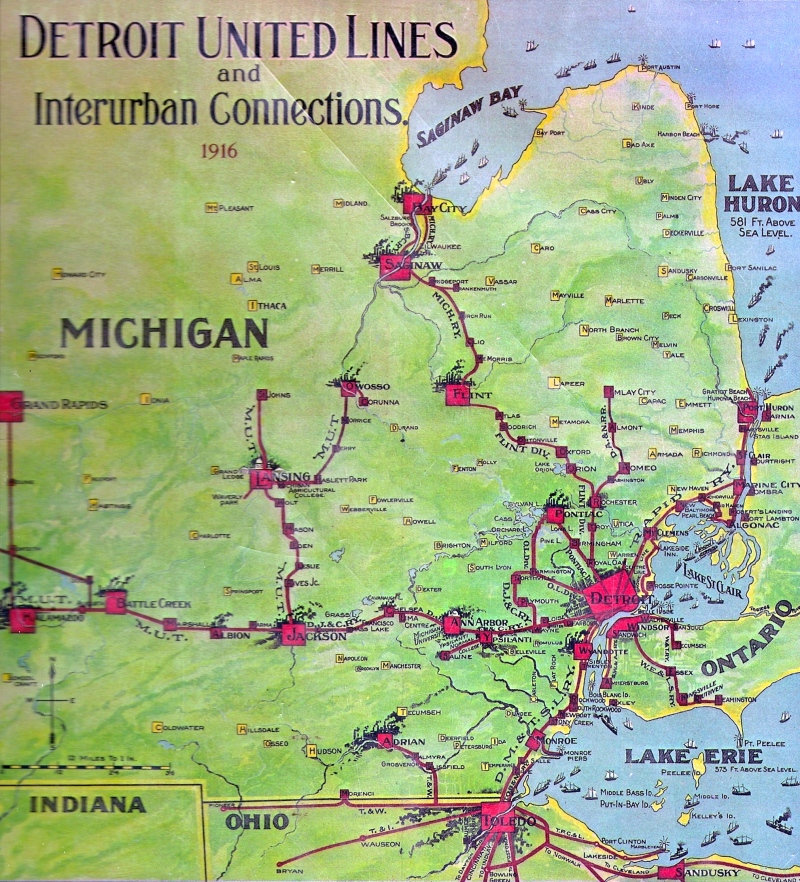 |
On January 14, 1907, the Detroit, Ypsilanti, Ann Arbor and Jackson Railway was absorbed by the newly-incorporated Detroit, Jackson and Chicago Railway (DJ&C), which was a division of the Detroit United Railways (DUR). Under the DUR, interurbans thrived transporting people and freight throughout Michigan and neighboring states.
The demise of the interurbans in Michigan were the result of competition from other forms of transportation, public subsidies of the highway and road system, and adverse government regulation. The Michigan Public Utilities Commission (MPUC) began to issue franchises to competing bus and touring car operators for many of the same routes served by the interurbans. This broke the transportation monopoly of the interurbans in many areas of the State. In 1921, the Michigan Legislature passed an Act placing the authority to regulate interurban fares under the jurisdiction of the MPUC. The MPUC rate regulation superseded the franchises held by the local communities. Many of the most profitable parts of the interurban system faced competition, which diminished the ability of the DUR to be profitable over the entire system.
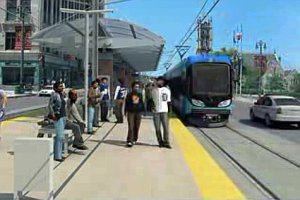
Detroit Light Rail Concept
 |
As riders deserted the interurbans for buses the ability for the interurban railways to remain profitable spiraled downward. On March 10, 1925, the DUR filed for bankruptcy. The interurban line that served Chelsea survived for several more years and on September 4, 1929 the last interurban run was made.
Ironically, over 100 years after the interurban railway first started to operate in the Detroit-Ann Arbor-Jackson corridor, studies are taking place to restore service at least to the Detroit to Ann Arbor area. To restore rail service to the southeast Michigan area is likely to cost billions of tax dollars.
This geocache placed with the permission of Chelsea Community Hospital.
