The posted
coordinates are not the actual coordinates of the cache, but the
cache is within 1 kilometer of the posted
coordinates.
According to Greek mythology, Medusa the Gorgon, along with her
sisters, Stheno and Euryale, were the daughters of Porcys and Ceto.
Of the three sisters, Medusa was the youngest and most beautiful.
Said to have been extremely wise, they all served as priestesses to
the virgin goddess of wisdom, Athena. However, the Seagod Poseidon
desperately desired Medusa. In a moment of raw passion he ravaged
Medusa inside of Athena's temple of worship. In anger, the three
sisters became petty and vindictive toward men.
Appalled, Athena transformed Medusa and her sisters into Gorgons
- hideous beasts with scaly skin, dragon's wings and hair formed of
dozens of coiling snakes. Anyone who stared at the Gorgons was
instantly turned to stone when their eyes met.
Mythology tells us that Medusa was supposedly slain by the God
Perseus. However, many scholars believe that the three sisters
escaped to various parts of the world: Medusa to North Africa,
Stheno to Southern England, and Euryale to North America.
To substantiate these claims, researchers allege that Stonehenge
in England was actually constructed from the bodies of local
villagers that were turned to stone after staring into the eyes of
Stheno. As well, the Pyramids of Giza in Egypt were supposedly
formed from the bodies of villagers and animals that stared into
Medusa’s eyes.
Until recently, researchers have been unable to determine the
location in North America to which Euryale supposed escaped.
However, recent excavations near the Tomb of Tuthmosis III, in the
Valley of the Kings on the west bank of the Nile, have uncovered an
elaborately painted papyrus scroll whose meaning they have been
unable to decipher. The outer wrapping of the scroll is imprinted
with a never before seen cartouche, shown below. It is believed to
be the cartouche of Euryale.

Below the cartouche is what appears to be an early map of North
America. Using a combination of Carbon-14 dating and paleography,
Egyptologists have determined that the map was drawn about 1400
B.C. Close examination of the upper left corner of the map reveals
what appears to be a crude drawing of a head. Judging by the
various land masses shown on the map, the head is located on what
is believed to be the island of Newfoundland.
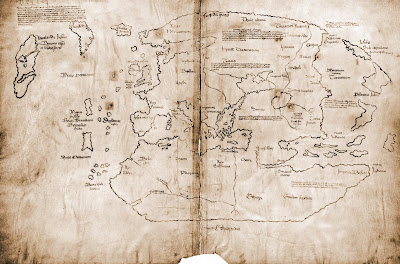
The outer wrapping has preserved the scroll quite well. Though
slightly faded, the six sections of the scroll still exhibit the
same vibrant colors that were used within the Pharoahs's tomb.
Although they have not been able to decipher it, Egyptologists
suspect the scroll is the key to finding Euryale’s home in
North America. They need your help!
Can you decipher the code?
|