During the late 1800's, Rice Lake was a popular duck hunting and
fishing spot and covered about 6 square miles in area. It was more
a marsh or bog than a lake; rather shallow and mildly acidic. As a
way to make the land more valuable and to create additional tax
revenue, the owner approached the county to drain the lake and use
the muck that remained for farming. In 1916, the lake was drained
to the south at county expense and the Rice Lake Drain became the
headwaters of the Rogue River.
What remained was a large area of muck. Muck is created by the
gradual accumulation of the remains of water-loving vegetation.
Water retards the complete oxidation of the organic matter by
preventing the air to come in contact with these vegetative
remains. In acid deposits such as was found here, the water
preserving influence is augmented by the soil acids, which prevent
the somewhat sterile muck from becoming infected by the organisms
that cause decomposition.
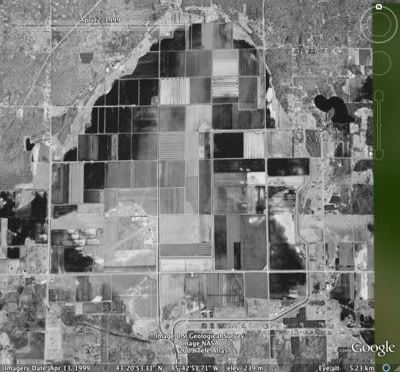
Aerial view of the Rice Lake muck farms
The Rice Lake muck farms grow specialty crops of onions,
carrots, beets, and mint. Muck is often hyped as a miracle soil,
capable of vast yields, which does not hold up in reality. It is
prone to problems, such as the fact that it is very light and
windbreaks must be provided to keep it from blowing away when dry.
It can also catch fire and burn underground for months. Oxidation
removes a portion of the soil each year so it becomes progressively
shallower. When some muck farms became unprofitable, they were
reclaimed for wildlife preserves. The Seney Wildlife Refuge in
Michigan's Upper Peninsula is a example of a reclaimed muck farm
that failed and was reclaimed as a Civilian Conservation Corps
project during the 1930's.

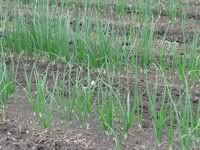
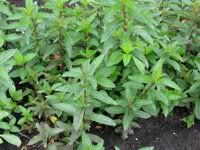
Carrots, Onions, and Mint growing in the muck
To claim credit for this cache, please post a photo of you and your
GPSr with Rice Lake in the background with your log. Do not include
the plaque or sign in your picture. Also, email us the answers to
the following questions:
- What is the width of the water surface of the Rice Lake
drain?
- What year was the Rice Lake pump station built?
- What does the pump station protect?
If you do not post a picture or
email the answers to #1, #2 and #3, your log will be
deleted.