Lossiemouth East Quarry is a large section of yellow and grey
sandstones of the “Lossiemouth Sandstone Formation”.
The quarry was worked from the 1790’s and was used to produce
stone for local building, including Branderburgh.
It was designated a SSSI during a Geological Conservation Review
(GCR) that was completed in 1989. The fossils were originally
thought to be fish remains and tortoise tracks but after much
debate amongst the Victorian scientists as to the date of these
fossils, they were eventually recognised as reptiles from the
Triassic period. Lossiemouth East Quarry is one of Britain's most
important vertebrate fossil localities, yielding eighty fossils of
eight different species from the Triassic Period (225 million years
ago). Of the six types of fossils discovered, five are unique to
Lossiemouth, including Saltopus, Britain’s oldest
dinosaur, the fossils of which are on display at the Natural
History Museum in London.
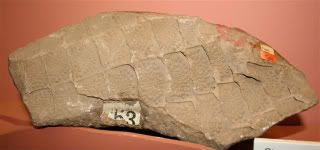
Stagonolepis: : A herbivore shaped rather
like a crocodile 2.7m long. It had extensive armour around its body
and possessed powerful digging limbs. It may have grubbed for plant
roots or invertebrates with its shovel-like snout.
Erpetosuchus : A small omnivore with a
body length of about 60cm and had crocodilian characters.
Ornithosuchus: Medium to large sized
carnivore of up to 3.5m in length This carnivore had sharp
dagger-like teeth and was probably used its large back legs for
running and the smaller fore limbs for grasping, but could use all
four for walking.
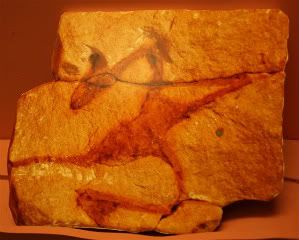
Saltopus : Small carnivore of around 60cm
ong. It had a long tail and hind legs and would run and prey upon
other animals, the tail being used for balance in rapid
manoeuvring. The Saltopus is Elgin area’s only
dinosaur and is Britain’s oldest.
Other fossil finds include:
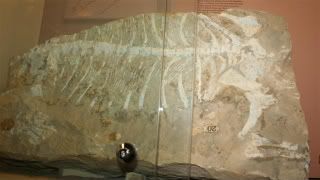
Hyperodapedon gordoni : Discovered in
1858 this rhynchosaur is just over 1m in length and has a beak like
snout for tearing off plant material.
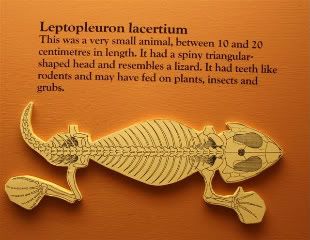
Leptoplueron lacertinum : A small rodent
like herbivore was possibly around 20cms long with a tail. It was
first described in 185 by Richard Owen.
Scleromochlus taylori: This debate on the
nature and appearance of this reptile still continue today, ideas
ranging from something comparing to a flying squirrel to a hopping
gerbil type creature.
Brachyrhinodon taylori : A tiny lizard
looking omnivore of only 20cms.
The fossils were first collected in 1844 by quarrymen, who took the
fossils to local experts. Patrick Duff, Elgin Town Clerk and
geologist, Mr Martin a schoolmaster, Mr Alex Robertson and Rev Dr
George Gordon were all involved in the early study and discovery of
these fossils, with Victorian scientists, including the famous
Swiss naturalist, Louis Agassiz, Professor Thomas Huxley and the
Scottish geologists Charles Lyell and Roderick Murchison all
involved in the debate as to their age.
This site is managed by the Moray Council who has given permission
or this cache. Please do not attempt to collect fossils yourself as
you could damage the scientific interest of the site. It is also
extremely unlikely that you will find any fossils as any remaining
will be buried deep within the sandstone accessible only with
renewed quarrying.
Further information regarding Lossiemouth East Quarry SSSI can be
found by contacting the Scottish Natural Heritage on 01343 541551
or by visiting http://www.snh.org.uk/snhi and choosing “Site
Links” from the menu on the right hand side.
Further information on the fossils found in this and other SSSIs in
the Elgin area can be found at Elgin Museum. Visit
www.elginmuseum.org.uk for opening times and prices.
Thank you to Scottish Natural Heritage and Elgin Museum for their
support and information. Images are courtesy of Elgin Museum.
Check out Moray Geocachers on Facebook
https://www.facebook.com/pages/Moray-Geocachers/126001280851564