The Masonshaugh site was designated a SSSI during a Geological Conservation Review (GCR) that was completed in 1989. The two and a half kilometre coastal strip and adjacent disused stone quarries that represents the Masonshaugh site, encompass excellent exposures of two groups of sedimentary rocks known as the Burghead and Hopeman Sandstone Formations. These formations, which consist essentially of wind-blown and water deposited sand respectively, provide an excellent indication of the environmental conditions that prevailed in the area at the end of the Permian and during the Triassic geological periods, which are crucial in understanding the development of the Moray Firth area.
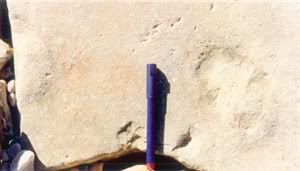
In addition, the quarries at Masonshaugh have yielded a range of fossil reptile tracks and footprints. The footprints were first recognised in 1850. An excellent range of fossil footprints, small, medium and large, have been found there and show that the animals moved northwards over the sand. The large sized ones appear to be unique in the world, whereas the smaller prints compare with finds elsewhere in England and Germany. The footprints are found on both horizontal and inclined beds of sandstone associated with the ancient sand dunes. Little mounds of sand behind some prints strongly suggest that, in these cases, the creature making the track was moving uphill over a dune. It is thought that two or three species of reptile, each displaying a range of sizes made the track-ways as they headed at, different times, across a dune-field, toward the centre to the playa lake(s) of the Moray Firth Basin to the north.
An understanding of the environment in which the Elgin reptiles lived during the time of the deposition of the Hopeman/Cuttie’s Hillock and Lossiemouth Sandstones, is hampered by the complete lack of plant and invertebrate fossils and by the occurrence of the reptile fossils in what are in effect desert sediments. Clearly the omnivores would have required well-vegetated areas in which to live, therefore it is thought that the Elgin reptile fauna lived in well-vegetated areas, possibly around inter-dune pools or close to the lakes outside the dune-field. Water-deposited sediments in the Lossiemouth Sandstone Formation do show evidence of being disturbed by invertebrates of some sort, which does suggest that lake-shore type environments, possibly vegetated, did exist. At intervals, large sand dunes migrated across the area and many of the animals may have been overwhelmed. The animals would have migrated across the dunes between inter-dune pools leaving their tracks.
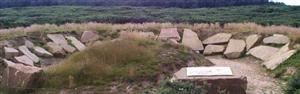
This site is managed by the Moray Council who has given permission for this cache. The cache is located just off the Moray Coast Trail and can be done in connection with other caches on this path, including A Bridge Too Far. Care should be taken in the vicinity of the steep coastal cliffs and if walking along tide line, care should be taken to note the tide phase which can be found online or in the the Northern Scot.
Further information regarding Masonshaugh SSSI can be found by contacting the Scottish Natural Heritage on 01343 541551 or by visiting http://www.snh.org.uk/snhi and choosing “Site Links” from the menu on the right hand side.
Further information on the fossils found in this and other SSSIs in the Elgin area can be found at Elgin Museum. Visit www.elginmuseum.org.uk for opening times and prices.
Thank you to Scottish Natural Heritage and Elgin Museum for their support and information.