STAR 2
brightness
If you look up to the sky on a dark night, you will notice that
not all stars are even bright.
Astronomers have made a scale for this brightness.
Because astronomy is a very old science (maybe even the oldest),
so is the scale for measuring the brightness.
In the second century before Christ a Greek called Hipparchus came
up with the so called magnitude scalel.
He named the brigthest stars stars of the 1st magnitude. Stars wich
were half as bright he called stars of the 2nd magnitude and so on
till the 6th magnitude(the weakest stars he could see). After the
discovery of the telescope we were able to see much weaker stars
and the scale was adapted till 30! The brightness we are judging is
the apparent brightness. This apparent brightness depends on the
real brightness of the star and the distance the star is away from
us. So a star wich is very far away but even bright as a star wich
is much closer will have greater real brightness.
In the 19th century better methods were developed to determine
the amount of light from a star.
These measurements showed that a star of the 1st magnitude was
about 100 times brighter tan a star of the 6th magnitude.
In other words you need 100 stars of the 6th magnitude to receive
the same amount of light energy at the earth as a star of the 1st
magnitude. To make the calculations easier the magnitude scale was
adapted so that a difference of 5 magnitudes was exactly a diffence
of 100x in brightness. 1 magnitude in difference therefor
corresponds with a factor 2.512 in brightness because: 2.512 x
2.512 x 2.512 x 2.512 x 2.512 = (2.512)5 = 100.
To be able to name even more bright objects the scale was also
adapted to the negative side until even-26.7 for the brightness of
our star: the sun.
A list of brightness from very bright to weak:
Sun (-26.7)
Full moon (-12.6)
Venus (-4.4)
Sirius (-1.4)
Border for the naked eye (+6.0)
border for binoculars (+10.0)
Pluto (+15.1)
Border for a big telescope (+21.0)
Border for the Hubble telescope (+30)
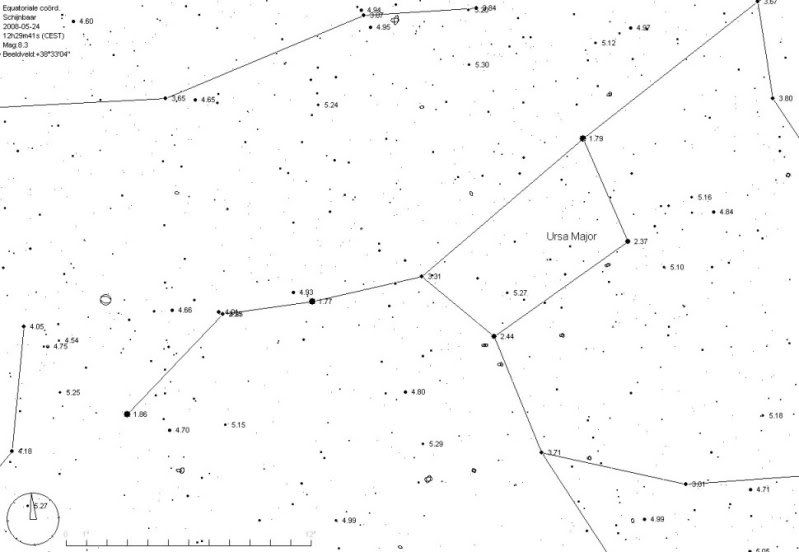
And now what it is all about:
Solve the puzzle and find the cache at the given location:
Write down the code you will find inside the cache
Take the following three stars:
1 Deneb (Cygnus, swann)
2 Altair (Aquila, eagle)
3 Vega (Lyra, lyre)
A = number of the star with the largest apparent magnitude.
B = the number of times a star of the 1st magnitude is brighter
than a star of the 3th magnitude(whole number, no decimals)
You will find the cache at:
S 34 37.(( 244 X A ) + ( B : 3 ))
E 150 49.5 ( B )(B)
The picture is made with the free drawing programm on "Cartes du
Ciel" http://www.stargazing.net/astropc/index.html
http://www.worldwidetelescope.org/
You can check your answers for this puzzle on Geochecker.com.
(With many, many thanks to Ozzeger, Blerick, Netherlands!) HONOURS FOR FTF GO TO TEAM CASHO!