#6 Wally Wickander's Medical Mystery Tour Mystery Cache
#6 Wally Wickander's Medical Mystery Tour
-
Difficulty:
-

-
Terrain:
-

Size:  (regular)
Please note Use of geocaching.com services is subject to the terms and conditions
in our disclaimer.
A puzzle cache based on the Human Respiratory System
CACHE IS NOT AT POSTED COORDINATES!!!!
The Respiratory System
A respiratory system's function is to allow gas exchange to all parts of the body. The space between the alveoli and the capillaries, the anatomy or structure of the exchange system, and the precise physiological uses of the exchanged gases vary depending on the organism. In humans and other mammals, for example, the anatomical features of the respiratory system include airways, lungs, and the respiratory muscles. Molecules of oxygen and carbon dioxide are passively exchanged, by diffusion, between the gaseous external environment and the blood. This exchange process occurs in the alveolar region of the lungs.
Other animals, such as insects, have respiratory systems with very simple anatomical features, and in amphibians even the skin plays a vital role in gas exchange. Plants also have respiratory systems but the directionality of gas exchange can be opposite to that in animals. The respiratory system in plants also includes anatomical features such as holes on the undersides of leaves known as stomata.
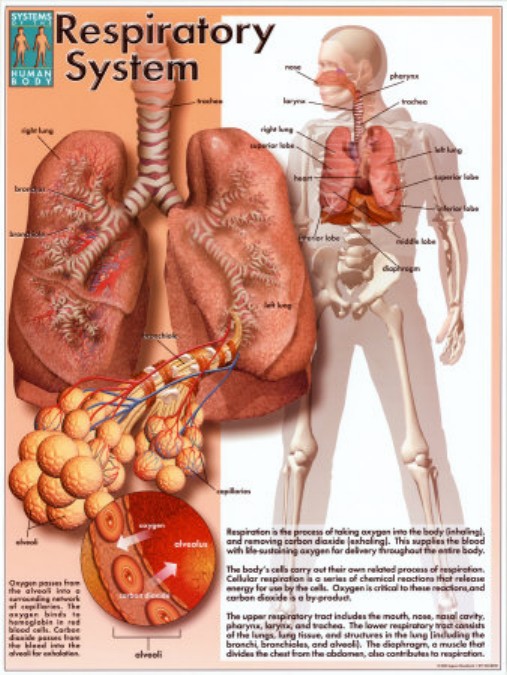
Ventilation: Ventilation of the lungs is carried out by the muscles of respiration.
Control: Ventilation occurs under the control of the autonomic nervous system from parts of the brain stem, the medulla oblongata and the pons. This area of the brain forms the respiration regulatory center, a series of interconnected brain cells within the lower and middle brain stem which coordinate respiratory movements. The sections are the pneumotaxic center, the apneustic center, and the dorsal and ventral respiratory groups. This section is especially sensitive during infancy, and the neurons can be destroyed if the infant is dropped and/or shaken violently. The result can be death due to "shaken baby syndrome."
Inhalation: Inhalation is initiated by the diaphragm and supported by the external intercostal muscles. Normal resting respirations are 10 to 18 breaths per minute, with a time period of 2 seconds. During vigorous inhalation (at rates exceeding 35 breaths per minute), or in approaching respiratory failure, accessory muscles of respiration are recruited for support. These consist of sternocleidomastoid, platysma, and the scalene muscles of the neck. Under normal conditions, the diaphragm is the primary driver of inhalation. When the diaphragm contracts, the ribcage expands and the contents of the abdomen are moved downward. This results in a larger thoracic volume and negative (suction) pressure (with respect to atmospheric pressure) inside the thorax. As the pressure in the chest falls, air moves into the conducting zone. Here, the air is filtered, warmed, and humidified as it flows to the lungs. During forced inhalation, as when taking a deep breath, the external intercostal muscles and accessory muscles aid in further expanding the thoracic cavity.
Exhalation: Exhalation is generally a passive process; however, active or forced exhalation is achieved by the abdominal and the internal intercostal muscles. During this process air is forced or exhaled out.The lungs have a natural elasticity: as they recoil from the stretch of inhalation, air flows back out until the pressures in the chest and the atmosphere reach equilibrium. During forced exhalation, as when blowing out a candle, expiratory muscles including the abdominal muscles and internal intercostal muscles, generate abdominal and thoracic pressure, which forces air out of the lungs.
Circulation: The right side of the heart pumps blood from the right ventricle through the pulmonary semilunar valve into the pulmonary trunk. The trunk branches into right and left pulmonary arteries to the pulmonary blood vessels. The vessels generally accompany the airways and also undergo numerous branchings. Once the gas exchange process is complete in the pulmonary capillaries, blood is returned to the left side of the heart through four pulmonary veins, two from each side. The pulmonary circulation has a very low resistance, due to the short distance within the lungs, compared to the systemic circulation, and for this reason, all the pressures within the pulmonary blood vessels are normally low as compared to the pressure of the systemic circulation loop.
Gas exchange: The major function of the respiratory system is gas exchange between the external environment and an organism's circulatory system. In humans and mammals, this exchange facilitates oxygenation of the blood with a concomitant removal of carbon dioxide and other gaseous metabolic wastes from the circulation. As gas exchange occurs, the acid-base balance of the body is maintained as part of homeostasis. If proper ventilation is not maintained, two opposing conditions could occur: 1) respiratory acidosis, a life threatening condition, and 2) respiratory alkalosis. Upon inhalation, gas exchange occurs at the alveoli, the tiny sacs which are the basic functional component of the lungs. The alveolar walls are extremely thin (approx. 0.2 micrometres). These walls are composed of a single layer of epithelial cells (type I and type II epithelial cells) in close proximity to the pulmonary capillaries which are composed of a single layer of endothelial cells. The close proximity of these two cell types allows permeability to gases and, hence, gas exchange. This whole mechanism of gas exchange is carried by the simple phenomenon of pressure difference. When the atmospheric pressure is low outside the air from lungs flow out. When the air pressure is low inside, then the vice versa.
Non-respiratory functions: Vocalization: The movement of gas through the larynx, pharynx and mouth allows humans to speak, or phonate. Vocalization, or singing, in birds occurs via the syrinx, an organ located at the base of the trachea. The vibration of air flowing across the larynx (vocal chords), in humans, and the syrinx, in birds, results in sound. Because of this, gas movement is extremely vital for communication purposes.
Temperature control: Panting in dogs and some other animals provides a means of controlling body temperature. This physiological response is used as a cooling mechanism.
Coughing and sneezing: Irritation of nerves within the nasal passages or airways, can induce coughing and sneezing. These responses cause air to be expelled forcefully from the trachea or nose, respectively. In this manner, irritants caught in the mucus which lines the respiratory tract are expelled or moved to the mouth where they can be swallowed.

This Medical Terminology Cache will require that you find words by their definitions and use the letter specified as a number in the coordinates which will be thus for this cache: N 37° 39. ABC W 122° 03. XYZ To get the letter to convert into a number, use the following rules:
1. letters A through I are 1 through 9. (simple, right?)
2. letters J through Z: take the number value, add the two digits, like a checksum. For J and S: ignore the 1 in the 10, use ZERO. (example: J is 0, K is 2, L is 3…R is 9, S is 0, T is 2, U is 3…).
3. The only letter that will yield a 1 is A, remember this!
I will provide six definitions, you will need to figure out what word it is and what number the specified letter corresponds to, then plug it into the coordinates. The medical terms used come primarily from Latin and Greek. For example, cardiomyopathy is from Greek and the three parts mean “heart” “muscle” “disease”. Have fun and learn some new terms! Then go get that cache!
Order is: Letter in coordinates, Letter in word, Definition
A: letter 13: surgical puncturing of a lung
B: letter 5: surgical removal of part/all of a lung
C: letter 2: collapsed (trauma) or unexpanded (fetal) lungs
X: letter 7: examination of interior of the larynx
Y: letter 3: condition caused by chronic inhalation of dust particles
Z: letter: 5: uncomfortable breathing in any position other than standing or sitting up
Cache is a medium-sized jar with camo that is found at a nice little spot to view the creek and take a deep breath! Please use natural materials to keep this out of plain sight!
CHECKSUM N=37 W=25
Happy Caching!
Additional Hints
(Decrypt)
zbffl, qbjarq gerr, haqre
Treasures
You'll collect a digital Treasure from one of these collections when you find and log this geocache:

Loading Treasures