Indiana Oilfields EarthCache
-
Difficulty:
-

-
Terrain:
-
Size:  (not chosen)
Please note Use of geocaching.com services is subject to the terms and conditions
in our disclaimer.
no need to leave the road for this one.
To log this cache do the following:
1: take picture of yourself and or your gps with one of these in
background
2: answer these questions
A: what are they gathering here?
B: Estimate the height and width of the tanks
C: on the sign at coordinates what is the word on 2nd line?
D:how many wells can you see from this spot?
E: are these injection wells?
Petroleum (L. petroleum, from a Greek word meaning literally "rock
oil") or crude oil is a naturally occurring, flammable liquid
consisting of a complex mixture of hydrocarbons of various
molecular weights, and other organic compounds, that are found in
geologic formations beneath the earth's surface. The term
"petroleum" was first used in the treatise De Natura Fossilium,
published in 1546 by the German mineralogist Georg Bauer, also
known as Georgius Agricola.
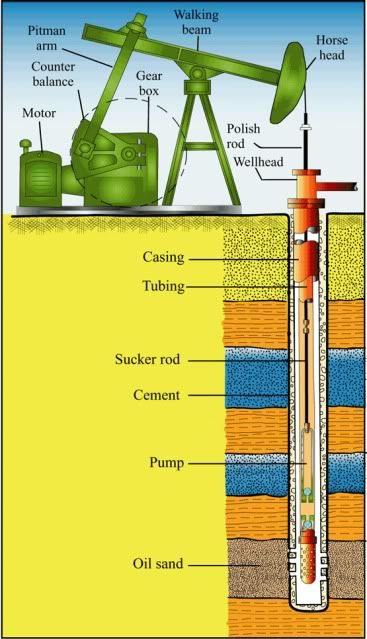
An oil well produces predominantly crude oil, with some natural gas
dissolved in it. Because the pressure is lower at the surface than
underground, some of the gas will come out of solution and be
recovered (or burned) as associated gas or solution gas. A gas well
produces predominately natural gas. However, because the
underground temperature and pressure are higher than at the
surface, the gas may contain heavier hydrocarbons such as pentane,
hexane, and heptane in the gaseous state. Under surface conditions
these will condense out of the gas and form natural gas condensate,
often shortened to condensate. Condensate resembles gasoline in
appearance and is similar in composition to some volatile light
crude oils. Crude oil varies greatly in appearance depending on its
composition. It is usually black or dark brown (although it may be
yellowish or even greenish). In the reservoir it is usually found
in association with natural gas, which being lighter forms a gas
cap over the petroleum, and saline water which, being heavier than
most forms of crude oil, generally sinks beneath it. Wells are
drilled into oil reservoirs to extract the crude oil. "Natural
lift" production methods that rely on the natural reservoir
pressure to force the oil to the surface are usually sufficient for
a while after reservoirs are first tapped. In some reservoirs, such
as in the Middle East, the natural pressure is sufficient over a
long time. The natural pressure in many reservoirs, however,
eventually dissipates. Then the oil must be pumped out using
“artificial lift” created by mechanical pumps powered
by gas or electricity. Over time, these "primary" methods become
less effective and "secondary" production methods may be used. A
common secondary method is “waterflood” or injection of
water into the reservoir to increase pressure and force the oil to
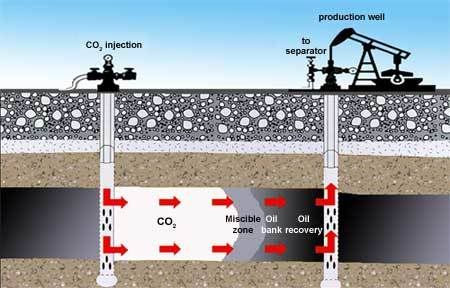
the drilled shaft or "wellbore." Eventually "tertiary" or
"enhanced" oil recovery methods may be used to increase the oil's
flow characteristics by injecting steam, carbon dioxide and other
gases or chemicals into the reservoir. In the United States,
primary production methods account for less than 40% of the oil
produced on a daily basis, secondary methods account for about
half, and tertiary recovery the remaining 10%. Extracting oil (or
“bitumen”) from oil/tar sand and oil shale deposits
requires mining the sand or shale and heating it in a vessel or
retort, or using “in-situ” methods of injecting heated
liquids into the deposit and then pumping out the oil-saturated
liquid.
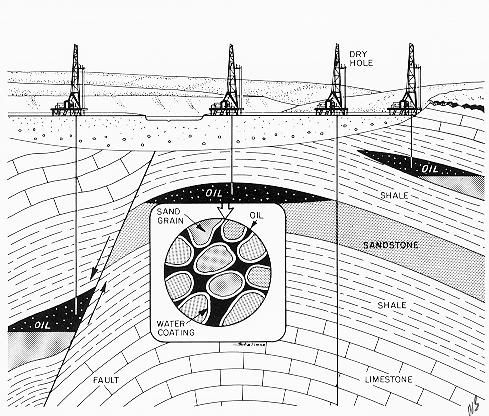
Indianas oil wells produced nearly 5 million barrels of oil during
1978. Most of this oil comes from rocks of Mississippian age (300
to 350 million years old) underlying southwestern Indiana. Those
porous limestones and sandstones are commonly saturated with water.
If oil is present, it rises to the highest parts of the porous
formations because it is lighter than water. Oil-bearing traps are
capped by impervious rock, generally shale, which prevents the oil
from escaping until the cap rock is pierced by the drill. The
illustration above shows how oil accumulates along faults (left),
on domes and anticlines (center), and in stratigraphic traps
(right). Most of Indiana's oil occurs in various stratigraphic
traps. The inset drawing shows a generalized view of oil occurrence
in sandstone. Trenton Field The history of oil and gas development
in the state of Indiana officially began in the mid-1800s with the
early settlers' practice of drilling for salt water. Salt was a
necessity for the preservation of foodstuffs and critical to the
early state's agricultural industry; shallow wells were sunk in
many parts of the state to obtain salt water that could be
evaporated to produce salt. Drilling was probably accomplished by
using a "spring pole" method. Early settlers also became aware of
gas springs and oil seeps along the Ohio River in Harrison and
Crawford Counties. Following the news of the success of Colonel
Edmond Drake's oil well in Titusville, Pennsylvania in 1859, oil
exploration moved westward into Ohio and Indiana. Between 1862 and
1869, wells were drilled in Pulaski County and Vigo County and gas
and oil were discovered but not further developed. Gas was
discovered in what would become the Trenton Field near Eaton in
Delaware County in 1876. Beginning in 1886 and continuing into the
first decade of the 20th century, gas and then oil were discovered
and developed in east central Indiana. The boom quickly ended in
the beginning of the 20th century because wasted resources and
unregulated drilling practices caused a precipitous drop in
production. Unfortunately much of the resource was wasted or lost
through the burning of gas at the surface and the contamination of
oil by fresh water within the subsurface reservoir. Southwestern
Indiana As gas and oil production quickly declined in northern
Indiana, new discoveries were being made in the southwestern part
of the state known as the Illinois Basin. Production from fields in
Vigo and Pike Counties was rapidly followed by new discoveries in
Sullivan and Gibson Counties. Unlike the single field of northern
Indiana that produced from a single reservoir, these new
discoveries produced from many smaller fields and a variety of
different reservoirs at different depths. Also, unlike the Trenton
Field, the Illinois Basin fields produced mostly oil, not gas. Soon
all the counties located in the southwestern part of the state were
contributing to oil production. Production peaked in 1956 at over
12 million barrels for the year. Since that time both the number of
holes drilled and the production for the state have declined.
| I have earned GSA's highest level: |
 |
Additional Hints
(No hints available.)
Treasures
You'll collect a digital Treasure from one of these collections when you find and log this geocache:

Loading Treasures